At Tuesday's close, prediction markets gave Democrats roughly three-in-four odds of taking the Senate. They took it, and the House, with wins in Texas, Ohio and South Carolina. Bettors had priced the Senate as all but certain more than an hour before the networks called it. Wall Street still flinched. Nasdaq futures fell as much as 2.4%, Tokyo's chip stocks cracked and bitcoin slid to about $75,700. By sunrise, most of it was gone. The winner was never the surprise. The real question is what a split Washington does to the physical side of the AI boom, and it is not the question most investors were asking at midnight. 
But before we get to that, a quick look at what moved overnight and what matters today… 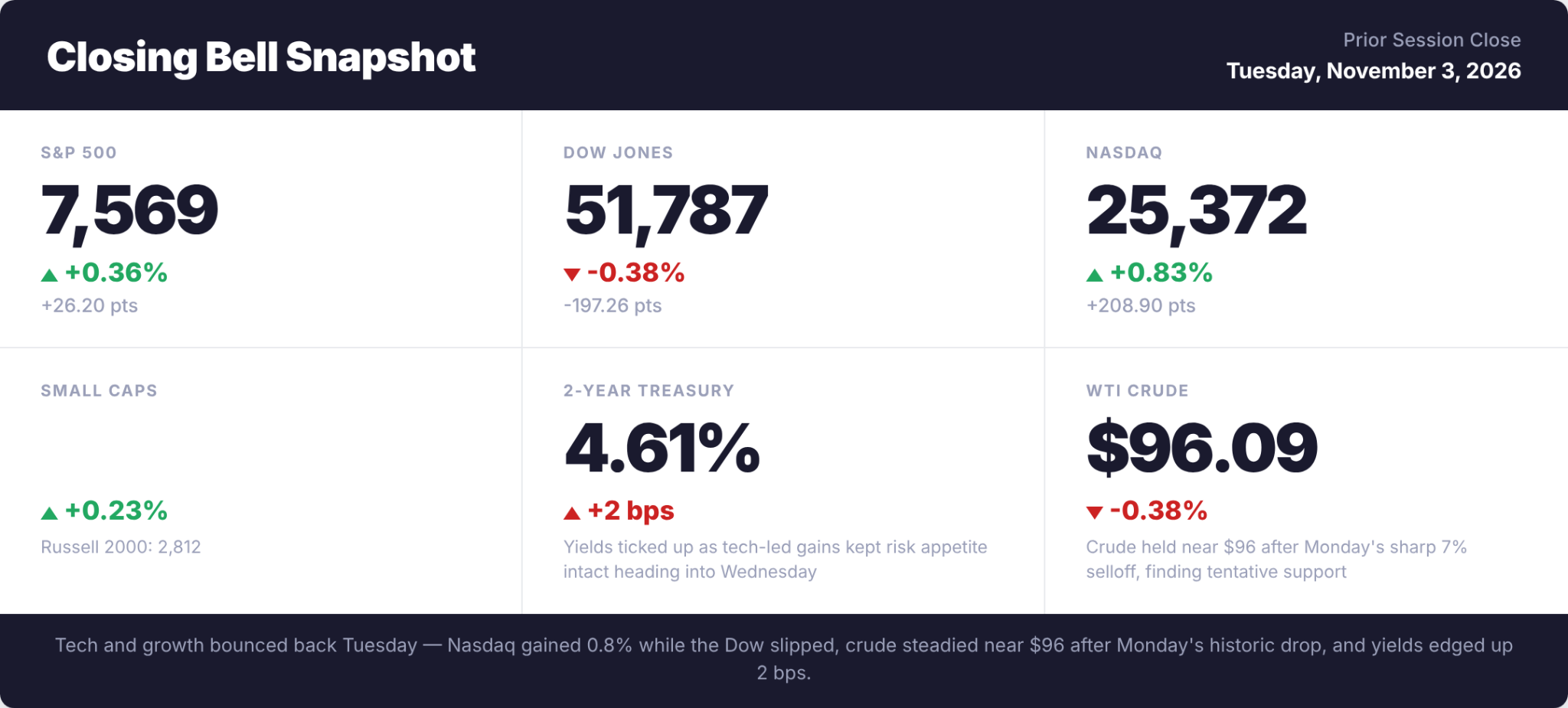
3 Movers in 3 Minutes 1. AMD guided to $17 billion. Super Micro showed who keeps the money. Advanced Micro Devices (AMD) reported record revenue of $13.4 billion, up 45%, as data center sales nearly doubled. It guided the fourth quarter to about $17 billion and told analysts it expects server revenue to double in 2027. The stock rose as much as 7.5% after hours, but most of that gain had faded by early premarket trading. Super Micro Computer (SMCI) booked $19.9 billion of sales, nearly four times a year ago, but its gross margin fell to 12.7% from 17.5% the quarter before and operations burned $434 million. Arista Networks (ANET) was up about 8% on its own beat. The build-out pays everyone who sells into it, just not equally: On an adjusted basis, AMD keeps about 56 cents of gross profit per sales dollar, Super Micro less than 13. 2. 3M agreed to pay $7.35 billion for PFAS claims. It barely pays before 2028. 3M (MMM) settled about 99% of current personal-injury claims tied to firefighting foam, without admitting liability. The bill runs nine years, with a present value of $5.8 billion, about 6% of 3M's market value. It pays $50 million this year, nothing in 2027 and about 20% in the final two years. About an hour earlier, 3M announced a new $6 billion buyback, lifting total authority to $7.5 billion. Shares were about 3% higher in thin premarket trading. 3M just turned a legal overhang into an installment plan, and for the next two years the biggest number in its plans is the one it chose. 3. Japan's state fund found a buyer for JSR. The buyer is worth less than the price. Japan Investment Corp. plans to sell photoresist maker JSR to Mitsui Chemicals in a deal that could exceed 1.3 trillion yen ($8.2 billion), two people familiar with the matter told Reuters. JIC paid about 900 billion yen two years ago, pitching JSR as the base for consolidating Japan's chip-materials industry. Mitsui Chemicals, which says it hasn't decided, was worth about 800 billion yen before the report and carries 876.4 billion yen of debt. Its shares fell 13%. Financial owners are cashing out where AI has lifted chip-supply valuations. The open question is whether the buyers paying those prices can carry them. 3 Signals for Today CVS made the breakup official: CVS Health (CVS) beat this morning, earning $2.09 a share against about $1.65 expected, and raised its full-year outlook to at least $8.20. In a separate release, it said it plans to split into two public companies. One keeps Aetna, the Caremark pharmacy-benefit business and its care-delivery units. The other, CVS Pharmacy, takes about 9,000 drugstores. CVS expects to finish in the first half of 2028, in a separation intended to be tax-free to shareholders. Arkansas and Tennessee have moved to stop pharmacy-benefit managers from owning drugstores. What it could change: the 8 a.m. call is the first chance to hear how debt, costs and those state fights get divided, before a split that is still more than a year away.
ISM services meets the hike bet: The overnight bond rally read divided government as less new borrowing. Rate traders saw it differently. December hike odds rose toward 80% in prediction markets and futures, after climbing on Tuesday too. ISM services is expected near 54.8, and its prices index hit 74.0 in September, the highest since July 2022. Treasury's refunding also lands, including what happens to the long-bond buybacks it doubled through today. What it could change: a prices reading above 75 sides with the hike bet and could undo much of the overnight drop in yields before Friday's payrolls.
Arm and Qualcomm after the close: AMD's data-center sales nearly doubled, yet it guided client and gaming revenue down more than 20% from last quarter. Skyworks Solutions (SWKS) pointed to softness in the Android market and was about 14% lower premarket. Qualcomm (QCOM) is the cleanest read on phones, and Arm (ARM) collects royalties on both phones and servers. What it could change: if both point to softer handsets, the chip rally rests entirely on data-center spending, the same build-out that picked up a political risk overnight.
And with that out of the way, let's get to today's big story: what Wall Street actually sold at midnight, and why it bought it back. The SipCongress flipped overnight. The AI trade's new risk isn't demand.At Tuesday's close, Kalshi and Polymarket priced a Democratic Senate in the mid-70s. That is a favorite, not a lock. Then the results arrived. Democrats won Senate races in Texas, Ohio and South Carolina and took the House. Kalshi's Senate contract traded at 99 cents more than an hour before the first major projection. Markets were less calm than the bettors. Nasdaq-100 futures fell as much as 2.4%. Japan's Nikkei, back from a holiday, dropped as much as 4.8%, led by chip names such as Advantest and Tokyo Electron. Bitcoin slid to about $75,700. The 10-year Treasury yield fell to about 4.9%, the dollar touched a one-month low and gold futures jumped about 3% to above $4,000. By dawn, most of the equity damage had been repaired. S&P 500 futures turned higher, the Nikkei closed down 1.4% and bitcoin was back near $78,000. The winner was priced. The size of the win was not. The bettors weren't surprised. The tape was.A 74-cent favorite winning is one result, not proof that prediction markets know better. The better explanation for the overnight swing is breadth, not the winner. Democrats won in Republican strongholds for the first time in generations, and that is the part the tape had not priced. A 99-cent price is also not a payout. Settlement still runs on each contract's fine print, and Kalshi's can settle early on a media consensus or on the party of the Senate's president pro tempore on Feb. 1. With more than $1.4 billion traded on Kalshi's midterm contracts alone, the venues' next test is paying out. What the first sell-off pricedThe selling hit AI first, and it hit hardest where the build-out is physical. Democrats gained in key data-center states, where local opposition to the industry's expansion has been growing. Before the vote, Goldman Sachs (GS) strategists said a Democratic Congress "might limit data center tax incentives, but a national moratorium looks unlikely in any election outcome." The premarket tape followed that line. CoreWeave (CRWV), IREN (IREN) and Hut 8 (HUT), which rent out data-center capacity, were all lower, giving back part of Tuesday's 7% to 16% rally. Notice what was sold. Nothing in Tuesday's vote changes how many chips AI customers want. It can change how fast those chips get plugged in: power hookups, local permits, tax incentives. Those get decided in statehouses, utility commissions and committee rooms, not in AMD's order book. Why it reversed before breakfastTwo things arrived on the same night. AMD guided to $17 billion and said server revenue should double next year. And President Trump said he would accept the results. The market had two questions about 2027 in front of it. One came with a number from a chief executive. The other came with a vote count and no bill. It priced the one it could model. Gridlock, as one Saxo strategist put it overnight, "doesn't necessarily mean weaker corporate earnings." That holds for this quarter. It says less about what a new majority does with its gavels in January. Gridlock has a bond-market price, and a crypto priceLong-dated Treasury yields fell, consistent with a Democratic Congress and a Republican White House finding big new spending harder to pass. The rate market didn't follow: December hike odds rose toward 80% overnight. Bonds priced a Congress that adds less new debt. The hike contract priced a Fed whose problem, inflation, was not on the ballot. Both can be true for a few days. They cannot both drive yields for long. Crypto paid a clearer price. Its market-structure bill, the CLARITY Act, failed a Senate procedural vote 49-50 in September and dies on Jan. 3 unless the outgoing Congress passes it. TD Cowen's Jaret Seiberg wrote on Election Day that his firm does "not expect the Clarity Act to pass over the next two years." Bitcoin's quick rebound suggests traders had already marked that bill down. What settles itToday's ISM prices index and Friday's payrolls decide whether the bond rally or the hike bet was right. The data-center names, over the next few sessions, show whether the market keeps separating AI demand from AI permission. And from Jan. 3, the new committee chairs decide whether oversight of AI means hearings or rules. PARTNER SPOTLIGHT 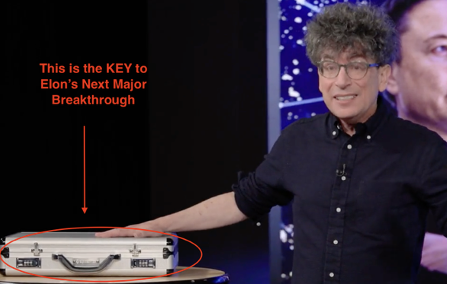
Renowned tech investor James Altucher – the man who called the rise of Nvidia, Apple and SpaceX years in advance – just uncovered Elon Musk’s latest breakthrough idea…And according to James, it’s going to be even bigger than the SpaceX IPO – creating up to 1.8 million new millionaires over the coming years. The pieces behind it are inside this briefcase – which he reveals 100% FREE in this video. Click here now for all the details. The Market Sips TakeawayThe sweep didn't change what AI customers want to buy. It changed who gets a vote on where it gets built. If chipmakers hold their gains while data-center operators lag, the market is pricing permission as a separate risk from demand. If everything recovers and the new Congress opens with taxes and health care instead of data centers, the overnight scare was noise. Either way, watch the agencies. With Washington split, rules get made by regulators and fought in court. Hours after the CFTC cleared single-stock perpetual futures, a group backed by Cboe Global Markets (CBOE) and Citadel Securities sued to undo it. That is likely the shape of policy for the next two years: approved by an agency, challenged by incumbents, decided by a judge. Until then, sip slowly! The Market Sips Desk Reply prompt: Is a Democratic Congress a real risk to the AI build-out, or a new excuse for a market that was already nervous? Hit reply and tell us. Big Pharma Stopped Watching AI Drug Discovery. It Started Paying.Sanofi has paid one AI biotech $144 million in upfront and milestone payments. Eli Lilly invested $40 million in another. Bristol Myers Squibb is putting a third company's AI co-scientist to work inside its own research organization.
The industry's biggest drugmakers used to watch this technology from the sidelines. Now they're customers.
We profiled the 5 companies leading AI drug development in a new FREE Special Report: AI Moves Into the Biotech Lab.
We'll text it straight to your phone. Get the Free Report by Text → |
|