On Friday we asked whether Apple would echo Intel's warning on memory costs. It did, with the same word Intel's chief had used: unprecedented. Apple just had its best September quarter ever, raised prices on Macs, iPads and iPhones, and still expects to keep less of every dollar it sells this winter. If one of the most powerful buyers in hardware can't negotiate its way out of a cost, the cost isn't Apple's problem alone. It's a toll on everyone who needs the same chips. Meanwhile, polls close tonight. 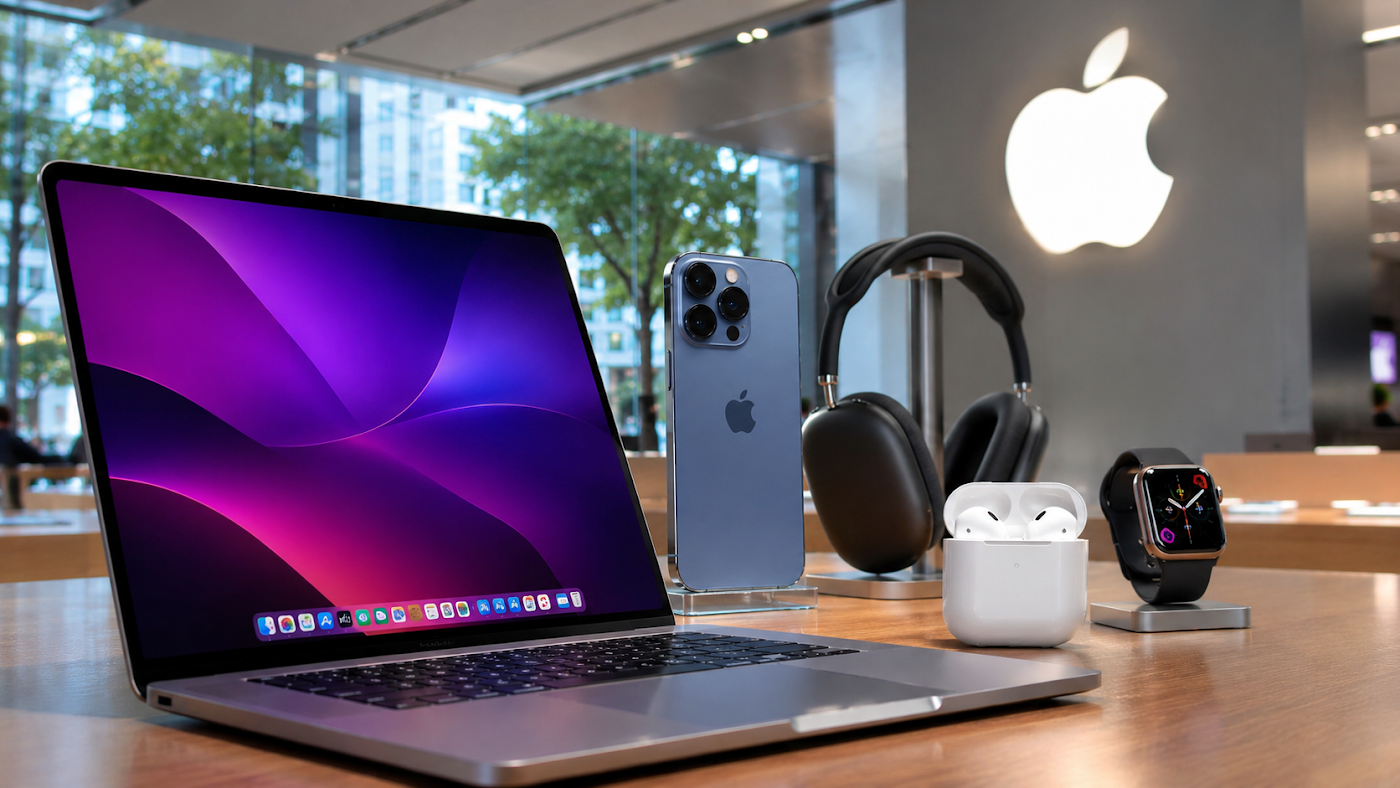
But before we get to that, let's take a quick look at the markets and what matters today… 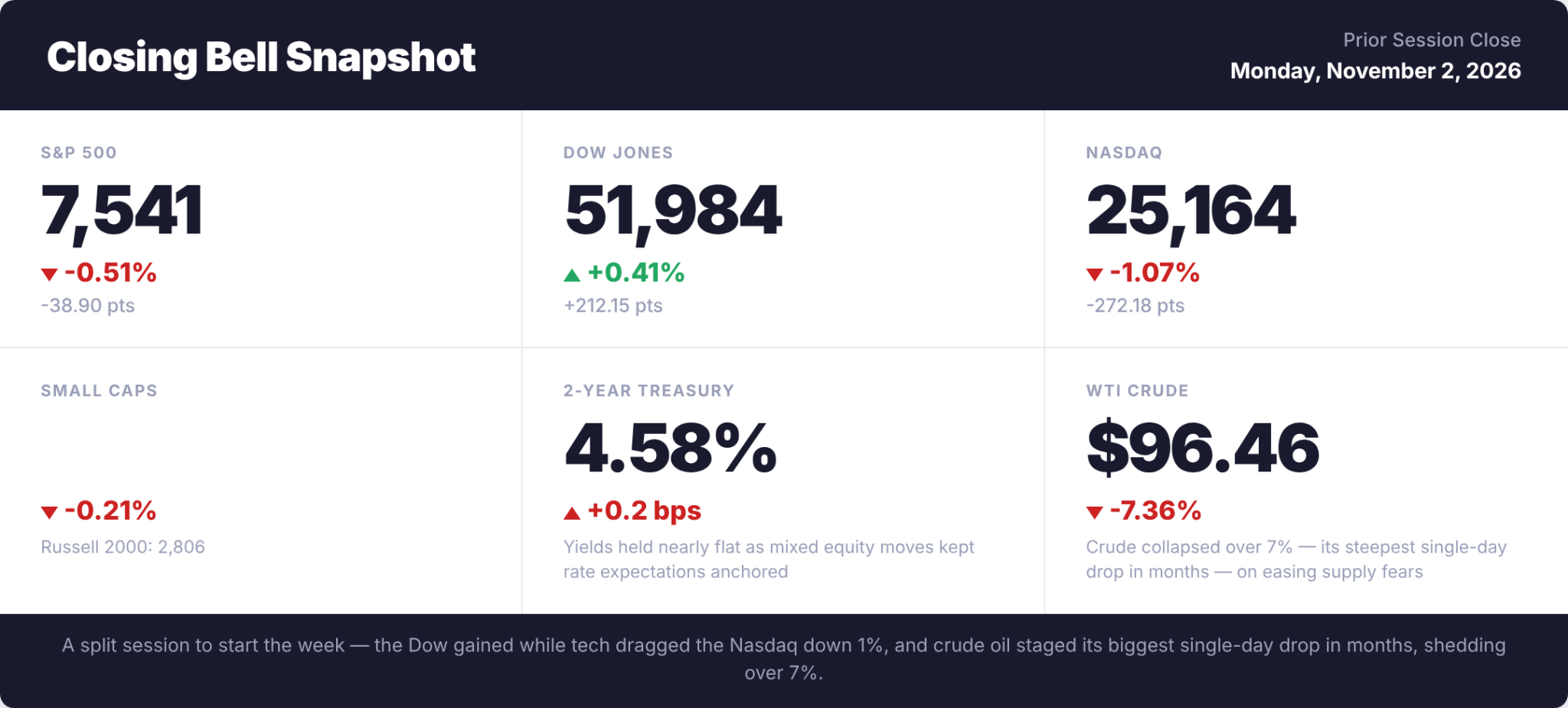
3 Movers in 3 Minutes1. Palantir nearly doubled revenue. Its new deals grew 6%. Palantir (PLTR) grew third-quarter revenue 96% to $2.31 billion, and U.S. commercial sales of $984 million passed U.S. government sales for the first time. It raised its 2026 forecast to about $8.53 billion. The shares still fell about 8% before the open. The number underneath explains the mood. Total contract value signed rose just 6% from a year earlier. In U.S. commercial, revenue grew 29% from the prior quarter, while the remaining value of contracts grew 4%. In its fastest-growing business, Palantir is booking revenue faster than its backlog is growing. For a company valued near $400 billion, investors are paying for the backlog, not the quarter. 2. Bettors leaned toward peace. Washington was already striking. Oil fell 7.4% Monday to settle at $96.46 as U.S.-Iran talks gathered pace. By early afternoon, Polymarket traders had also cut the odds of a U.S. strike on Iran by 12 points, though that gain faded by the close. That evening, the Wall Street Journal reported the U.S. had struck Iran's Qeshm Island, the latest in a series of small, unannounced strikes that officials described as defensive. Within about 10 minutes, the contracts betting the ceasefire would last through Nov. 8 and Nov. 15 fell to 16.5 and 12 cents. Polymarket has since settled six ceasefire contracts "no," and two earlier ones are now in dispute, including an Oct. 31 contract that expired at 99 cents. Crude is up about 2% near $98, a fraction of Monday's drop. Traders were pricing a binary, deal or war. They missed a third state that was already underway. 3. One bitcoin fund lost more than the whole market. U.S. spot bitcoin ETFs lost a net $398.6 million Monday, according to Farside Investors. The iShares Bitcoin Trust (IBIT) alone lost $405.3 million, its biggest outflow since June, while Fidelity's fund took in $6.7 million and the rest were flat. Add Friday, and about $1.04 billion has left in two sessions. By SoSoValue's count, that roughly erases what the funds gathered all year. Coinbase (COIN) closed at $137.83 after a fresh 52-week low, with bitcoin near $77,000. Who sold isn't known, but the pattern suggests concentrated selling in one fund rather than a broad retreat. 3 Signals for Today AMD reports after the close, and it sits on both sides of the memory squeeze. AMD (AMD) is expected to earn about $1.95 a share on $13.1 billion of revenue, after falling 7.5% Monday before saying a word. It sells AI chips to the data centers driving memory demand. It also sells PC processors into a market Intel (INTC) expects to shrink about 12% in units this year as memory runs short. A strong data-center outlook paired with a soft PC outlook would confirm that the AI buildout is crowding out consumer hardware. Arista Networks (ANET) and Super Micro Computer (SMCI) also report tonight.
The midterms, then Washington's borrowing bill. Results arrive after the market closes, with Polymarket and Kalshi both pricing Democratic control of the Senate near 76 cents early Tuesday. Treasury sets the size of its next 3-year, 10-year and 30-year sales Wednesday morning. Setting aside a bigger starting cash pile, its own estimate says it needs $24 billion more this quarter than it projected in August. It sees $800 billion of borrowing in the first quarter of 2027. Control of Congress shapes spending, tariffs and how much debt Treasury must sell. The answer lands hours before Treasury sizes those sales.
Apollo reported before the open, just as private markets showed their liquidity limits. Investors asked Partners Group's flagship U.S. evergreen private equity fund for $2.2 billion and got about a third, as requests hit roughly 15% of net assets against a 5% cap. The Fed's loan officer survey showed banks tightening standards on loans to private equity funds. Apollo (APO) earned $2.07 a share on an adjusted basis, below the $2.19 analysts expected, even as origination hit a record $114 billion and inflows reached $53 billion. Its release doesn't say how much of that came from individual investors, so the call is where to look. Steady wealth-channel demand would make the Partners Group queue look like one fund's problem. A slowdown would mean the channel that funded private markets' growth is narrowing.
And with that out of the way, let's get to today's big story: the quarter Apple won, and the bill it couldn't negotiate. The SipApple raised its prices. Memory raised its prices faster.Apple (AAPL) did almost everything right in its September quarter. Revenue rose 12% to a record $114.5 billion. iPhone sales jumped 17% to $57.6 billion despite supply constraints. Earnings of $2.10 a share beat forecasts. And it guided to the biggest quarter in its history. The stock was down about 4% before the open anyway, near $325. The reason was one line in the outlook. Apple guided December-quarter gross margin to 45% to 46%, citing "primarily the impact of higher memory costs," along with costs tied to the ramp of Siri AI. The buyer that couldn't negotiateApple rarely loses a price fight with its suppliers. It sells into an installed base of more than 2.5 billion active devices. It raised prices on Macs and iPads at the end of June and on iPhones in September. It wasn't enough. "What we're seeing with memory pricing right now is unprecedented," Chief Executive John Ternus said on his first earnings call in the job. Apple expects memory costs to climb again this quarter. And after that? "Looking beyond the December quarter, we see the pricing for memory purchases continuing to increase." Smaller than it looks, harder than it soundsThe headline drop overstates the damage. September's 47.9% margin included about a point of tariff refunds. Strip that out and the guide is a step down of one to two points, not two to three. The finance chief said most of it comes from memory. That is the uncomfortable part. A one-time tariff gain fading is easy to explain. A component cost that the company expects to keep rising is not. The usual cushion is thinner, too. Apple guided services growth to 8% to 9%, below the roughly 10.7% analysts had modeled. Services carries a 76% gross margin and normally softens a hardware squeeze. This quarter the squeeze is getting harder while the cushion grows more slowly. FROM OUR SPONSORS People paid $8,000… yours for FREE
Some people have paid $8,000 to be in the room with Luke Lango in Las Vegas. But he believes the new Elon venture he's uncovered (not space or AI) is so big that EVERYONE needs to know about it. See how to get in while we're still early here. This ad is sent on behalf of InvestorPlace Media at 1125 N. Charles Street, Baltimore, Maryland 21201. If you're not interested in this opportunity, please click here. Where the money is goingOn the call, Apple didn't name AI. In June it did: "The rapid expansion of AI data centers has created an extraordinary surge in demand for memory and storage." Intel said last week the industry faces one of the worst supply shortages in its history, driven by AI demand. Memory prices are now hitting PCs. Australia's central bank raised rates on Tuesday. Its statement noted that "AI-related investment is driving rapid growth in prices for technology-related goods." Apple is clearly bracing for a longer fight. It said its manufacturing purchase obligations rose $33 billion in a single quarter as it worked to secure supply. Then comes the contradiction. The memory makers are winning this fight, yet their stocks are falling. Micron (MU) dropped 5.8% Monday, before Apple reported, in a broad chip selloff. In Seoul on Tuesday, Samsung and SK hynix fell 4% to 6% as the Kospi lost 3.6%. One reading is that investors doubt prices this high can last if they shrink the market for the devices that use the chips. Apple's forecast argues the other way. It still expects record revenue, which says demand is holding even as costs climb. What settles itThe December quarter will show whether Apple's higher prices hold demand. Memory makers' next outlooks will show whether supply loosens in 2027. And if Apple has to raise prices again, the memory bill stops being a margin story and becomes a consumer story. PARTNER SPOTLIGHT without building a single new power plant… People think he's crazy. But Adam O'Dell says he's already deployed 4,000 units of his solution across 14 states — and used them to power the largest supercomputer on the planet. With Microsoft, Amazon, Google and Facebook set to spend $680 billion this year on AI data centers that can't get enough power to run, Elon's solution is about to be in extraordinary demand. Go here now to see how he's going to do it — and get one of Adam's top picks to play it absolutely free. The Market Sips TakeawayApple's quarter turns the memory squeeze from a PC problem into a device problem. The AI buildout isn't only costing the companies that pay for data centers. It is raising the bill for anyone who buys the same parts. The thesis holds if memory makers guide prices higher into 2027 and other device makers cite the same cost. It breaks if new supply arrives faster than expected, or if Apple's December margin lands above its range. Watch the memory sellers, who hold the pricing power, and every hardware company that lacks Apple's ability to raise prices without losing customers. Apple can afford this bill. Most of its rivals will find it harder. Until then, sip slowly! The Market Sips Desk Reply prompt: Would you pay more for your next iPhone, or keep the one you have for another year? Hit reply and tell us. The Next AI Race Isn't About the Best Model.Models improve. Computing gets cheaper. An algorithm can be matched.
What's hard to copy is a company's own lab data: experiments run at industrial scale, with every result fed back to make the AI smarter.
In drug development, that loop may become the edge that matters most. Not who has the best model. Who can learn biology fastest.
We profiled 5 companies building that loop in a new FREE Special Report: AI Moves Into the Biotech Lab.
We'll text it straight to your phone. Get the Free Report by Text → |