The S&P 500 crossed 7,800 for the first time on Monday. The 10-year Treasury yield crossed 5.3% on Wednesday, the highest since 2002. One of those numbers means the economy is running too hot. The other means investors could not care less. The last time stocks and yields climbed together like this, Bill Clinton was president and the internet was going to change everything. Sound familiar? 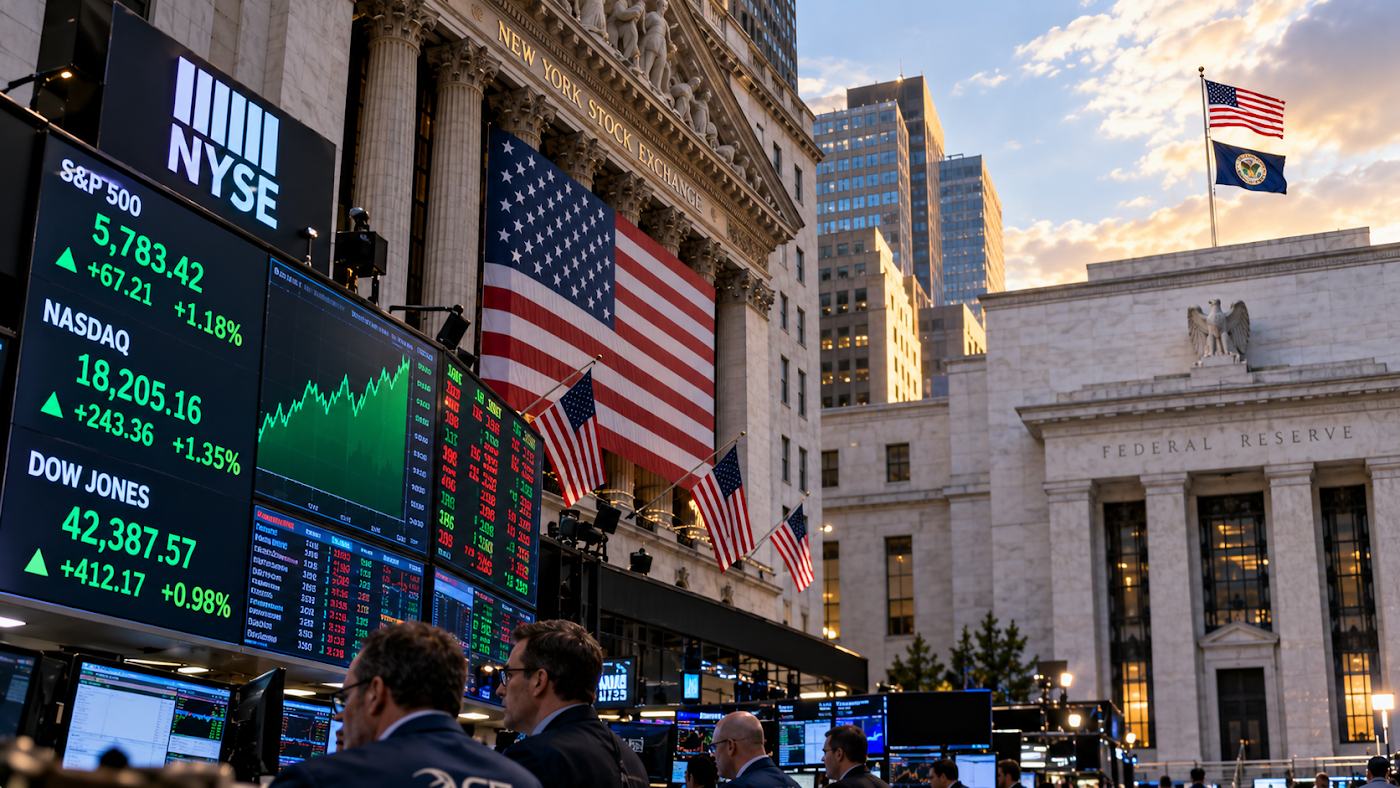
But before we get to that, let's take a quick look at the markets and what matters... 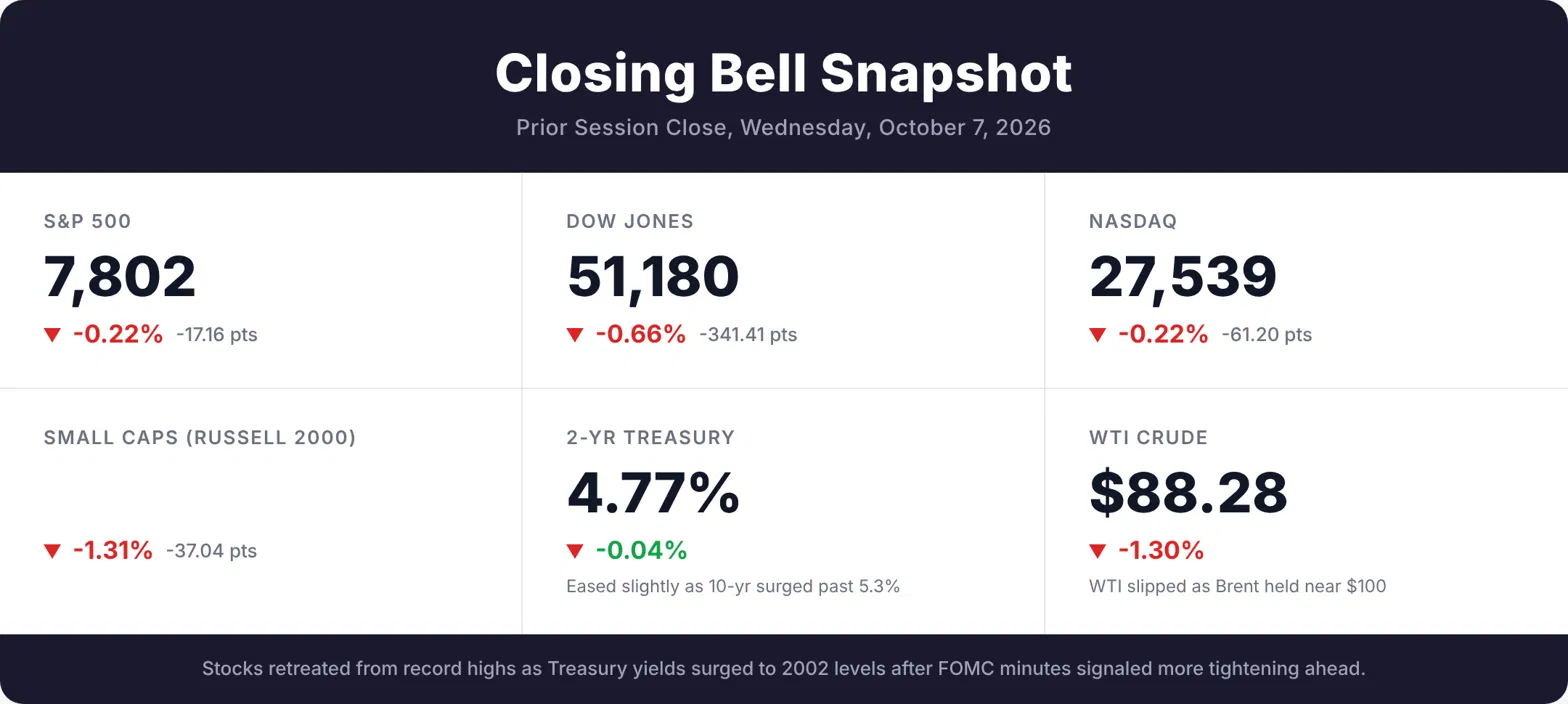
3 Movers in 3 Minutes - Treasury yields hit levels not seen since 2002. The 10-year yield surged past 5.36% intraday before settling near 5.28%, while the 30-year touched 5.66%. The bond market is screaming that the Fed is not done tightening. Mortgage rates climbed to 7.63%, the highest since October 2023, putting fresh pressure on housing and anything rate-sensitive.
- Constellation Brands (STZ) beat on earnings but still fell 5%. The beer and spirits giant posted $3.74 adjusted EPS against a $3.56 estimate and $2.63 billion in net sales above the $2.54 billion consensus. The problem: full-year guidance of $11.20 to $11.90 came in below the $11.71 Wall Street was expecting. Even a clean quarter cannot outrun a cautious outlook.
- Webull (BULL) cratered 20% after Congress flagged its ties to China. A House committee report questioned the fintech brokerage's ownership structure and data-handling practices. The stock has now lost roughly 40% over the past month. The sell-off rippled through fintech names, with COIN and HOOD also falling as crypto and fintech sentiment soured broadly.
3 Signals for Today PEP reports Q3 earnings before the open, with consensus at $2.28 EPS and $25 billion in revenue. The stock hit a 52-week low yesterday, so the bar is set low but the margin for error is even lower. Weekly initial jobless claims land this morning alongside the preliminary University of Michigan consumer sentiment reading for October, a key gauge of how households feel about inflation and spending. Bank earnings season starts next week with JPM, GS, WFC, and C all reporting on October 13. Analysts expect S&P 500 earnings growth of 30.6% for Q3, driven almost entirely by AI-linked names. PREMIER FEATURE The 7 Stocks Built to Outlast the MarketSome stocks are built for a quarter… others for a lifetime. Our 7 Stocks to Buy and Hold Forever report reveals companies with the strength to deliver year after year - through recessions, rate hikes, and even the next crash. One is a tech leader with a 15% payout ratio - leaving decades of room for dividend growth. Another is a utility that’s paid every quarter for 96 years straight. And that’s not all - we’ve included 5 more companies that treat payouts as high priority. These are the stocks that anchor portfolios and keep paying. This is your chance to see all 7 names and tickers - from a consumer staples powerhouse with 20 years of outperformance to a healthcare leader with 61 years of payout hikes. The report is free for a limited time - go here to get it now. And with that out of the way, let's get to today's big story: why the stock market is partying while the bond market panics. The Sip7,800 and RisingThe S&P 500 crossed 7,800 on Monday for the first time in history. Five consecutive winning sessions. New record after new record. Three companies alone, NVDA, AAPL, and MSFT, now make up roughly a fifth of the entire index. The AI earnings machine is so powerful that it has lifted the benchmark through a rate-hiking cycle, through oil climbing back toward triple digits, and through bond yields not seen since George W. Bush's first term. On Wednesday, the index pulled back 0.22%. In any other context, that would barely register. But it happened on the same afternoon the Fed released minutes from its September meeting, and those minutes told a very different story than the one stocks have been pricing in. The Minutes Nobody Wanted to ReadThe FOMC minutes from the September 15-16 meeting revealed that most participants believe another rate hike "would likely be appropriate by year end." Chair Kevin Warsh led a unanimous 12-0 vote to raise the federal funds rate by 25 basis points to 3.75% to 4.00%, the first hike since 2023. But the unanimity masked a war underneath. The dot plot from September shows 12 of 18 officials penciling in one more hike this year, four projecting two, and only two expecting rates to hold. Dallas Fed President Lorie Logan has said publicly that rates may need to rise "an additional 50 basis points or more." Governor Michelle Bowman sits on the opposite end, seeing little need for further moves in 2026. Here is where it gets interesting. Despite all of this, futures markets are pricing in only about a 17% chance of a hike at the October 27-28 meeting. The bond market is saying rates need to go higher. The dot plot is saying rates will go higher. And the stock market is saying: so what? The 1990s PlaybookThis disconnect has a precedent, and it is not a comfortable one. Between 1997 and 2000, the S&P 500 roughly doubled while the Fed kept rates elevated between 5.25% and 6.50%. The reasoning then was the same reasoning you hear now: a productivity revolution was rewriting the earnings math. Back then it was the internet. Today it is artificial intelligence. The parallels run deeper than the surface narrative. In both eras, a small number of mega-cap technology stocks drove the bulk of index-level returns. In both eras, bond yields climbed while equity investors argued that earnings growth would outrun the cost of capital. In both eras, the economy was growing fast enough that the Fed felt compelled to tighten even as Wall Street celebrated. FROM OUR SPONSORS Wall Street veteran goes ALL in on Bank of Elon
A 20-year Wall Street veteran – who worked at a $10 billion hedge fund – is putting ALL his money in Elon Musk's new bank. He says he can see the writing on the wall for traditional banks. And he's not the only one. See if you should join him here (not just for the 6% yield). This ad is sent on behalf of InvestorPlace Media at 1125 N. Charles Street, Baltimore, Maryland 21201. If you're not interested in this opportunity, please click here. Q3 earnings season, which kicks off next week with the big banks, is expected to show S&P 500 profit growth of 30.6%. Strip out the AI-adjacent names, the semiconductor designers, the hyperscalers, the cloud platforms, and that number shrinks dramatically. The market is not broadly healthy. It is narrowly exceptional. That is exactly what the late 1990s looked like. A handful of stocks carrying an index while the underlying economy ran hotter than the Fed wanted. The productivity story was real then, too. The internet did change everything. But the stocks that led the charge still fell 70% to 90% when the music stopped. What the Bond Market KnowsThe 10-year yield at 5.3% is not just a number. It is a price signal. It means the bond market believes inflation is not beaten, that the Fed has more work to do, and that the federal government's borrowing costs are going to stay elevated for years. Mortgage rates at 7.63% are already freezing the housing market. Small caps, as measured by the Russell 2000, fell 1.31% on Wednesday, more than six times the S&P's decline. Rate-sensitive sectors, banks, homebuilders, REITs, utilities, all bled red. The stock market's response has been to concentrate even further into the names that can grow through any rate environment. NVDA alone is worth more than the entire Russell 2000. That is not a sign of broad market confidence. That is a sign of a market that has made one very large, very specific bet: that AI earnings growth will be so explosive it renders the cost of money irrelevant. Maybe it will. The 1990s productivity boom lasted three years before the reckoning. AI may have a longer runway. Nvidia's data center revenue alone is growing at a pace that would have made Cisco's 1999 earnings look modest. Microsoft and Apple are printing cash flows large enough to service a small country's national debt. The fundamental case for these companies is not fiction. But the fundamental case for Pets.com was not entirely fiction either. The question was never whether the technology was real. It was whether the prices being paid for exposure to it had already absorbed years of future growth. When the 10-year yield sits at 5.3%, every dollar of future earnings is worth less today. That is not an opinion. That is arithmetic. The trade is getting crowded, the yields are getting painful, and the Fed's own members cannot agree on whether they have done enough or barely started. The MarketSips TakeawayStocks and rates rising together is not a contradiction. It happened in the late '90s and it can happen again. But it only works as long as earnings growth stays ahead of the cost of capital. Right now, a handful of AI giants are doing the heavy lifting for the entire index while bond yields scream that the rest of the economy is under pressure. The number to watch is not the S&P 500 level. It is the spread between mega-cap earnings growth and the 10-year yield. The moment that gap starts closing, the 1990s parallel stops being a comfort and starts being a warning. Until then, sip slowly! The Market Sip Desk Reply prompt: Is AI earnings growth strong enough to keep stocks climbing through a rate-hiking cycle, or is the bond market going to win this argument? 3 Market Signals Most Investors Aren't WatchingThe headline is usually the last place the story shows up.
By the time everyone is talking about a stock… the signals underneath it may have been changing for weeks. • Institutional money moves. • Options activity changes. • Management confidence shifts. • Fundamentals improve, or quietly begin telling a different story. That’s exactly what our analysts found in three stocks where the evidence stopped agreeing with itself.
And in all three cases, the story is still developing. See the 3 Stocks, Get the Free Report → |