Nine years ago, Palmer Luckey got pushed out of Facebook after selling them a virtual reality headset. Today his defense startup is worth $61 billion, he just landed a $2.9 billion Navy contract, and he co-leads a Pentagon advisory group that will recommend which weapons America should build next. His company happens to build those weapons. The defense industry has not seen a story this audacious since Lockheed won the stealth fighter contract in the 1970s. 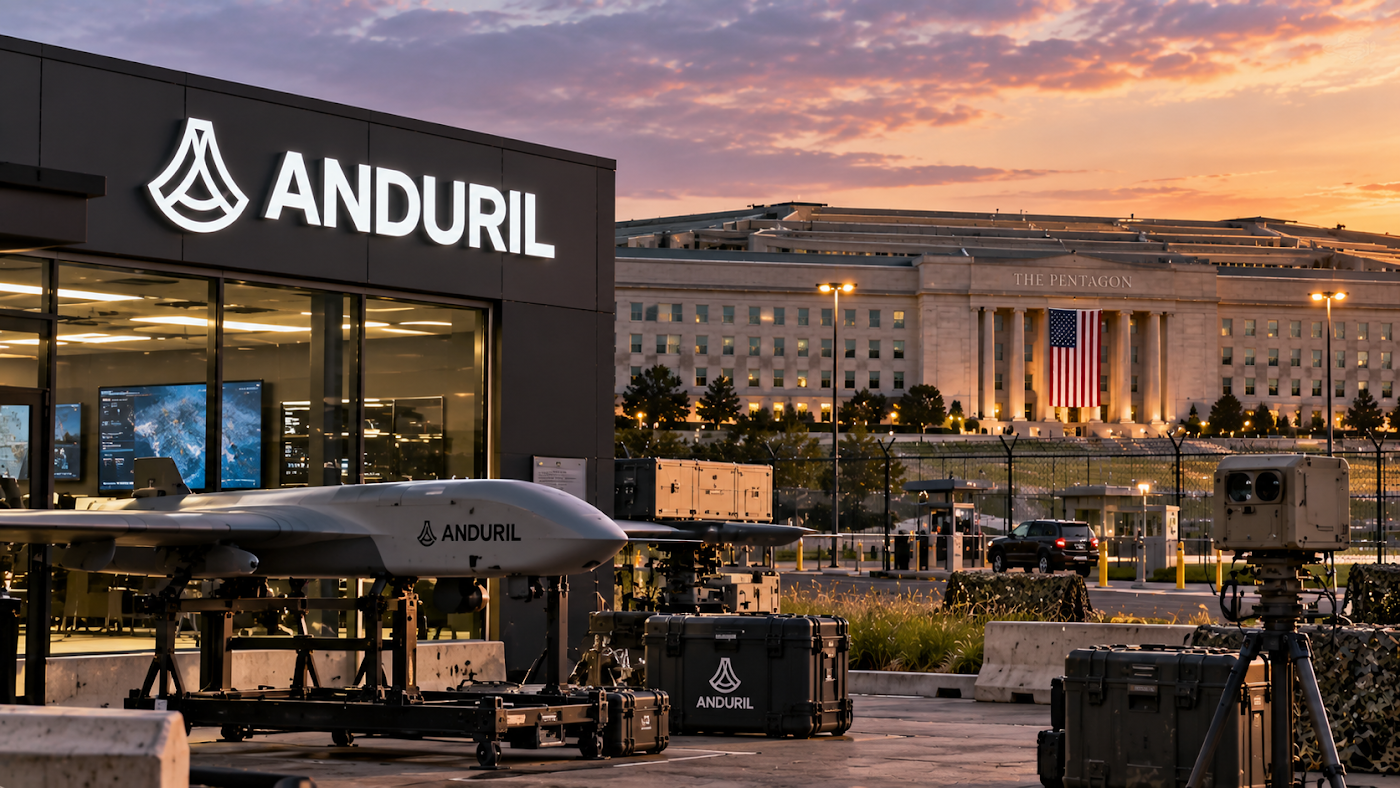
But before we get to that, let's take a quick look at the markets and what matters today... 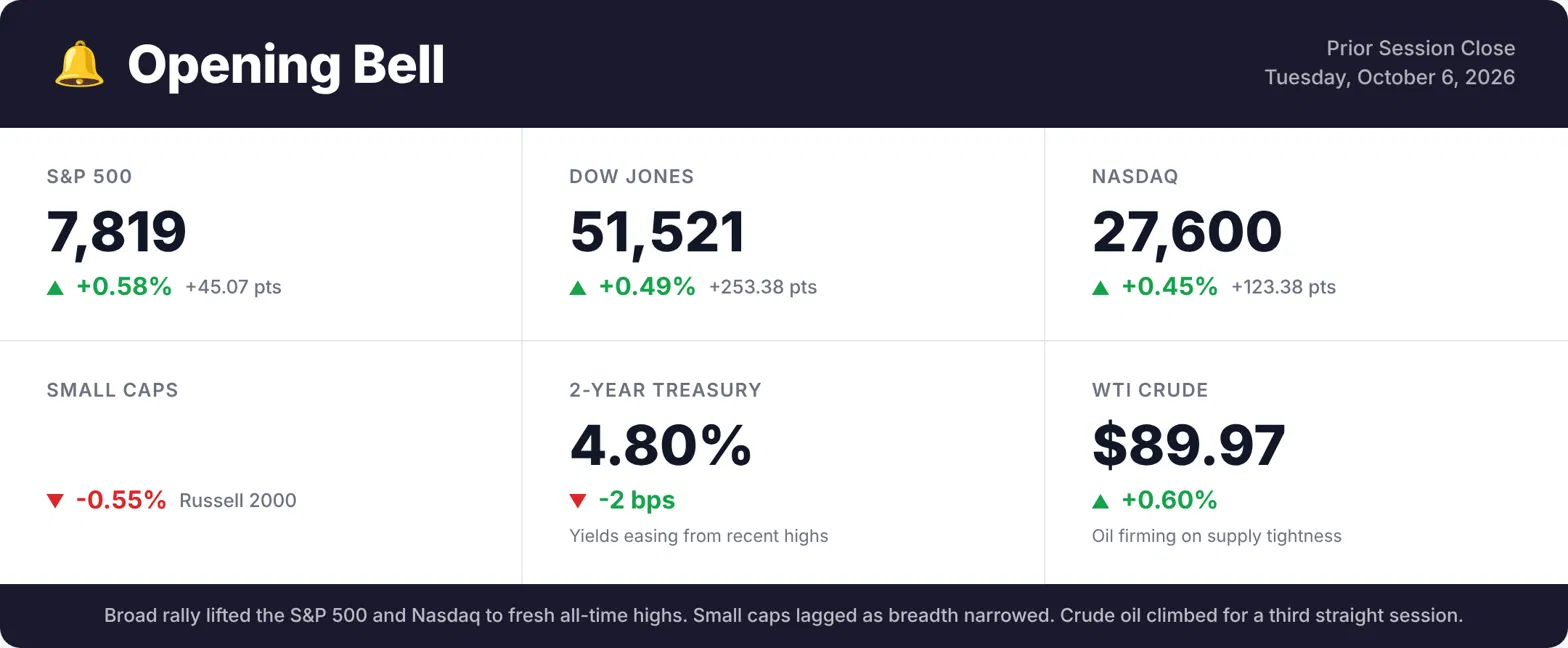
3 Movers in 3 Minutes - Nuclear stocks catch fire on Constellation Energy deal. Constellation Energy (CEG) surged roughly 12% after announcing a landmark 20-year power purchase agreement with Alphabet's Google to develop 890 megawatts of nuclear capacity worth over $4.3 billion. The deal sent Vistra (VST) and Talen Energy (TLN) sharply higher and underscored that Big Tech's appetite for carbon-free baseload power is far from peaking.
- Marvell Technology rallies 7% on investor day ambitions. Marvell (MRVL) jumped after its investor day laid out revenue targets powered by custom AI silicon and data infrastructure. The chipmaker is positioning itself as the go-to partner for hyperscalers building custom accelerators, a market that analysts say could reach $60 billion by 2028.
- Memory stocks slide on Toshiba competitive threat. Sandisk (SNDK), Seagate Technology (STX), and Western Digital (WDC) all fell between 5% and 8% after reports that Toshiba is aggressively expanding NAND production to capture market share, stoking fears of another pricing downcycle in the storage industry.
3 Signals for Today Constellation Brands (STZ) hosts its Q2 FY2027 earnings call at 8:00 AM ET after reporting $3.74 comparable EPS and 6% revenue growth last night, with beer depletions declining 0.6%. The U.S. Treasury auctions $39 billion in 10-year notes today, a test of demand as yields hold near 5.27% and investors weigh the Fed's rate path heading into year-end. PepsiCo (PEP) reports Q3 earnings Thursday morning, followed by Delta Air Lines (DAL) on Friday, kicking off what promises to be a telling early window into Q3 earnings season. PREMIER FEATURE 7 AI Stocks to Lead the Next DecadeAI is fueling the Fourth Industrial Revolution – and these 7 stocks are front and center. One of them makes $40K accelerator chips with a full-stack platform that all but guarantees wide adoption. Another leads warehouse automation, with a $23B backlog – including all 47 distribution centers of a top U.S. retailer – plus a JV to lease robots to mid-market operators. From core infrastructure to automation leaders, these companies and other leaders are all in 7 AI Stocks to Invest in Today. Free today, grab it before the paywall locks. And with that covered, let's get to today's big story: how a guy who got fired over a VR headset became the most consequential defense contractor of this generation. The SipThe $2 Billion DetourPalmer Luckey was 19 when he built a virtual reality headset prototype in his parents' garage. By 21, he had sold Oculus VR to Facebook for $2 billion. By 24, he was out. The departure was messy. Internal emails later obtained by The Wall Street Journal showed Facebook executives pressured Luckey over his political donations during the 2016 election. He negotiated a severance of at least $100 million and walked away from one of Silicon Valley's most celebrated acquisitions. Most people who get fired at 24 with a nine-figure exit buy a yacht. Luckey founded a weapons company. Three months later, he launched Anduril Industries with a team of former Palantir executives and a thesis that sounded absurd: the American defense industry is broken, and a startup can fix it. Nine years on, the absurd thesis looks prophetic. The $61 Billion BetAnduril raised $5 billion in its Series H round in May 2026 at a $61 billion valuation, led by Thrive Capital and Andreessen Horowitz. Just 72 days later, Reuters reported the company was in talks for fresh funding that could value it at approximately $100 billion. The math is staggering. Anduril generated $2.2 billion in revenue in 2025, more than doubling from the prior year. At $100 billion, that is roughly 45 times revenue. Lockheed Martin (LMT), the largest traditional defense prime, trades at about 1.8 times. Anduril is being priced like a tech platform, not a weapons maker. The legacy primes, Lockheed, RTX (RTX), Northrop Grumman (NOC), grew up on cost-plus contracts. The government says what to build, agrees to pay whatever it costs plus a margin, and the program runs for decades. The incentive is to build slowly and expensively. The F-35 has cost over $1.7 trillion across its lifecycle. Anduril flips that model. It builds the product first with its own capital, then sells it. Its flagship, Lattice, is a software platform that ties together autonomous drones, sensors, and command networks. On top of that sits a growing hardware fleet: the Ghost Shark autonomous submarine (in production under a $1.7 billion Australian Navy deal), the Roadrunner interceptor drone, and Thunder, an autonomous attack tiltrotor built with Archer Aviation (ACHR), set for first flight in 2027. The Pentagon has noticed. In March, the Army awarded Anduril a 10-year enterprise agreement with a $20 billion ceiling. On Monday, CNBC reported Anduril landed a $2.9 billion Navy submarine shipyard contract. The Fox Guarding the HenhouseHere is where the story gets uncomfortable. On September 30, Defense Secretary Pete Hegseth announced the creation of Project Meridian, a 120-day study tasked with identifying "the capabilities required to achieve absolute technological dominance on the next-generation battlefield." It will produce an unclassified public report with actionable recommendations for what weapons and technologies America should prioritize. FROM OUR SPONSORS 
Could This Stock Be “Trump’s Next Big Buy”?Jim Rickards believes the Trump administration is about to take a direct stake in a tiny $2 stock. The Trump administration has taken a direct stake in MP Materials, Lithium America, Trilogy Metals, and USA Rare Earth. Each time, shares sprinted higher. Click here to see why Jim believes this one is next. The co-directors: Elon Musk, whose SpaceX holds billions in Pentagon launch contracts. Palmer Luckey, whose Anduril holds billions more. And former House Speaker Newt Gingrich. The same day, Hegseth unveiled something even more consequential: the Autonomous Warfare Command, or AutoWarCom. A four-star combatant command with service-like authorities, it will oversee drones, AI systems, and autonomous networks across every military domain. It is scheduled for activation in October 2027, pending Congressional approval. It is, effectively, a new branch of the military built around the exact technologies Anduril sells. The conflict of interest is not subtle. Luckey will help write the recommendations for what the Pentagon should buy. His company will then bid on those contracts. Ethics watchdogs and several members of the Senate Armed Services Committee have raised concerns about industry leaders shaping requirements they will later fill. The arrangement, as multiple outlets have reported, "raises questions about the independence of industry leaders developing recommendations for future military requirements." Luckey's defenders argue the point misses the forest for the trees. The legacy defense procurement system already has a revolving door. Retired generals sit on defense company boards. Lobbyists write legislation. The difference, they say, is that Luckey is not hiding behind a lobbying firm. He is sitting at the table, in a Hawaiian shirt, telling the Pentagon directly that its procurement model is a dinosaur. What the Legacy Primes Cannot AdmitThe real tension underneath this story is not about Palmer Luckey's ethics. It is about an industry structure that has not been challenged since the Cold War. The top five defense contractors, Lockheed Martin, RTX, Northrop Grumman, Boeing (BA), and General Dynamics (GD), have a combined market cap north of $600 billion and employ over 700,000 people. They are optimized for a world where the Pentagon writes a 500-page requirements document, companies bid, and the winner delivers 15 years later. Ukraine proved that world is breaking. Commercial drones costing a few thousand dollars are destroying tanks worth millions. AI-guided munitions are being iterated in weeks, not years. Anduril's Arsenal-1 manufacturing facility spans over five million square feet and is designed to produce tens of thousands of autonomous systems annually. It is not building one exquisite fighter jet. It is building a factory that can flood a battlefield with cheap, intelligent machines. That is the bet the Pentagon is making. Whether or not you are comfortable with the man making the pitch, the pitch itself is hard to argue with. PARTNER SPOTLIGHT Middle East Conflict Lights Fuse on US Debt BombAmerica was already drowning in $38 trillion of debt, but the recent conflict in the Middle East just accelerated the timeline. As oil spikes, a 100-year-old stock market signal that accurately predicted the 2008 and 2020 crashes is flashing a massive "Sell" on dozens of popular U.S. equities. If you hold the wrong stocks when this debt crisis hits, it could wipe out years of gains. Click here to see the 10 popular stocks to dump immediately 11780 US Highway 1, Palm Beach Gardens, FL 33408-3080 Would you like to edit your e-mail notification preferences or unsubscribe from our mailing list? Copyright © 2026 Weiss Ratings. All rights reserved. The MarketSips TakeawayThe defense industry's next decade will not be defined by who builds the best fighter jet. It will be defined by who builds the best software platform for autonomous warfare and can manufacture at scale. Anduril, at $61 billion and climbing, is the leading candidate. For investors watching the defense sector, the question is no longer whether Silicon Valley will disrupt the Pentagon. It is whether the legacy primes can adapt before they become the new Kodak. Watch Lockheed, RTX, and Northrop's capital allocation this earnings season. If they start announcing autonomous warfare divisions and software acquisitions, Luckey's thesis has already won. Until then, sip slowly! The Market Sip Desk Reply prompt: Would you invest in Anduril at a $100 billion valuation? 3 Stocks at a Major Turning PointSomething unusual is happening beneath the surface of three widely followed stocks.
In each case, the fundamentals are saying one thing... while institutional activity, management signals or the options market are saying something else. That kind of disagreement can matter. Because when the evidence stops lining up, the next move in the story often comes down to a handful of signals most investors never think to watch. Our new FREE Market Tell Special Report breaks down three of these situations, and shows you exactly what we’re watching next. Get the Free Report: 3 Stocks at a Major Turning Point → | 


