For two years, the AI build-out has been a story about who gets paid. Last night it showed who pays. Qualcomm beat on revenue and guided revenue above forecasts, then fell about 10% before dawn. Its phone-chip sales dropped 26% in a quarter when global smartphone shipments hit a 14-year low. Behind that slump is a part most buyers never think about. AI servers are absorbing memory faster than factories can make it, and the phone keeps losing the bidding war. Apple can pass that bill on. Most of the market below it can't. 
But before we get to that, a quick look at what moved and what matters today… 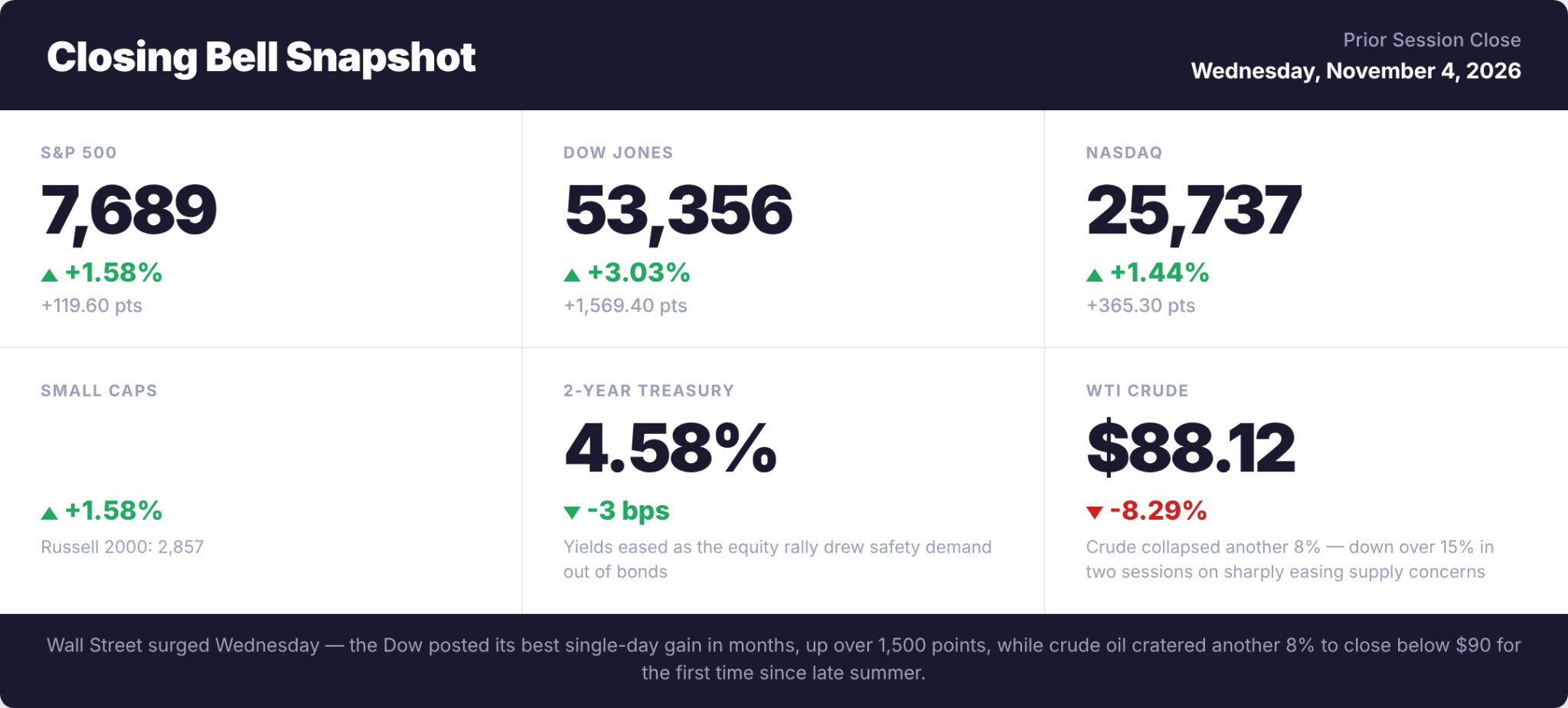
3 Movers in 3 Minutes 1. AppLovin made its case in a single quarter. AppLovin (APP) was up about 16% premarket after revenue rose 55% to $2.19 billion and net income rose 72% to $1.44 billion, a 66% net margin. Its fourth-quarter guide of $2.37 billion to $2.40 billion beat the roughly $2.25 billion analysts expected. The stock came into the report down about 60% this year. The margins aren't the debate. Durability is, and one quarter is all the evidence bulls have so far. 2. Trump Media's bitcoin moved the night its stock hit a record low. Wallets labeled as collateral for the convertible notes of Trump Media & Technology Group (DJT) sent about 4,259 bitcoin, roughly $342 million, to Crypto.com late Wednesday, Arkham data show. Hours earlier the stock closed down 24.5% at $4.49. The date that matters is Nov. 30, when noteholders can demand cash repurchase of up to about $1 billion. The company's own filing says it may have to sell bitcoin if refinancing falls short. A transfer is not a sale, and Trump Media called earlier moves custody or trading management. But at about $1.25 billion, the whole company is worth not much more than what its noteholders can ask for in 25 days. 3. Helen of Troy rejected $37. Its stock closed above it. Empower Brands, owned by Spectrum Brands (SPB) and Oaktree funds, went public with a $37-a-share cash proposal for Helen of Troy (HELE), about $1.6 billion including debt. It had offered $34 privately in August and raised that to $37 in October. The board unanimously said the bid "substantially undervalues" the company, and says Empower declined its offer of a look at the books. The stock jumped 25% to $37.04, four cents above the refused price, a sign investors expect a negotiation rather than a walkaway. Oaktree is chasing a public company through a strategic partner, and the tape suggests holders expect it to pay more. 3 Signals for Today The Bank of England is expected to hike into an oil slump. Economists expect a quarter-point increase to 4%, the bank's first hike in more than three years. Markets price it as close to certain. UK inflation has risen to 3.5%, mostly on fuel, while Brent is now on course for its biggest weekly drop since April 2020. Sweden hiked this week, and Norway held but said it is prepared to raise. What it could change: the vote split and the new forecasts. A hike with guidance for more would say central banks are fighting wages and services prices, not this week's oil price. That is the same argument underneath the Fed's December hike bet.
Labor costs get a vote before payrolls. Third-quarter productivity and unit labor costs arrive this morning with weekly jobless claims. Forecasters expect productivity to accelerate from 1.4% annualized, with estimates centered between about 2.6% and 3%, and labor-cost growth to slow from 1.2%, with estimates centered between about 0.5% and 1.1%. Cleveland Fed President Beth Hammack, who dissented for a hike in October, speaks on a stablecoins panel. Kalshi's December hike contract has held near 80 cents, and a December hike is still priced as likely despite oil's slide. What it could change: strong productivity with soft labor costs would weaken the wage case for a hike, leaving it to rest on services prices. A hot labor-cost print turns Friday's jobs report into a confirmation vote.
Prediction markets head into a courtroom week. Arkansas sued Kalshi on Wednesday, calling it an illegal gambling platform. Separately, a federal judge in Manhattan let single-stock perpetual futures keep trading on Kalshi, Bitnomial and Coinbase's (COIN) derivatives exchange. The challengers are a trade group whose members include Cboe Global Markets (CBOE) and Citadel Securities. She found them "likely to succeed," writing that the contracts "appear to satisfy the definition of a swap," which the CFTC doesn't regulate, but declined to halt trading because their claims of harm were "conjectural." The CFTC's reply is due Friday. Tonight, DraftKings (DKNG) reports. It runs a state-licensed sportsbook and a CFTC-regulated predictions app, and it pulled sports and political contracts from Utah last week. What it could change: DraftKings books revenue on both sides of this fight. Its tone on predictions will show whether operators see the federal license as growth or as a shrinking map.
And with that out of the way, let's get to today's big story: the bidding war inside your phone, and why Qualcomm just lost a round of it. The SipAI is outbidding your phone for memory. Qualcomm just showed who loses.Qualcomm (QCOM) delivered most of what it promised last night. Adjusted revenue of $10.44 billion landed at the high end of its own range and beat forecasts of about $10.1 billion. Car-chip revenue jumped 89% to a record of nearly $2 billion. Next quarter's revenue guide came in above estimates. The stock fell about 10% before the open anyway. The number that mattered was handsets. Revenue from phone chips fell 26% to $5.14 billion, short of the $5.25 billion analysts expected. Part of that is lost business at Apple (AAPL), and Qualcomm's new forecast assumes no further Apple sales. The rest is the market itself. Global smartphone shipments fell about 20% in the September quarter to a 14-year low, according to Counterpoint Research figures cited by Reuters. The auction the phone keeps losingThree companies make most of the world's DRAM, and the big suppliers are steering capacity toward AI servers, where demand and margins are higher. TrendForce says that leaves mobile memory allocations tight and prices still rising. Arm (ARM) described the same squeeze from a different seat. Its royalty revenue, paid on each chip its customers ship, grew just 8%, even with higher rates per chip. Licensing jumped 50%, and data-center royalties doubled. "Higher memory prices continue to pressure smartphone unit sales, particularly in the mid and lower-tier segments," Arm told analysts. It expects royalties to grow only low single digits from a year ago next quarter. Its stock was down more than 4% premarket. Notice where the pain lands hardest. On Monday, Apple called memory pricing "unprecedented" and guided its holiday-quarter gross margin down to 45% to 46%. But it had already raised iPhone prices in September, and it still expects its biggest quarter ever. A premium phone can absorb a pricier memory chip. A budget Android phone can't. So the bill doesn't fall on the brand. It falls on the unit count in the middle and bottom of the market, and on every supplier paid by the unit. FROM OUR SPONSORS 
It's rarely a slow bleed. It's usually one trade that was too big, held too long, hoping it would come back. My Safe Trade Options Formula gives you 5 checks to run before that trade ever happens. Normally $29.97. Free through this link. Protect your account. Qualcomm's fix adds to the billQualcomm's response is to raise prices of its own. "We are implementing price increases across our products to reflect the higher semiconductor input costs," finance chief Akash Palkhiwala said. The full benefit arrives in the second half of fiscal 2027. It said costs are rising across wafers, assembly, testing, advanced packaging and memory. That is the second-order effect. The AI build-out isn't only bidding up memory. It is claiming factory and packaging capacity too. Each supplier that passes its costs along makes the phone more expensive again, which is the same pressure that shrank unit sales in the first place. The margin repair hasn't shown up yet. Qualcomm guided next quarter's adjusted earnings to $2.15 to $2.35 a share. The $2.25 midpoint sits below the $2.27 analysts expected, even with revenue guided higher. The way out is to switch sidesQualcomm's longer answer is to sell to the machines causing the squeeze. It reiterated a $5 billion data-center revenue target for fiscal 2027 and expects non-handset revenue to grow more than 60%. "We expect the non-handset (revenue) to replace Apple entirely," Chief Executive Cristiano Amon said in an interview. He also says the worst is behind the phone business. Qualcomm told analysts its Android sales in China bottomed in the June quarter and have grown since. "Unlike some other companies, we called this memory thing early, and we prepared for it," Amon said. The premarket drop suggests investors are weighing the market more than the plan. A company can prepare for a shortage. It can't prepare its way out of a smaller phone market. What settles itFirst-quarter memory contract prices. Whether Qualcomm's price increases stick without denting Android volumes. Counterpoint's December-quarter shipment count. And the memory makers' own outlooks. Micron (MU) is still up about 179% this year, even after a 25% slide over the past month. The Market Sips TakeawayThe AI trade now has a cost line, and it runs through consumer hardware. The thesis holds if memory contract prices rise again in the first quarter and Android makers blame memory on their own calls. It gets stronger if Qualcomm's margin recovery slips past the second half of fiscal 2027, when it expects its price increases to take full effect. It breaks if new memory supply arrives faster than expected, or if Qualcomm's next quarter shows price increases landing with Android volumes intact. Watch the suppliers paid per phone. Skyworks (SWKS) just guided its smartphone revenue down by a low-teens percentage from the September quarter, citing seasonality, Android softness and an extra week in Qorvo's prior quarter. Arm's royalties grew 8% even with higher rates per chip. The memory makers are winning this auction. The phone supply chain is paying for it.
Until then, sip slowly! The Market Sips Desk Reply prompt: Would you rather own the company selling memory to AI, or the one selling chips into the phones it's squeezing? Hit reply and tell us. AI Moves Into the Biotech LabFor most of the AI boom, the money followed the hardware. Chips. Data centers. Cloud.
Now the algorithms are walking into the lab.
In September, a drug whose target was found by AI, and whose molecule was designed by AI, dosed its first patient in a Phase III trial. A second AI-engineered medicine is in Phase III too.
We profiled the 5 companies leading the shift in a new FREE Special Report: AI Moves Into the Biotech Lab.
We'll text it straight to your phone. Get the Free Report by Text → |