


Last night, two of the most powerful companies on earth reported earnings within hours of each other. Both spent tens of billions on artificial intelligence (AI). Both saw revenue grow. And yet one stock zoomed while the other crashed. That gap is not a coincidence or a quirk of analyst estimates. It is a signal about how AI investment actually works and which business models survive it.
When everyone is spending the same, execution is the only moat.
But before we get to that, let's take a quick look at the markets and what matters today...
3 Movers in 3 Minutes
1. Microsoft beats, Azure crosses $100B: Microsoft (MSFT) reported after the close, posting revenue of $90 billion, up 18% year over year, with Azure delivering 43% growth and crossing $100 billion in annual revenue for the first time. Adjusted EPS of $4.74 crushed the $4.24 estimate. The stock jumped 8% in after-hours trading, a rare act of investor approval in a week that has been brutal for tech.
2. Meta misses on earnings despite revenue beat: Meta Platforms (META) grew revenue 27% to $60.8 billion and beat on the top line, but EPS came in at $6.18 versus the $7.18 estimate as expenses surged 55% to $42 billion. Net income fell 14%. Shares dropped 6% after hours as investors focused less on the revenue line and more on what it cost to get there.
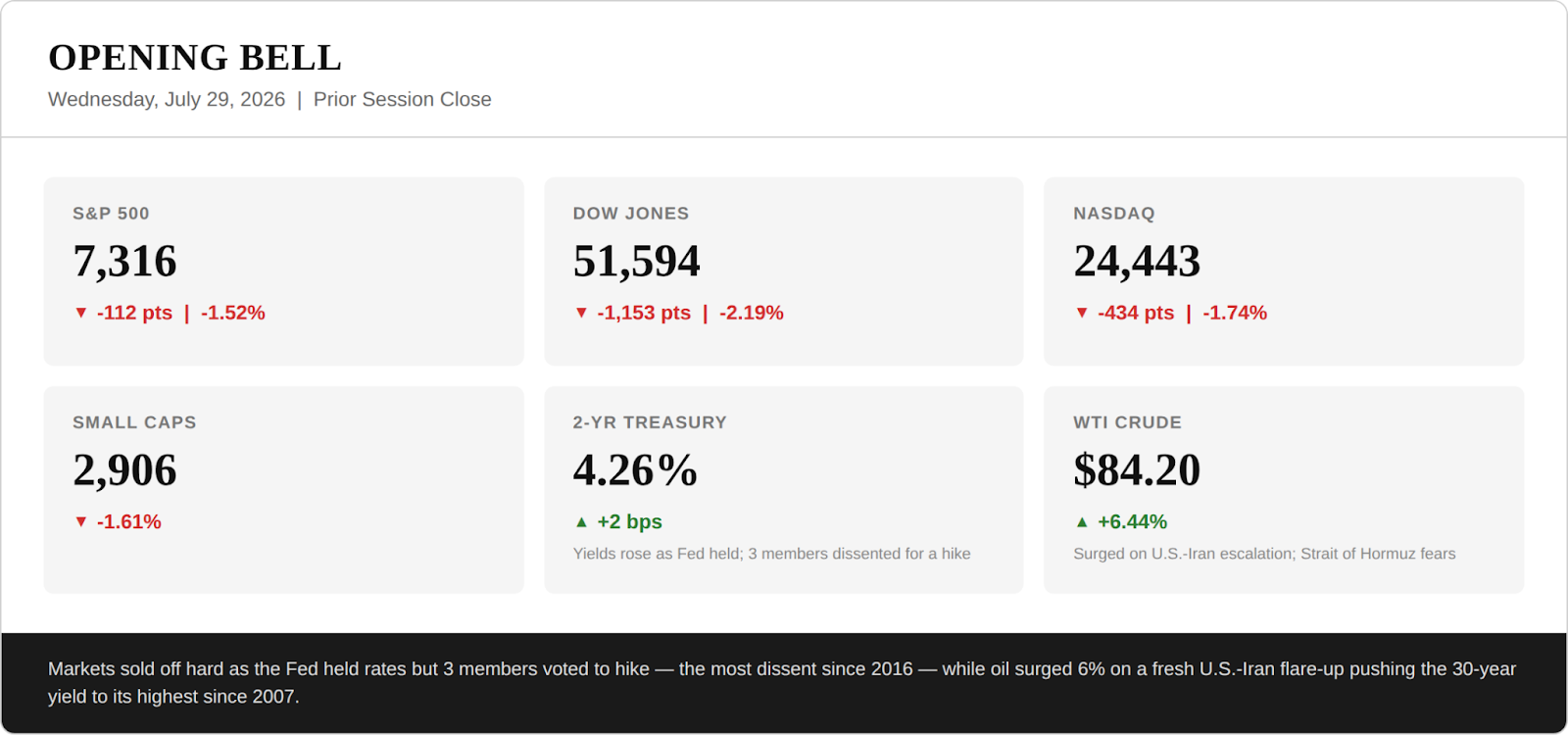
3. The Fed's hawkish hold sends yields and oil higher: The FOMC voted 9-3 to leave rates unchanged, but the three dissents, the most since 2016, rattled bond markets. Chair Kevin Warsh stripped out forward guidance entirely, telling reporters the Fed is in a period of "watchful waiting," which the market read as a signal that a September hike is now live. The 10-year yield rose to 4.70%, the 30-year hit 5.21%, and the Dow shed over 1,100 points.
3 Signals for Today
- PCE Inflation - The Fed's preferred inflation gauge drops this morning. Core PCE is expected to tick up around 0.1% month over month. After last night's hawkish Fed messaging, any upside surprise could sharpen rate-hike expectations heading into September and push yields higher still.
- Apple (AAPL) and Amazon (AMZN) earnings, after the close - With Meta's earnings miss fresh in memory, both companies face the same investor question: are AI costs running ahead of AI returns? Apple is also Tim Cook's final earnings call as CEO before John Ternus takes over September 1. Amazon faces scrutiny on AWS margins after Microsoft's Azure results reset expectations for cloud growth.
- Q2 GDP advance estimate - Released alongside PCE, this is the first read on second-quarter economic growth. Markets will watch closely for any sign that the U.S. is holding up under the combined weight of tariffs, oil price volatility, and the Middle East conflict. A weak print alongside hot PCE would be the worst possible combination for equity markets heading into the weekend.
A Tiny Government Task Force Just Finished a 20-Year Mission.
Almost no media coverage. Almost no public awareness.
But what they confirmed is one of the largest U.S. territorial expansions in modern history — a resource claim worth an estimated $500 trillion.
Thanks to sovereign U.S. law, this isn't just a national asset. It's an "American birthright."
Every citizen now has the legal right to stake a claim. Very few even know it exists.
The first profits will go to those who move early.
Get the full briefing while the "claim" window remains open
— Dylan Jovine, CEO & Founder, Behind the Markets
And with that out of the way, let's get to today's big story: how two identical AI bets just produced opposite market verdicts.
The Sip
The Same Trillion-Dollar Bet
Here's what happened in the span of about two hours last night.
Microsoft reported $90 billion in revenue, crushed earnings estimates, and revealed that Azure had crossed $100 billion in annual revenue for the first time in the company's history. Cloud growth accelerated to 43%. The stock rose 8% after hours. Investors cheered.
Then Meta reported $60.8 billion in revenue, grew 27% year over year, beat the top-line estimate, and then watched its stock fall 6% as earnings per share came in at $6.18 versus the $7.1 that analysts expected. Net income dropped 14%. Expenses surged 55% to $42 billion.
Two of the biggest companies on earth. Same week. Same AI investment thesis. Completely different outcomes.
And here is the thing almost everyone will miss in the headlines today. This is not a story about which company spent more wisely. Microsoft spent $41 billion on capex in the quarter alone, up 70%. Meta's full-year capex guidance sits between $130 billion and $145 billion. These are enormous, comparable commitments. The difference is where the money flows out of and where the revenue flows in.
The Man Who Called Nvidia Before It Soared 1,000% Issues New Elon Musk BUY Alert

Luke Lango was ranked America's #1 stock picker in 2020. He was mentored by two hedge fund billionaires from the Soros network and trained at Caltech. His readers have had the chance to see gains as high as AMD +8,500%... Nvidia +5,000%... Tesla +3,500%... Palantir +1,000%... and Apple +890%. Now he's releasing his next big pick.
This ad is sent on behalf of InvestorPlace Media at 1125 N. Charles Street, Baltimore, Maryland 21201. If you're not interested in this opportunity, please click here.
The Architecture of Returns
You see, Microsoft's AI bet is not really a bet. It is an infrastructure play with a captive billing system already attached to it.
Azure exists. Enterprise customers are already paying. When Microsoft builds a new data center or buys 10,000 GPUs, those assets plug directly into a $100 billion annual revenue machine that bills by consumption. Every dollar of capex supports a revenue line that already has over 30 million paid Microsoft 365 Copilot seats and long-term contracts worth more than $627 billion in commercial backlog. The infrastructure spend and the revenue engine are not two separate things. They are the same thing.
Azure crossed $100 billion in annual revenue. That is not a number. That is a moat.
Meta's situation is structurally different, and this is where it gets interesting.
Meta's AI investment is, at its core, a bet on future ad revenue and future hardware.
The company is pouring billions into training frontier AI models, developing its Llama family, building out the metaverse's AI layer, and constructing data centers that will power products that have not yet reached their monetization peak. The Family of Apps generated $55 billion in revenue in the first quarter alone, and ad impressions are growing 19% year over year. The business is strong. But the spending is running ahead of the returns by a meaningful margin. EPS fell year over year even as revenue climbed double digits. That gap is exactly what rattled markets last night.
The Lesson IBM Already Taught Us
This dynamic has a history.
In the mid-2010s, IBM spent billions repositioning itself as a cloud and AI company under the Watson brand. The pitch was compelling. The technology was real. The revenue never caught up. IBM spent years reclassifying its business as "strategic imperatives" grew, but traditional revenues kept shrinking faster than new ones arrived. By the time Azure and AWS had made cloud a commodity, IBM was a cautionary tale about the difference between investing in a technology and having a business model that monetizes it.
Meta is not IBM. The differences are substantial. Meta's core advertising business is healthy, growing, and globally dominant. Mark Zuckerberg's track record of long-cycle bets like mobile-first when everyone scoffed, acquiring WhatsApp when it looked expensive, and pivoting to video has been vindicated repeatedly. The company still expects 2026 operating income to exceed 2025. These are not the numbers of a company in distress.
But the market is asking a specific question right now, and last night's earnings made it louder. The question is not whether AI will eventually pay off. The question is whether the payoff arrives before the spending compounds into a structural earnings problem.
Microsoft answered that question clearly last night. Azure's 43% growth rate, and the CFO's guidance for 45% growth in the next quarter, told investors that the revenue is already catching the capex. The infrastructure spending is generating returns within the same fiscal year it is being deployed.
Meta's answer was less clear. Revenue grew. Costs grew faster. And the guidance on future capex, the low end raised to $130 billion, told investors to expect more of the same tension before they see resolution.
Why This Is the Question That Matters Now
We are entering a moment in the AI investment cycle where the first wave of pure spending is giving way to a harder test: monetization.
Every major technology platform has gone through this. The internet required enormous infrastructure buildout before browser advertising worked. Cloud required a decade of data center construction before AWS became the most profitable unit at Amazon.
Capital intensity first, margin expansion later.
The market is now, visibly, starting to separate the companies it believes are closer to the margin expansion phase from those it thinks are still deep in the capital intensity phase. Microsoft, with its consumption-based cloud billing and 30 million Copilot seats, is being priced as a company on the right side of that transition. Meta, with its enormous model training costs and still-emerging AI monetization story, is being priced as a company that has not yet crossed it.
That does not mean Meta is wrong. It might just mean Meta is earlier.
AI CEO Issues Code Red: Prepare for Meltdown
The CEO of this AI company (click here to get the name, 100% free) just issued a CODE RED in an internal memo…
Warning his employees that they’re dealing with a critical situation.
Another company executive even implied they might need a government bailout.
And now Jim Rickards is predicting this company is about to go bust, in a full-blown AI meltdown that could be 10 times bigger than Lehman Brothers.
The MarketSips Takeaway
The Microsoft and Meta earnings gap is not a referendum on AI spending. It is a referendum on business model architecture. Microsoft's capex buys revenue within the same quarter it is deployed, because Azure bills by consumption. Meta's capex buys optionality: future ad products, future AI services, future hardware. Optionality is worth something. But it is worth less than certainty when yields are at multi-decade highs and the Fed just signaled it might hike in September.
Watch today's PCE print. If it comes in hot, the rate-hike narrative firms up, and companies with long-dated AI bets will face another leg of multiple compression. If it comes in cool, you could see a relief rally heading into Apple and Amazon's numbers tonight. Either way, the question markets are really asking this earnings season has changed. It used to be: are you investing in AI? Now it is: is your AI investment paying you back?
Today's question: After last night's results, do you think Meta's AI spending will pay off before the market loses patience -- or is Microsoft's model the one that investors should be backing? Reply and let us know.
Until then, sip slowly!
The Market Sip Desk


