


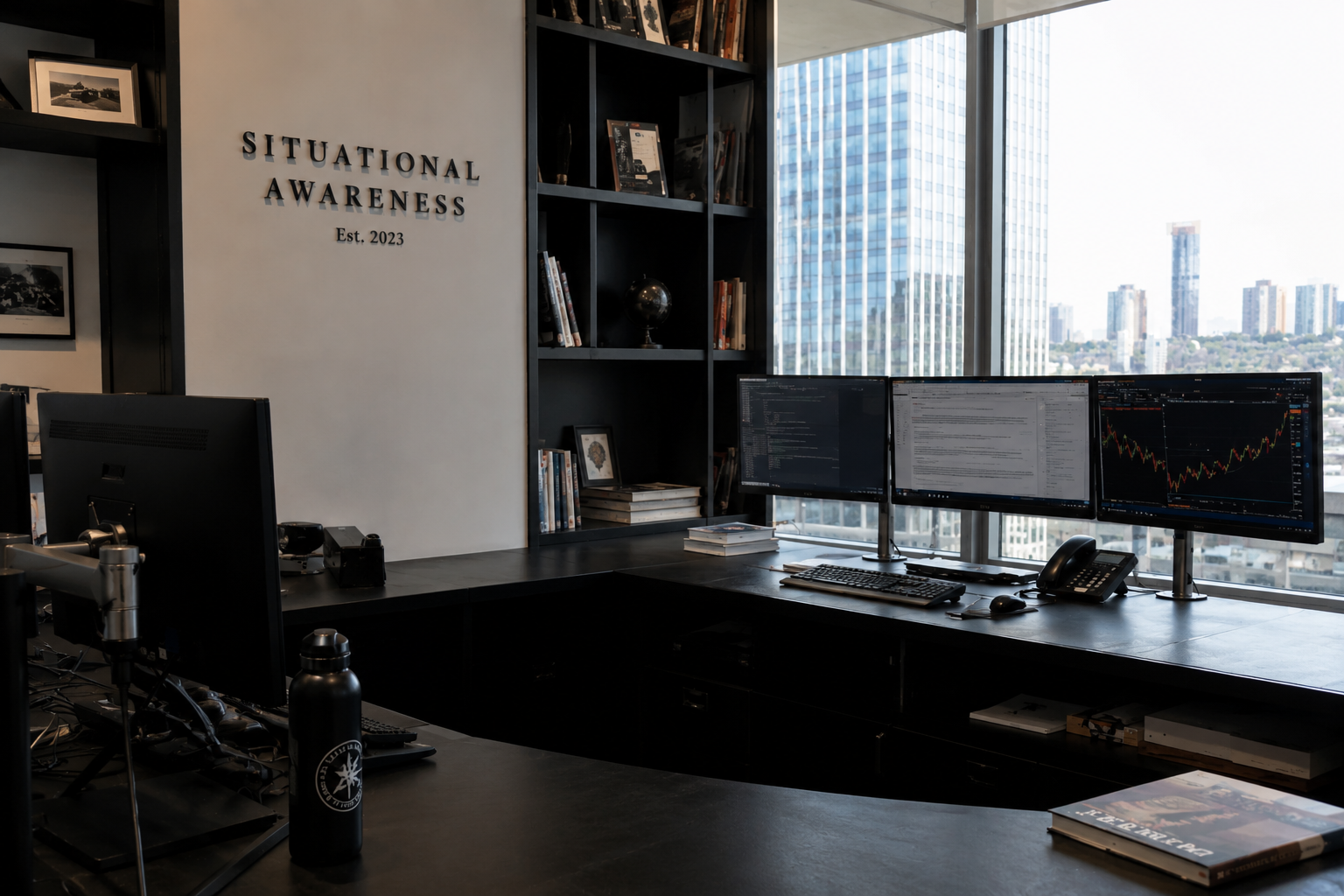
Leopold Aschenbrenner was 25 years old, had never managed a dollar of other people's money before 2024, and ran a hedge fund worth $45 billion. Then July happened. What followed is not just a story about one spectacular collapse. It is a story about what happens when an entire market borrows to believe, and what the wreckage reveals about where we are right now.
But before we get to that, let's take a quick look at the markets and what matters...
3 Movers in 3 Minutes
- Palantir's "otherworldly" quarter. Palantir Technologies (PLTR) surged 29.5% on Tuesday after posting 93% revenue growth to $1.94 billion, with U.S. commercial revenue up 149%. CEO Alex Karp called demand for AI sovereignty "otherworldly" and raised full-year revenue guidance to $8.15 billion. It was the stock's best single day in over two years.
- Caterpillar crosses $20 billion for the first time. Caterpillar (CAT) reported record quarterly revenue of $20.5 billion, up 24% year-over-year, with adjusted EPS of $8.17 crushing the $6.19 consensus. The backlog surged 92% to $72 billion, driven by North American construction demand and data center power generation projects. Shares rose roughly 6%.
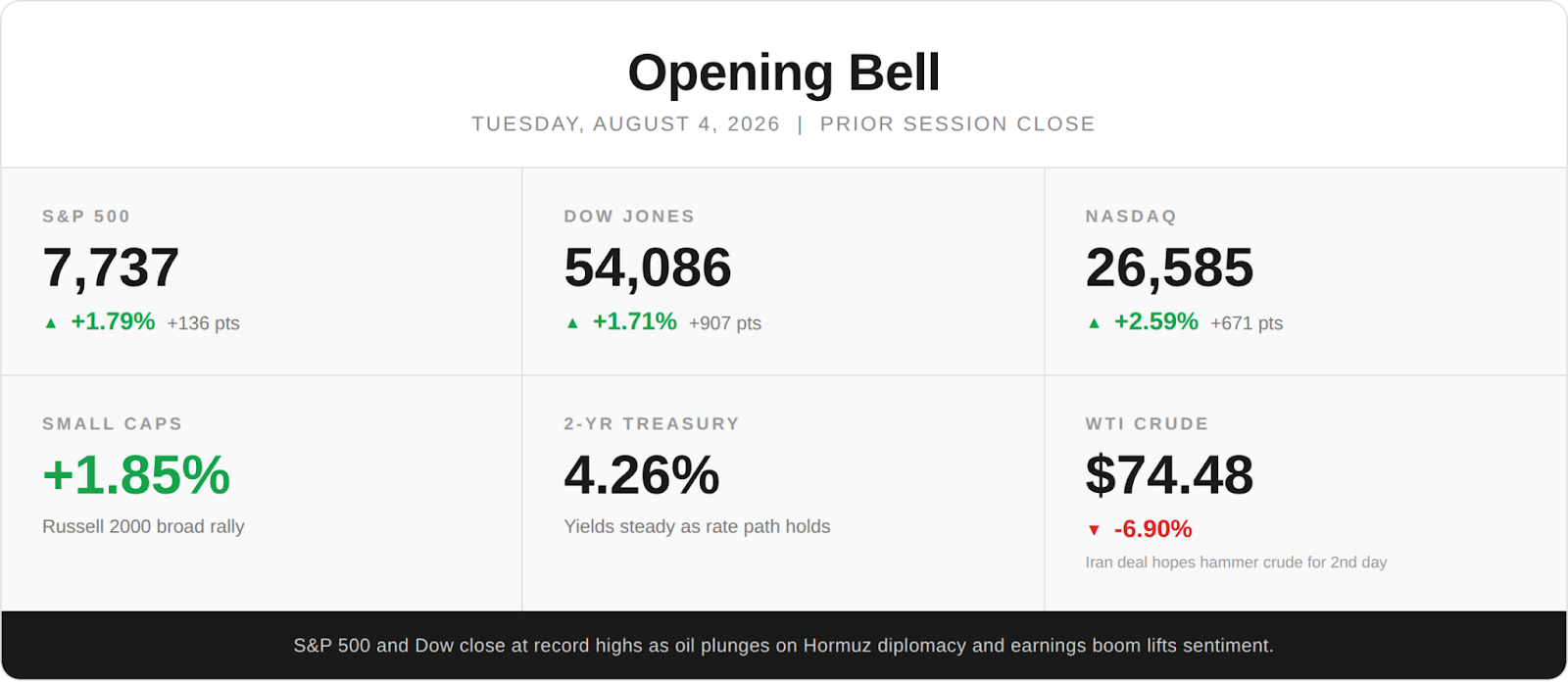
- Oil crashes for a second straight day on Iran deal hopes. WTI crude plunged to $75 as U.S. Treasury Secretary Scott Bessent said a deal to reopen the Strait of Hormuz could come "today or tomorrow." Qatar confirmed a de-escalation proposal was being circulated. Oil is now down over 10% in two sessions, its steepest two-day drop since December 2025. Iran, however, denied any direct talks with the U.S.
3 Signals for Today
- ADP Employment Change (8:15 AM ET). The July private payrolls print is expected at 120,000, up from 98,000 in June. A soft number could reignite rate-cut hopes; a strong beat adds to the "higher for longer" narrative under new Fed Chair Kevin Warsh.
- ISM Services PMI (10:00 AM ET). Consensus sits at 54.2, roughly in line with June's reading. Services remain the backbone of the U.S. economy, and any downside surprise here would matter more than manufacturing.
- SpaceX and AMD pre-market reaction. SpaceX (SPCX) beat revenue estimates in its first-ever earnings report ($7.81B vs. $6.93B expected) but fell roughly 7% after hours on $18.4 billion in quarterly capex. AMD (AMD) posted record revenue of $11.5 billion with data center sales doubling, but dropped 9% after hours. Watch how the market digests both prints at the open.
The Big AI Story Nobody Knows

There's a website called RentAHuman.ai. Its tagline: "Robots need your body."
721,000 people across 100 countries have signed up.
And according to Alexander Green - the man who bought Apple under $1, Netflix at $1.62, Amazon under $2* - this is the clearest signal yet that Phase 2 of the AI supercycle has arrived. (Split adjusted prices)
He's identified three companies set to dominate this next phase.
And with that out of the way, let's get to today's big story: the spectacular collapse of the AI era's most famous hedge fund.
The Sip
The Essay That Became a Balance Sheet
In June 2024, a 23-year-old former OpenAI researcher named Leopold Aschenbrenner published a 165-page essay titled "Situational Awareness: The Decade Ahead." It argued, with the urgency of a Cold War dispatch, that artificial general intelligence was arriving faster than anyone in government or finance understood. It became required reading in Silicon Valley within weeks.
One month later, Aschenbrenner did something unusual for a 23-year-old essayist. He launched a hedge fund. He named it Situational Awareness, after the essay, and started with roughly $225 million in capital. His backers read like a tech aristocracy: Patrick and John Collison of Stripe, former GitHub CEO Nat Friedman, and, notably, quantitative trading giant Jane Street.
The thesis was simple. If superintelligence was coming, the companies supplying its physical backbone, semiconductors, memory chips, data centers, power infrastructure, would become the most valuable enterprises on Earth. Aschenbrenner bet accordingly. Long on SK Hynix. Long on CoreWeave. Long on Nebius Group. Long on Micron Technology (MU). Short on legacy software names like Adobe (ADBE) that he believed AI would render obsolete.
And for two years, he was spectacularly right. It reported cumulative returns of 1,550% since inception. By the first half of 2026, the fund was up 439%. Assets under management ballooned to $45 billion by early July, making Aschenbrenner, at 25, one of the most successful new fund managers in a generation.
"A lot of people saw this blow-up as a matter of not if, but when."
Then July happened.
The Month That Ate $35 Billion
The AI infrastructure trade, which had powered Situational Awareness to extraordinary heights, violently reversed in mid-July. The trigger was familiar by now: a Chinese AI lab called Moonshot released a frontier model that performed near the level of the best American systems at a fraction of the training cost. Semiconductor stocks, already stretched by 18 months of relentless buying, cracked.
Nebius Group, Sandisk, and Micron, three of the fund's top disclosed positions, each shed more than 35% during July. CoreWeave, the GPU cloud computing company, dropped alongside them. Simultaneously, the short book went wrong. Adobe rallied. Legacy software, far from dying, was finding new life integrating AI into existing products rather than being replaced by them.
But what turned a painful drawdown into an existential crisis was not the thesis. It was the leverage.
According to multiple reports, Aschenbrenner was running some positions with up to 400% leverage, meaning for every dollar of capital, four dollars were deployed. When the underlying stocks moved 20-30% against him, the losses were multiplied four-fold. Prime brokers Bank of America (BAC), Goldman Sachs (GS), and JPMorgan Chase (JPM) issued margin calls in rapid succession. The fund needed cash it did not have.
WARNING: A Major Market Shift Could Hit Stocks in 2026
If you have any money in the stock market, you may want to pay attention.
New research points to a massive market-moving event that could send hundreds of popular stocks into a sudden free fall.
Holding the wrong stocks when this hits could erase years of gains.
That’s why analysts have now identified a list of stocks investors may want to avoid as this event unfolds.
If you want to see what’s coming — and which stocks could be most at risk —
On July 30, Situational Awareness sold the bulk of its public stock portfolio to Ken Griffin's Citadel at a roughly 10% discount. The portfolio was valued at approximately $16 billion. The fund's assets crashed from $45 billion to roughly $10 billion. A 67% loss in a single month.
Aschenbrenner, who had reportedly invested almost his entire personal net worth in his own fund, was getting married the same weekend the fire sale closed. His fiancee is the chief of staff to Anthropic CEO Dario Amodei. The wedding, as one person close to the situation put it, went ahead as planned.
The Canary, Not the Mine
Here is where the story gets uncomfortable. Because Aschenbrenner's collapse was not unique. It was just loud.
FINRA data shows that outstanding margin debt at U.S. brokerages surged 77% between April 2025 and June 2026, reaching an all-time high of $1.502 trillion. To put that in context, every previous time outstanding margin debt rose by 65% or more in a compressed timeframe, it preceded a major market event. An 80% spike between March 1999 and March 2000 preceded the dot-com crash. A similar surge between 2006 and 2007 preceded the financial crisis. And a sharp run-up in 2020-2021 preceded the 2022 bear market that wiped trillions from growth stocks.
Aschenbrenner was not an outlier. He was a concentrated, hyper-visible version of what thousands of funds and millions of retail investors are doing right now: borrowing money to own the AI trade at record valuations, while the S&P 500 sits at all-time highs.
The irony is striking. Aschenbrenner's thesis about AI may prove correct over the next decade. The companies he owned may indeed become some of the most valuable in history. But in the public markets, being right about the destination does not help if the leverage kills you before you arrive.
As one former Wall Street trader told CNBC: "Maybe his views on AI are correct in the long run, but in the public markets, you have to be prepared for the short-term."
There is another detail worth noting. Before Aschenbrenner launched his hedge fund, he worked at FTX, where he helped Sam Bankman-Fried run a philanthropic fund out of a Bahamas penthouse. That fund, too, was built on leverage and conviction. That, too, ended in ruins. One blow-up can be bad luck. Two starts to look like a pattern.
"A Dangerous Financial Plan Unfolding in D.C. Could Cost You 40% of Your Wealth"

Former Goldman Sachs executive who traded through Black Monday warns this plan is all written down in black and white, spearheaded by a financial insider who infiltrated the Federal Reserve... It's gone "viral" in the hedge fund circles… and yet practically nobody on Main Street understands this financial shock playing out across America. He lays out all the evidence... plus a detailed roadmap for exactly what to do. (And it doesn't require shorting... options... or perfectly "timing the market.")
You must see this critical market briefing today.
This ad is sent on behalf of Stansberry Research, 1125 N Charles St, Baltimore, MD 21201. If you would like to optout from receiving offers from Stansberry Research please click here.
The MarketSips Takeaway
The S&P 500 closed at a record high yesterday. The Dow is at an all-time high. Earnings from Palantir (PLTR), Caterpillar (CAT), and SpaceX (SPCX) suggest the economy is not only resilient but accelerating. And yet, beneath the surface, the leverage that has funded this rally is now at levels that have historically preceded every major correction of the past 25 years.
The question is not whether the AI thesis is right. It is whether the market's borrowing against it has already priced in more future than the present can survive.
Watch the ADP and ISM prints today. If the economy is cooling faster than earnings suggest, the first cracks will show in the most leveraged corners of the market. And Aschenbrenner's story will look less like an exception and more like a warning.
Until then, sip slowly!
The Market Sip Desk
📊The Market Sips Poll
What does the Aschenbrenner blow-up tell you about the current market?
- A) It's a one-off. The AI thesis is intact and this changes nothing.
- B) It's a warning sign. Margin debt at $1.5 trillion is a flashing red light.
- C) It's proof that even the smartest thesis can't survive bad risk management.
- D) It's the beginning. The next correction will be leverage-driven, not earnings-driven.


