


For sixty years, Berkshire Hathaway shareholders paid for one thing above all: Warren Buffett's brain. Yesterday, the stock closed at the same price it did the day before Buffett announced he was leaving. But the reason it's there is the opposite of what got it there the first time. That is a story worth reading before Tuesday's inflation print.
But before we get to that, let's take a quick look at the markets and what matters most today…
3 Movers in 3 Minutes
- Intel raises $15B by selling itself. Intel Corporation (INTC) fell about 3% after announcing a $15 billion underwritten common stock offering to fund its Foundry ambitions. The company's total capex commitment for the buildout now runs to hundreds of billions. Intel is choosing dilution over debt, which tells you what the credit market thinks of a chip fab timeline.
- eBay drops as Ryan Cohen wobbles. eBay Inc. (EBAY) slid 4% after Bloomberg reported that GameStop Corp. (GME) CEO Ryan Cohen is considering pulling GameStop's $56 billion offer for the marketplace. The move would end one of the strangest merger sagas of the year, in which a struggling video game retailer bid a valuation multiple of its own market cap for a legacy e-commerce platform.
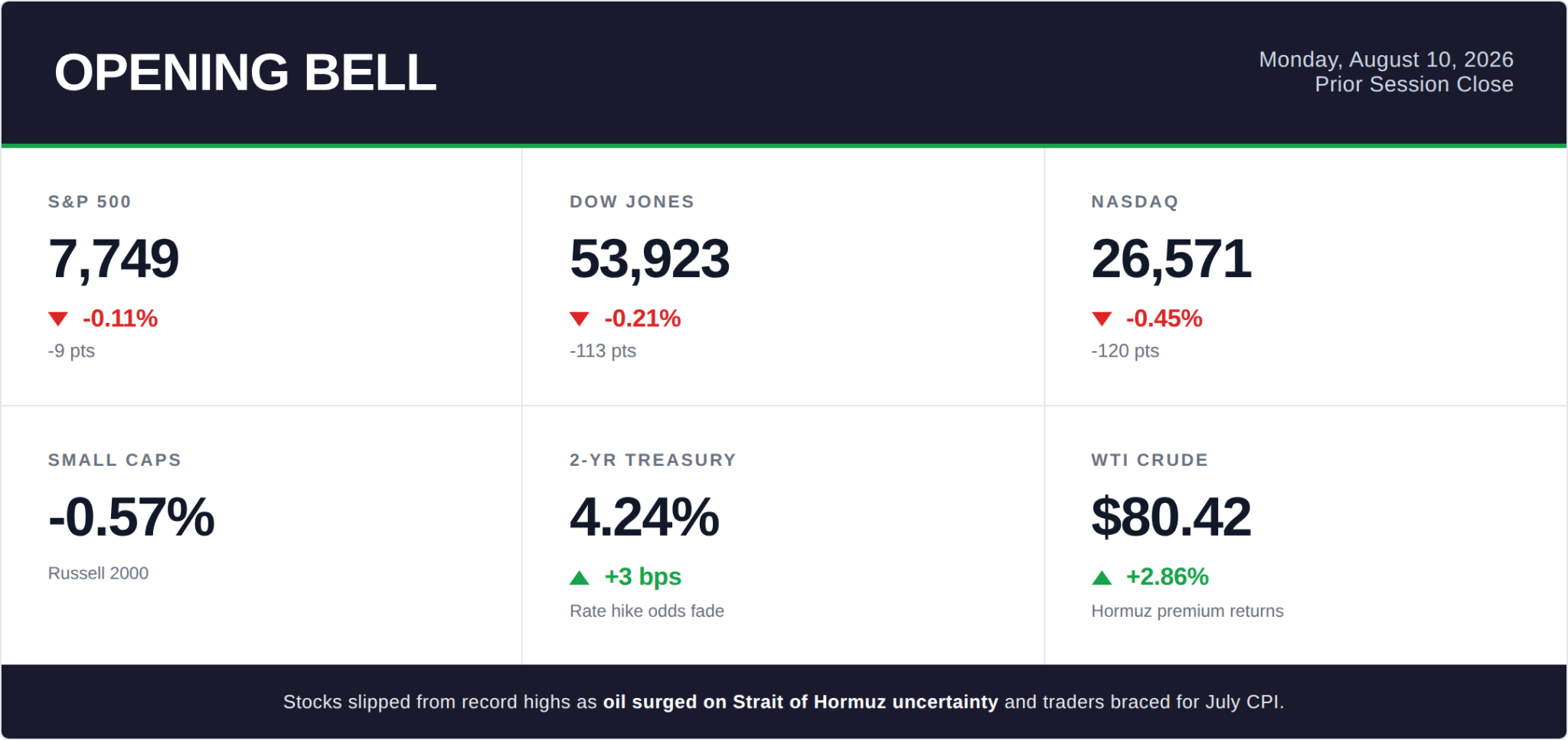
- Oil regains its war premium. WTI crude jumped 2.86% to $80.42 a barrel as Iran and Oman failed to finalise a Strait of Hormuz reopening deal. Iranian Foreign Minister Abbas Araghchi said Tehran is not in direct talks with Washington and repeated demands for compensation. US Strategic Petroleum Reserve holdings fell below 300 million barrels for the first time since 1983.
3 Signals for Today
July CPI, Wednesday, 8:30 AM ET. The single most important number of the week. After Friday's shock -23,000 jobs print, September rate hike odds have already fallen from 67% to 44%. A hot CPI reprices everything back the other way, fast.
CoreWeave Q2 earnings, after close. CoreWeave, Inc. (CRWV) delivers its first public report since a bruising few weeks of AI-financing headlines. The read on GPU cloud demand will matter more than the print itself.
Super Micro Computer earnings, after close. Super Micro Computer, Inc. (SMCI) is the cleanest read on server-order momentum. Backlog commentary will move the AI trade tomorrow morning either way.
AI's "All In" Moment
In the dot-com days, former Wall Street money manager Alexander Green bought Apple under $1. Netflix at $1.62. Amazon under $2. (Split adjusted.)
Now he's doing the same with AI.
And he says it's the biggest opportunity he's seen in 40 years.
Every few decades, a window opens that can change your financial life forever.
And with that out of the way, let's get to today's big story: the number that just told us Berkshire without Buffett might be worth more than Berkshire with him.
The Sip
A price, twice
On May 2, 2025, Berkshire Hathaway Inc. (BRK.A) Class A shares closed at roughly $806,000. It was a Friday. The next morning, at the annual meeting in Omaha, Warren Buffett stood up and told the world he was stepping down as CEO after sixty years. The stock started drifting lower that afternoon and kept drifting for fifteen months.
Yesterday, Berkshire hit $806,102 in morning trade. Same number. Different world.
In May 2025, that price was what the market paid to keep Buffett in the chair. In August 2026, it is what the market pays to have him out of it.
That is a strange sentence. It is also, quietly, the most important thing that happened in equity markets yesterday.
Fourteen quarters of not doing anything
For most of the last three and a half years, Berkshire was less a value investing firm and more a very large money market fund with a railroad attached. From late 2022 through the first quarter of 2026, the company was a net seller of stocks for fourteen straight quarters, one of the longest such stretches in its history. Cash climbed from around $109 billion to a record $397.4 billion.
Buffett had reasons. Treasuries were paying 5%. Valuations felt stretched. Tariffs were a moving target. He said as much at the 2025 meeting.
The market accepted the reasoning and punished the outcome anyway. Through the first seven months of 2026, Berkshire Class B shares were up about 3%. The S&P 500 was up 13%. The cash pile that had once been Buffett's superpower was starting to look, from the outside, like a drag.
Then Greg Abel started spending.
The $28 billion signal
In its Q2 2026 report filed Saturday, Berkshire disclosed something it had not done in years. It bought $23.5 billion of other companies' stocks. It bought $4.5 billion of its own. And in July, it followed with another $10.1 billion in buybacks and the completed acquisition of homebuilder Taylor Morrison.
The new position was Alphabet Inc. (GOOGL). Berkshire bought $10 billion of it directly from the company on June 1.
You need to sit with that for a second. In 2017, Buffett stood in front of shareholders and called missing Google his single biggest investing mistake. Buffett started the position himself in Q3 2025, in what looked like a legacy trade before handing off the keys. Abel just multiplied it.
The stake didn't just settle a regret. It repriced Berkshire's identity.
The Verdict Is In for AI Stocks in the second half of 2026
The AI trade that made the Mag 7 soar is starting to crack.
Overpriced giants like Nvidia, Tesla, and Amazon are facing slowing returns — just as smaller, lesser-known names are positioning to take market share.
Waiting could be costly.
Three under-the-radar AI stocks are already showing the potential to outperform the Mag 7 in the second half of 2026.
Make sure these alternatives are on your radar before markets open tomorrow.
The Tim Cook parallel
There is a version of this story that says Abel is breaking with Buffett style. The market says the opposite. It says Abel is finally doing what Buffett didn't.
And there’s a nice angle worth noting here. Every legend is also a constraint. When Steve Jobs died in 2011, Apple was worth about $370 billion. Tim Cook took over and, within three years, did three things Jobs had refused to do: he started paying dividends, he ran an aggressive buyback programme, and he opened up entire product categories, from wearables to Services, that violated the old Jobs discipline. The critics said Cook was diluting the founder's vision. The market rewarded him with roughly $4.7 trillion of additional market cap over the next decade.
Satya Nadella at Microsoft ran the same play. So did Andy Jassy at Amazon.
The pattern is the same. A founder builds a machine that only they can run. When they leave, the successor gets to run it without the constraints that were baked in over decades. The market often mistakes the constraints for the machine, and prices the successor low. Then the successor turns the crank the founder wouldn't turn, and the stock reprices.
That is what happened yesterday.
What Abel actually inherited
The elegant part of the pivot is that Abel didn't have to change the philosophy. He just had to reach for the wallet. Buffett had been buying good businesses at fair prices for six decades. He simply chose not to buy them for the last three and a half years, and built a huge pile of cash that is ready to deploy when a good opportunity strikes. Abel is choosing to buy it again.
The cash pile is still $364 billion. Berkshire's operating businesses, from the railroad to Geico to the utilities, delivered $12.98 billion in Q2 operating profit, up 16%. The insurance float is intact. The moat is intact.
What changed is the style of allocating funds.
Hidden in Tesla's Filing: A $12 Billion "Super Startup"
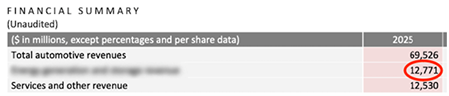
Pull up Tesla's most recent SEC filing. Page 5.
And you'll see a single line showing $12 billion in revenue from a brand-new "super startup" Elon Musk has been quietly incubating inside Tesla.
This new "super startup" has nothing to do with cars or robots or space or AI…
But it sits at the center of what Blackstone calls "a $23 trillion investment opportunity."
And on Oct 21st, Elon is expected to pull back the curtain and reveal exactly what he's building.
But Adam O'Dell already knows… and he reveals it all in this urgent video.
The MarketSips Takeaway
The Buffett premium was always a strange thing. Investors paid extra for Berkshire because one man in Omaha was thinking about capital allocation more clearly than almost anyone else. When he announced he was leaving, the premium began to leak.
Now the leak has reversed. And the reason isn't that Abel has become Buffett. It is that, for the first time in more than three years, the company is putting its balance sheet to work again. The stock isn't back at $806,000 because the market missed Buffett. It is back because it stopped waiting for him.
For every reader who watches a mid-cap founder-led company trade at a premium tied to the founder, this is the question worth holding onto: how much of that premium is the founder's judgement, and how much is the constraint that only their departure will lift? Sometimes the best thing a legend can do for their company is walk out of the room.
Until then, sip slowly!
The Market Sip Desk


