


In 2014, Pascal Soriot told Pfizer that AstraZeneca was not for sale. Everyone on Wall Street thought he was delusional. The pipeline was thin, the stock was sinking, and Pfizer was offering the largest premium in pharma history. Twelve years later, Soriot's AstraZeneca is reportedly in talks to merge with Bristol Myers Squibb in a deal that would create a roughly $400 billion pharmaceutical giant. The man who refused to be bought is now attempting the biggest acquisition the drug industry has ever seen. The question isn't whether he's bold enough. It's whether the patent math gives him any other choice.
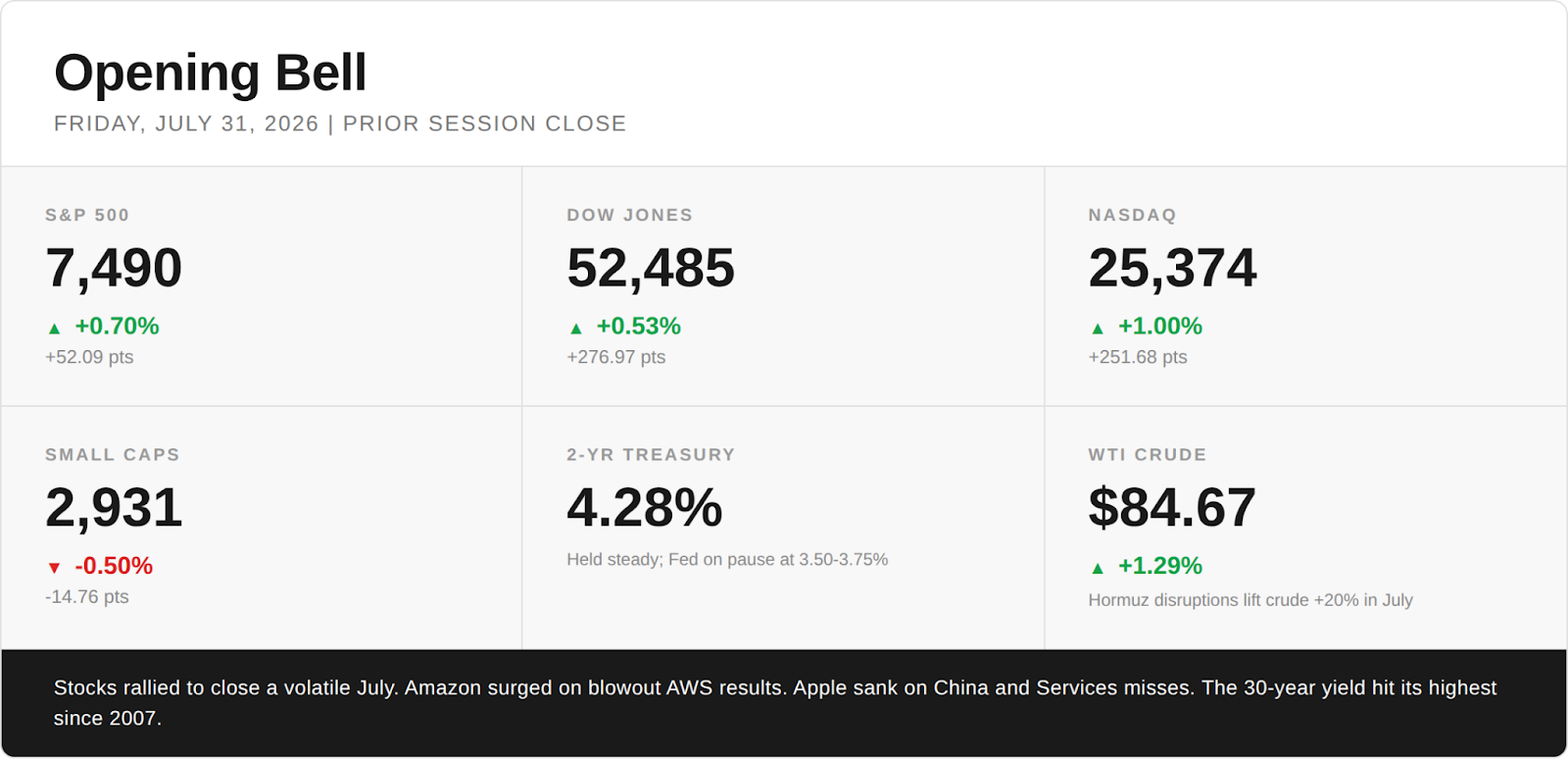
But before we get to that, let's take a quick look at the markets and what matters...
3 Movers in 3 Minutes
- Amazon crosses $200 billion in a single quarter. AMZN reported Q2 revenue of $200.6 billion, up 20% year over year, while AWS grew 37%, its fastest pace in 18 quarters. Net income surged to $62.6 billion, though $53.4 billion of that came from unrealized gains on Amazon's Anthropic stake. Free cash flow swung to a negative $7.6 billion on $169 billion in trailing twelve-month capex.
- Apple drops 7% as Services and China miss. AAPL posted $109.4 billion in Q3 revenue, up 16%, and iPhone sales hit a June-quarter record at $54.3 billion (+22%). But Services revenue of $30.7 billion and Greater China sales of $18.8 billion both fell short of estimates. CEO Tim Cook flagged an increasing impact from a global memory chip shortage on forward guidance, and the stock suffered its worst single-day decline in 16 months.
- The 30-year Treasury yield closes at its highest level since 2007. The long bond yield settled at 5.25% on Friday, extending a selloff driven by inflation fears from rising oil prices, growing government borrowing, and the Fed's hawkish hold. The 10-year yield topped 4.75%. Bond investors are now pricing in the possibility that the Fed's next move could be a hike, not a cut.
3 Signals for Today
- ISM Manufacturing PMI (10:00 AM ET) will show whether the factory sector is stabilizing or sliding further into contraction, with the Prices Paid component critical for the inflation outlook.
- Earnings from PLTR (Palantir Technologies, after close) and ON (ON Semiconductor, before open) kick off a heavy week of AI-adjacent and industrial results that includes SPCX, AMD, DIS, MCD, and COST.
- Friday's July nonfarm payrolls report is the week's main event, and the data matters more than usual because the Fed dropped forward guidance at its last meeting. The jobs number is now, effectively, the guidance.
There's a Strategy Behind the Iran War.
I know because I've seen the evidence firsthand.
On March 2nd — three days after the first missiles hit — I sat across from two U.S. Congressmen in back-to-back private meetings.
Those meetings pointed me toward something I spent weeks verifying.
The real purpose behind the strikes. The real objective. And the single company at the dead center of all of it.
This isn't random. It's a calculated Two-Front Economic War.
And there's one company positioned right at the heart of it.
See the strategy behind the Iran war — and the company at the center of it
The sooner you understand what's really happening — the better positioned you'll be before August 12th.
— Dylan Jovine, Founder, Behind the Markets
And with that out of the way, let's get to today's big story: the pharmaceutical merger that could reshape the entire industry.
The Sip
The Man Who Said No
In May 2014, Pascal Soriot was running a pharmaceutical company that Wall Street had largely written off.
AstraZeneca's bestselling drugs were expiring. Its pipeline was thin. And Pfizer, the largest drugmaker on earth, had just tabled a $118 billion takeover offer, the biggest attempted acquisition in pharmaceutical history. Most CEOs would have taken the money and called it a career.
Soriot refused. Not once, not twice, but three times, insisting that Pfizer was dramatically undervaluing the company's science. Investors thought he had lost his mind. The board backed him anyway.
What followed was one of the most remarkable turnarounds in corporate history. Soriot bet everything on oncology, pivoting AstraZeneca away from its old primary-care blockbuster model toward higher-risk precision cancer drugs. It worked. AstraZeneca's share price has more than quadrupled during his 14-year tenure. Cancer treatments alone accounted for roughly $25 billion of the company's 2025 sales, nearly half the total. In February 2026, the company completed a direct listing on the New York Stock Exchange, positioning itself squarely in the world's deepest capital market.
And now, Soriot is on the other side of the table.
The Biggest Deal Nobody Saw Coming
On Sunday, the Financial Times reported that AstraZeneca has been in talks with Bristol Myers Squibb (BMY) about a potential merger that would create a combined company worth roughly $400 billion. The deal, if completed, would be the largest pharmaceutical transaction in history. Larger than Pfizer's $90 billion acquisition of Warner-Lambert in 2000. Larger than the $74 billion BMS-Celgene deal in 2019. Larger than anything the industry has ever attempted.
The talks have been going on for months, according to people familiar with the matter. A deal could materialise soon. Or it could collapse entirely.
But the logic is hard to ignore.
The Patent Cliff That Changes Everything
Bristol Myers Squibb is staring down the steepest patent cliff in its history.
Eliquis, the blood thinner it co-markets with Pfizer, is one of the world's best-selling drugs, with roughly $14.4 billion in 2025 sales. Its European exclusivity expired in May 2026. Its US patent protection falls away in 2028. Revenue is projected to plummet 92% by 2030. Meanwhile, Opdivo, the blockbuster cancer immunotherapy, faces biosimilar competition around 2028-2029. Together, these two drugs accounted for over half the company's revenue as recently as last year.
BMS isn't standing still. Its "growth portfolio" of newer drugs now generates 55% of revenue and grew 17% in 2025. Q2 2026 earnings beat expectations handsomely, with $12.97 billion in revenue and EPS of $2.04 against a $1.61 estimate. CEO Christopher Boerner has been confident about pivotal pipeline readouts replacing lost revenue by 2030.
But the market doesn't believe him. BMS trades at roughly 8.9 times forward earnings, a discount that screams skepticism. And that discount is precisely what makes the company attractive to a buyer with a longer time horizon and a complementary portfolio.
Why are companies flying spy planes over Elon's closely-guarded AI lab?
Elon did the seemingly impossible – far faster than anyone expected...
And it's sent the tech industry into PANIC MODE.
ChatGPT, Claude, Google Gemini, and DeepSeek could soon become obsolete.
And three little-known firms could soar 10X or higher as a result.
Why Soriot Wants This
AstraZeneca has publicly stated its ambition to reach $80 billion in annual revenue by 2030. That's nearly double its current run rate. Organic growth alone won't get it there. And while AstraZeneca's oncology franchise is formidable, combining it with BMS's immunotherapy platform, its cardiovascular pipeline, and its global commercial infrastructure would create something no single pharma company has ever had: dominant positions across oncology, cardiology, rare disease, and immunology simultaneously.
There is also a quieter strategic thread. AstraZeneca moved its US listing from Nasdaq to the NYSE in February 2026, a signal that it wanted American investors to view it as a domestic-scale pharmaceutical company, not a British one with a US outpost. A merger with BMS would complete that transformation overnight.
The Catch
This deal has an obvious problem. Both companies derive more than 40% of their sales from oncology. Their cancer immunotherapies compete directly. Antitrust regulators would almost certainly demand significant divestitures. One antitrust lawyer told Reuters he would expect a Trump FTC to scrutinize the deal closely, especially where drug portfolios and late-stage pipeline assets overlap.
And then there is the sheer scale. Large pharma mergers have grown rarer in recent years, not more common. The regulatory environment, the political pressure to lower drug prices, and the operational complexity of integrating massive R&D organizations have all conspired to keep dealmakers cautious. The last time AstraZeneca itself was formed through a megamerger, when Astra AB and Zeneca Group combined in 1999 for $67 billion, it took years to fully integrate the research pipelines.
But history also shows that patent cliffs have a way of forcing hands. When Pfizer faced its own Lipitor expiry in 2011, it went on a buying spree that reshaped its entire business. When BMS itself confronted the Revlimid cliff, it acquired Celgene for $74 billion in 2019. The pattern is consistent: big pharma companies don't grow their way out of patent cliffs. They buy their way out.
The question has never been whether pharma would consolidate again. The question was always who would move first, and at what price.
Middle East Conflict Lights Fuse on US Debt Bomb
America was already drowning in $38 trillion of debt, but the recent conflict in the Middle East just accelerated the timeline.
As oil spikes, a 100-year-old stock market signal that accurately predicted the 2008 and 2020 crashes is flashing a massive "Sell" on dozens of popular U.S. equities.
If you hold the wrong stocks when this debt crisis hits, it could wipe out years of gains.
Click here to see the 10 popular stocks to dump immediately
11780 US Highway 1, Palm Beach Gardens, FL 33408-3080 Would you like to edit your e-mail notification preferences or unsubscribe from our mailing list? Copyright © 2026 Weiss Ratings. All rights reserved.
The MarketSips Takeaway
The AstraZeneca-BMS talks signal that the era of cautious, bolt-on pharma deals is ending. Patent cliffs are accelerating across the industry, AI is making R&D pipelines more valuable, and the cost of doing nothing is growing faster than the cost of doing something big. If this $400 billion merger materialises, it won't just be the largest deal in pharmaceutical history. It will be a template that Pfizer, Merck, and every other major drugmaker will be forced to respond to. Watch whether Monday's market reaction prices this as a one-off headline or the opening move in a new wave of mega-consolidation. The answer will tell you where pharma goes for the next decade.
Until then, sip slowly!
The Market Sip Desk


