


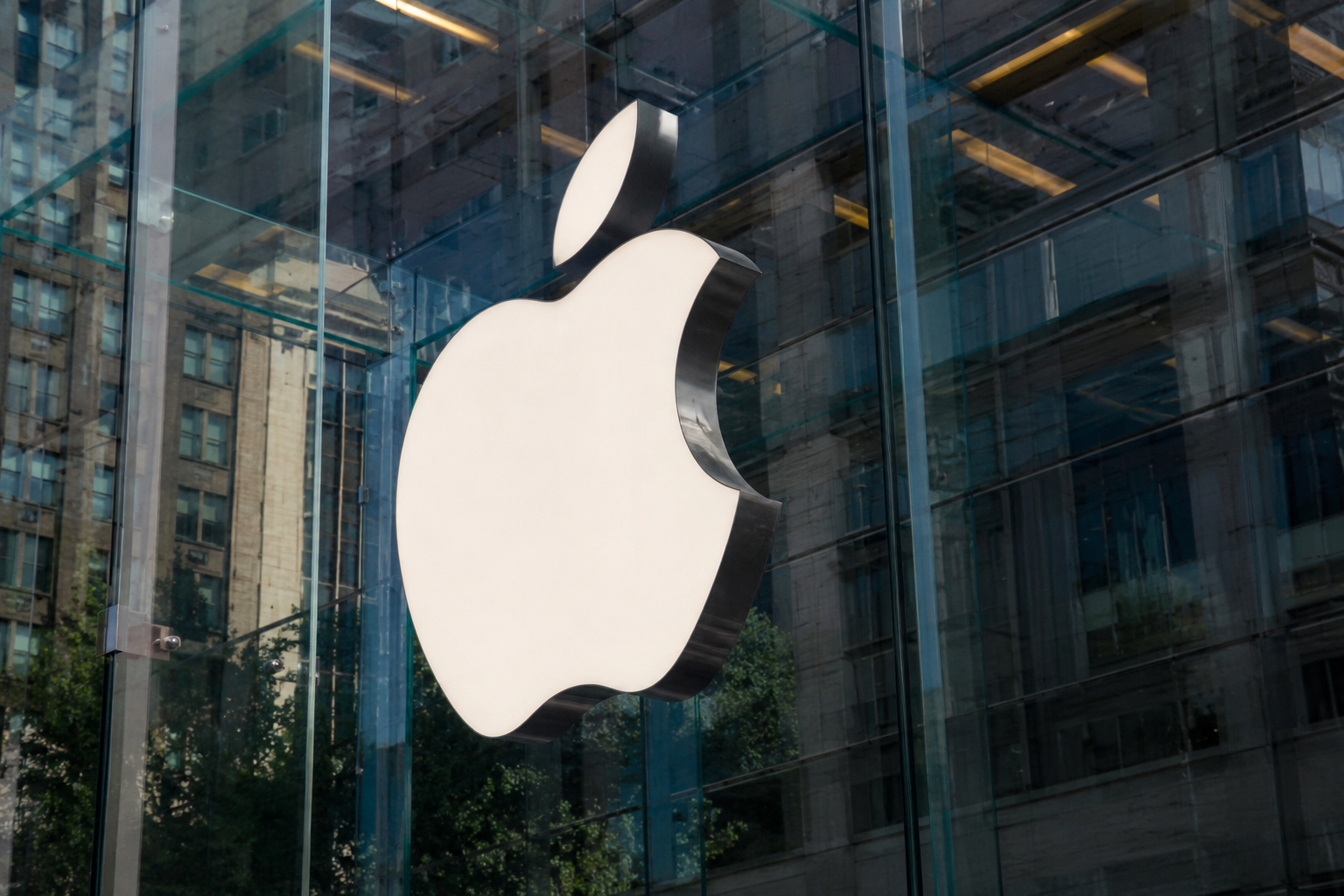
Here is the most counterintuitive sentence in markets right now: the company spending the least on artificial intelligence is worth the most. On Tuesday, Apple briefly crossed $5 trillion in market capitalization. It got there not by building data centres or buying GPUs, but by doing almost nothing. In a year when the biggest tech companies on earth are collectively burning through $725 billion on AI infrastructure, Apple's restraint has become its greatest asset. That should make you rethink everything you thought you knew about who wins the AI era.
But before we get to that, let's take a quick look at the markets and what matters today…
3 Movers in 3 Minutes
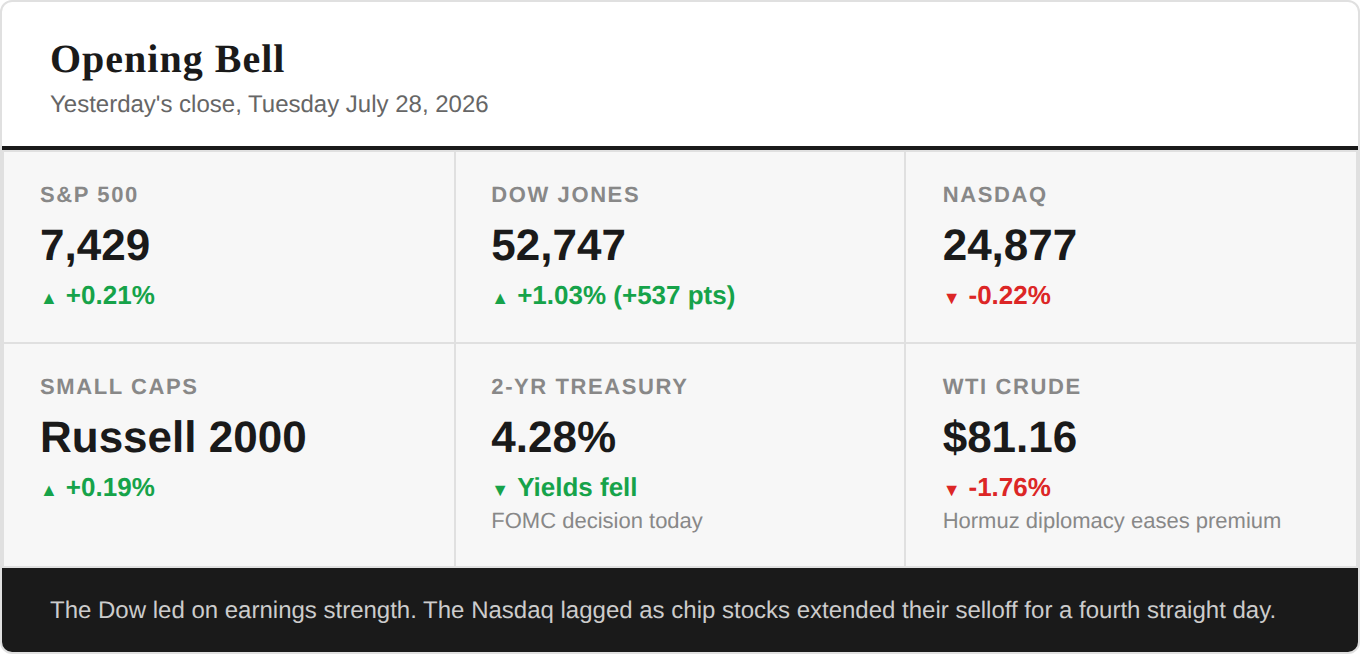
- Chip bloodbath, day four. The semiconductor selloff deepened on Tuesday, with the VanEck Semiconductor ETF (SMH) falling over 3% for a fourth straight session. Micron (MU) dropped 8.8%, AMD lost 8.1%, and Sandisk (SNDK) cratered 14.2%. South Korea's Kospi triggered its ninth circuit breaker of 2026, dragged by SK Hynix and Samsung. The selloff reflects deepening anxiety over AI circular financing and China's advances in lithography equipment, which could chip away at ASML's dominance.
- Old economy strikes back. Sherwin-Williams (SHW) surged 8% after a Q2 earnings beat to lead the Dow, while Coca-Cola (KO) popped 5% on a top and bottom line beat plus a full-year guidance raise. In a week dominated by AI anxiety, the Dow's outperformance is being driven by companies that sell paint and sugar water. Sometimes the market votes for simplicity.
- SpaceX keeps falling. Shares of SpaceX (SPCX) slipped to roughly $112, setting a new post-IPO low for a second consecutive session. The stock has been on a steady downward slide since its mid-June debut, with the initial euphoria fading fast. For a company valued at nearly $1.5 trillion in private markets just months ago, the public market is delivering a cold reality check.
3 Signals for Today
- The Fed decides at 2:00 PM ET. The FOMC wraps its two-day meeting today with a rate decision. Markets expect a hold at 3.50%-3.75%, but Citadel Securities has flagged a possible surprise hike to reinforce Warsh's inflation-fighting credentials.
- Microsoft and Meta report after close. MSFT is expected to post Q4 FY26 EPS of $4.24 on $87.6 billion in revenue, and META is expected to deliver Q2 EPS of $7.18 on $60.2 billion in revenue. The headline numbers matter less than the capex guidance. After Alphabet's $205 billion capex bomb sent its stock tumbling last week, investors will parse every spending figure for signs of restraint or escalation. Microsoft's Azure and Meta's ad business are healthy. The question is whether the AI infrastructure tab is sustainable.
- Apple and Amazon on deck Thursday. AAPL reports fiscal Q3 with expected EPS of $1.86, and AMZN follows with Q2 results. Apple's report is Tim Cook's last as CEO before John Ternus takes over on September 1. Amazon's print will reveal whether its $200 billion capex plan is generating proportional cloud revenue, or just depleting cash.
When the Fed Cuts, These Go First
The rate-cut rally is already taking shape, and our analysts just pinpointed 10 stocks most likely to lead it.
They’ve dug through every chart, sector, and earnings trend to find companies positioned for explosive upside once the Fed eases.
From AI innovators to dividend aristocrats, these are the names attracting billions in early institutional money.
Miss them now, and you’ll be chasing the rally later.
Get the Top 10 Best Stocks to Own in the Second Half of 2026 — free today before the next leg higher begins >>
And with that, let's get to today's big story: the company that won the AI era by refusing to play the AI game.
The Sip
Five Trillion Dollars of Doing Nothing
On August 2, 2018, Apple became the first publicly traded company in history to reach a $1 trillion market capitalisation. It took the company 42 years to get there from its 1976 founding.
Two years later, in August 2020, it hit $2 trillion.
Five years after that, in October 2025, it crossed $4 trillion.
And on Tuesday, July 28, 2026, Apple's stock briefly touched $342.8 a share, pushing its market capitalisation past $5 trillion for the first time. It became only the second company in history to reach that number, after Nvidia (NVDA) crossed it in October 2025.
That last trillion took less than nine months.
But here is what makes the milestone genuinely strange. Apple did not get here by leading the AI revolution. It got here by sitting it out.
The Anti-Capex Play
Right now, the largest technology companies on earth are locked in what can only be described as a spending war. Amazon has committed $200 billion in capital expenditures for 2026. Alphabet guided to $175 to $205 billion. Microsoft is on pace for roughly $190 billion. Meta's range sits between $125 and $145 billion. Together, the four hyperscalers are plowing approximately $725 billion into AI infrastructure this year alone. GPUs, data centres, cooling systems, power contracts, custom silicon. The works.
And Apple? Apple's capital expenditures for the entire fiscal year are projected at around $14 billion. Its spending over the last two reported quarters totalled just $4.3 billion. For a company that just touched $5 trillion in value, that number is comically small.
You see, while its peers were building the picks and shovels of the AI gold rush, Apple was generating cash at a rate that would make a sovereign wealth fund jealous. Trailing twelve-month free cash flow exceeded $129 billion, and the company is expected to post a record $140 billion in free cash flow for the full fiscal year. That is up more than 40% from 2025.
Compare that to the companies spending the most. Alphabet's free cash flow turned negative in Q2 for the first time since its IPO in 2004. Amazon's trailing free cash flow collapsed roughly 95%, from approximately $38 billion to $1.2 billion. Oracle has already crossed into negative free cash flow territory entirely. Microsoft stock is down over 15% in 2026.
The market's message has been blunt. It used to reward companies for spending more on AI. Now it rewards them for spending less.
So how did Apple pull this off?
The short answer: it decided to rent what everyone else was building.
Rather than pouring hundreds of billions into AI training clusters, Apple signed a deal to use Google's Gemini models to power its upgraded Siri. It chose to license frontier AI capabilities for a fraction of what it would cost to build them. And because Apple controls the endpoint, the 2.2 billion active devices where AI actually reaches a human being, it does not need to own the infrastructure. It just needs access to it.
"If you think AI capex is going to keep expanding, buy Nvidia. If you think it is going to slow, Apple is the better play."
That framing, from a Rye analyst, captures the binary bet the market is now making. And right now, the market is choosing Apple.
There is an irony here worth sitting with. Two years ago, investors criticised Apple relentlessly for being behind in the AI race. Its Apple Intelligence platform debuted in late 2024 with delays and missing features. Key Siri upgrades were pushed back. Executives were reshuffled. The consensus on Wall Street was that Apple had missed the boat.
Turns out, missing the boat can be a strategy. Especially when the boat is leaking cash.
FREE Gold Ticker to Buy ASAP: (NYSE:___)
Jim Rickards – the world’s #1 gold expert – has just revealed one of his favorite gold plays… 100% FREE

As Jim sees it, we’re witnessing the biggest gold boom of the last 100 years – and those who keep their money on the sidelines are missing their chance at a fortune thanks to gold’s epic run.
But smart investors who get in now, could make 10X their money in the coming months.
The Handoff
The $5 trillion milestone also arrives at a symbolic inflection point. On September 1, Tim Cook will step aside as CEO, becoming executive chairman and handing the company to John Ternus, who has led Apple's hardware engineering for years. Thursday's earnings report will be Cook's final quarterly presentation at the helm.
Cook took over from Steve Jobs in 2011, when Apple was worth around $350 billion. Under his watch, the company's value grew roughly fourteenfold, not by reinventing the product line every few years, but by perfecting the machine around the product: Services, the App Store, wearables, and a supply chain so tight it became its own moat. Whether Ternus can maintain that discipline as rising component costs squeeze hardware margins is the question the next year will answer.
The Long Angle
Here is the wider lesson. The $5 trillion number is not really about Apple at all. It is about what happens when an entire industry's spending outpaces its revenue, and one company simply refuses to join.
The hyperscalers are spending $725 billion this year. By 2027, analysts project that number will approach $950 billion. But the revenue from AI products has not yet scaled to match. Free cash flows are collapsing. Debt is rising. And the market, which once rewarded ambition, is now rewarding restraint.
Apple's bet is that in any technology gold rush, the most durable business is not the one that mines the gold. It is the one that owns the town the miners have to walk through.
So far, that bet is worth $5 trillion.
Navellier Warns: This Could Leapfrog Elon's SpaceX IPO
Elon Musk could take SpaceX public in 2026, at an estimated $1.75 trillion valuation. The IPO would include Elon's AI model, Grok. But according to Louis Navellier, a radical new AI model will launch this year… over 1,000 times more powerful than Elon's. And the company behind it could outperform SpaceX in the process.
Click here for full details (including Louis' new pick — free).
This ad is sent on behalf of InvestorPlace Media at 1125 N. Charles Street, Baltimore, Maryland 21201. If you're not interested in this opportunity, please click here.
The MarketSips Takeaway
Apple's $5 trillion moment is not a story about one company's success. It is a market-wide repricing of what matters in the AI era: cash flow, distribution, and capital discipline are winning over raw spending and ambition.
Tonight, Microsoft and Meta report. Their capex numbers will tell us whether the rest of Big Tech has heard the same message. Watch the spending guidance closely. The market is no longer paying for promises. It is paying for proof.
What do you think: is Apple's restraint a stroke of genius, or will it look like a missed opportunity in five years? Hit reply.
Until then, sip slowly!
The Market Sip Desk


