


There is a particular kind of corporate crisis that should, by every rational measure, kill a company. Pay $16 billion in legal settlements. Spin off your fastest-growing division. Watch your stock lose half its value. Bring in a CEO who has never spent a single day inside your walls.
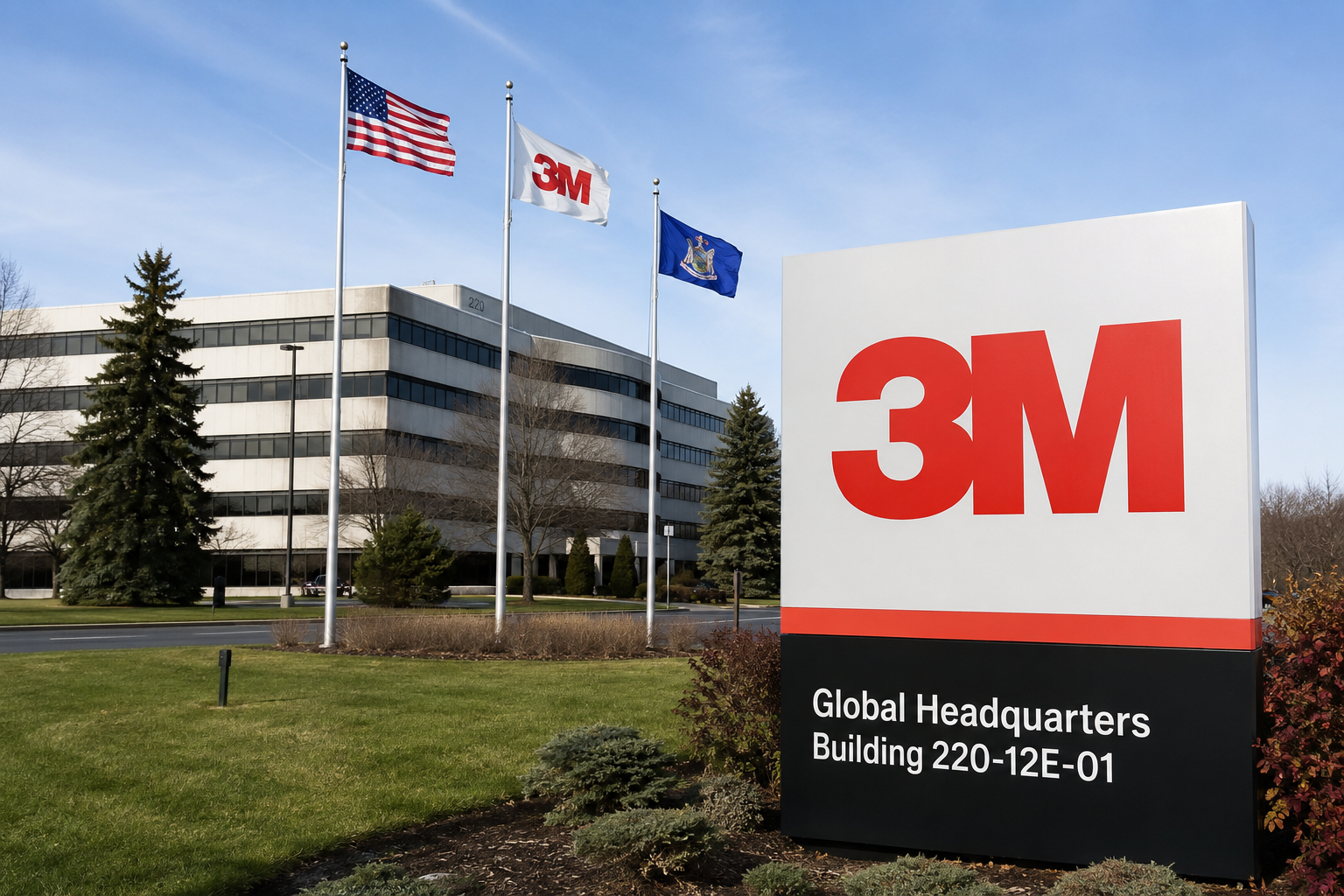
And yet, yesterday, 3M reported the kind of quarter that made even its harshest critics pause. Turns out, the best thing that ever happened to a 122-year-old conglomerate was being forced to take itself apart.
But before we get to the full story, let's take a quick look at the markets and what matters…
3 Movers in 3 Minutes
1. 3M's comeback quarter stuns Wall Street. MMM jumped roughly 7% after the industrial conglomerate posted adjusted EPS of $2.40, well ahead of the $2.24 consensus, and raised its full-year guidance to $8.80 to $8.95. Organic revenue growth came in at 5.4%, driven by strength in data center and semiconductor markets.
2. Nvidia formalises its $5 billion bet on ex-Yandex. An SEC filing revealed that NVDA now holds a 9.3% stake in Nebius Group (NBIS), the Amsterdam-based AI cloud infrastructure company carved out of Russia's Yandex after Western sanctions. Nebius shares surged 19% on the disclosure. Nvidia first invested $2 billion in March and is now the company's largest outside shareholder, highlighting how the chipmaker is effectively seeding its own customer base.
3. Germany's Intersnack takes Utz private at a 91% premium. UTZ soared after announcing a $2.9 billion all-cash deal to be acquired by Intersnack Group, one of Europe's largest snack companies. The $14.25 per share offer valued the stock at nearly double its Monday close. The founding Rice and Lissette families will roll their equity into a 50/50 joint ownership structure, giving Intersnack an instant American footprint in salty snacks.
3 Signals for Today
- Tesla (TSLA) and Alphabet (GOOGL) report Q2 earnings after the close. Tesla's report is the first since SpaceX's IPO. Markets will focus on automotive gross margins after aggressive promotional pricing, while Alphabet faces questions on AI monetisation and ad revenue resilience amid the Iran conflict.
- Trump's 10% global tariff is set to expire Friday. Trade Representative Jamieson Greer signalled on CNBC that new duties under Section 301 could land on up to 60 countries as soon as this week, citing forced labour standards. The replacement regime, if it arrives on schedule, will test whether markets have priced in perpetual tariff escalation or still flinch on the headlines.
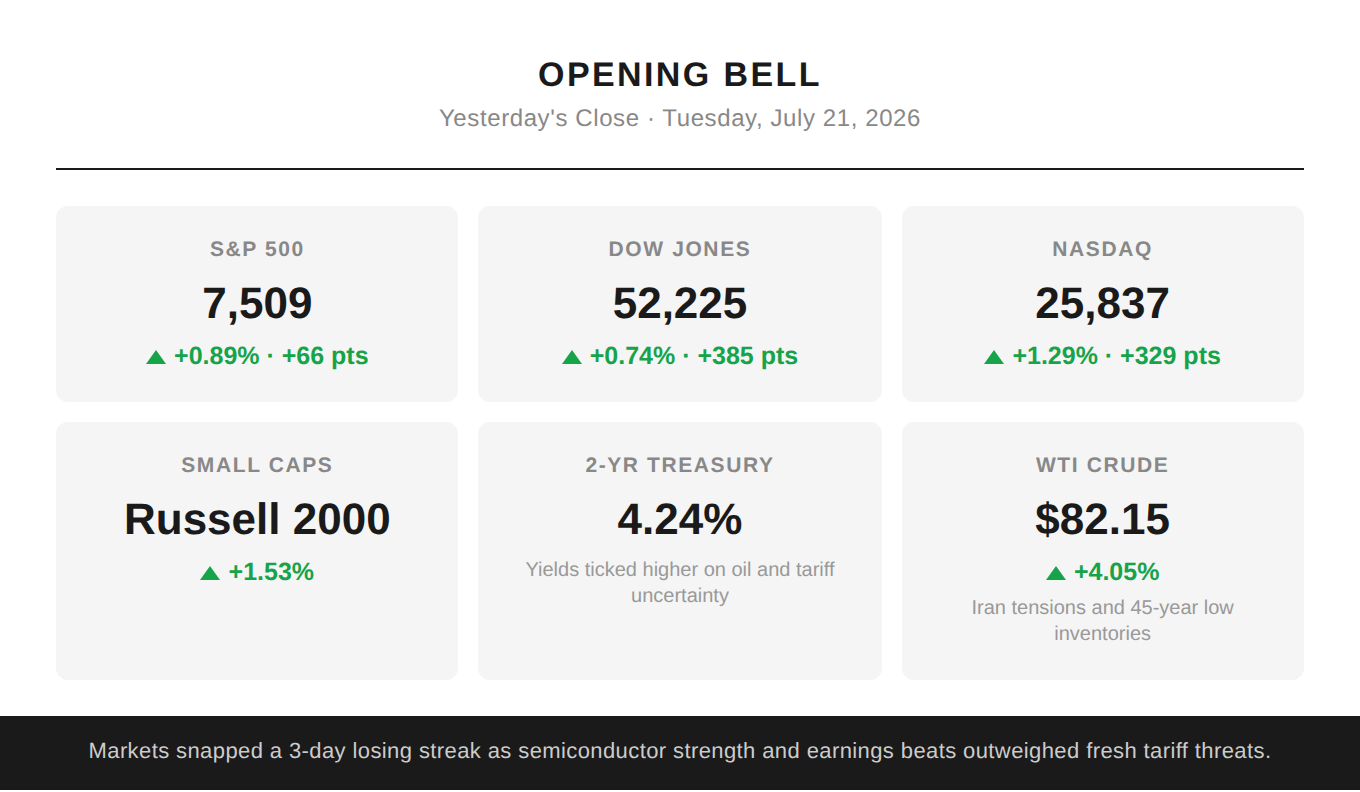
- EIA crude oil inventory data drops at 10:30 AM ET. With WTI jumping 4% yesterday on the back of Iran tensions and U.S. crude inventories reportedly at a 45-year low of just 43 days of supply, the reading will test whether supply anxiety has legs or whether it is purely geopolitical froth.
There's a Strategy Behind the Iran War.
I know because I've seen the evidence firsthand.
On March 2nd — three days after the first missiles hit — I sat across from two U.S. Congressmen in back-to-back private meetings.
Those meetings pointed me toward something I spent weeks verifying.
The real purpose behind the strikes. The real objective. And the single company at the dead center of all of it.
This isn't random. It's a calculated Two-Front Economic War.
And there's one company positioned right at the heart of it.
See the strategy behind the Iran war — and the company at the center of it
The sooner you understand what's really happening — the better positioned you'll be before August 12th.
— Dylan Jovine, Founder, Behind the Markets
And with that out of the way, let's get to today's big story: a 122-year-old company that found its edge by losing almost everything.
The Sip
A Chemical That Lasts Forever
In 1902, five men in Two Harbors, Minnesota, started a company to mine sandpaper minerals. The mine was worthless. But the company survived, and over the next century built one of the most prolific invention machines in American history: Scotch tape, Post-it Notes, N95 masks. Over 60,000 products. A fixture of the Dow. The kind of stock your grandfather bought and never sold.
But somewhere along the way, 3M also created something it could not take back: PFAS.
Short for per- and polyfluoroalkyl substances, these synthetic chemicals became central to dozens of 3M products, from Scotchgard to firefighting foams. Cheap, versatile, and virtually indestructible.
That last quality was the problem.
The Reckoning
PFAS do not break down. Not in soil, not in water, not in the human body. Scientists began calling them forever chemicals, and by the 2020s, they had been found in the drinking water of thousands of American communities.
Public water suppliers sued. Settlement: $10.3 billion, payable over 13 years. Then came the Combat Arms earplug litigation, in which hundreds of thousands of military veterans alleged 3M's dual-ended earplugs were defectively designed. That settlement: $6 billion. Together, $16.3 billion in legal commitments.
The stock collapsed. From an all-time high near $250 in late 2017 to 10-year lows in 2023. More than half its market value, gone.
The company that had invented the future now looked as if it had been buried by its past.
The Outsider
On March 12, 2024, 3M did something it had never done in 122 years: it hired a CEO from the outside.
William Brown came from L3Harris, the aerospace and defence contractor where he orchestrated the merger of Harris Corporation and L3 Technologies. He knew manufacturing and cost structures. He did not know Post-it Notes. That was the point.
Three weeks later, 3M completed the spinoff of Solventum, its healthcare business. Solventum had generated roughly $8.2 billion in annual revenue, a quarter of 3M's total. Overnight, the sprawling conglomerate was forcibly leaner.
The conventional reading was grim. But a quieter logic was at work.
Why are companies flying spy planes over Elon's closely-guarded AI lab?
Elon did the seemingly impossible – far faster than anyone expected...
And it's sent the tech industry into PANIC MODE.
ChatGPT, Claude, Google Gemini, and DeepSeek could soon become obsolete.
And three little-known firms could soar 10X or higher as a result.
Addition by Subtraction
With Solventum gone and the legal settlements locked in, 3M's remaining businesses, Safety and Industrial, Transportation and Electronics, Consumer, could be evaluated on their own merits for the first time in decades.
And those merits, it turned out, were better than anyone expected.
Yesterday's Q2 2026 results were the clearest evidence yet. Adjusted operating margins hit 24.9%. Organic revenue grew 5.4%. Adjusted earnings per share came in at $2.40, beating the $2.24 consensus by a comfortable margin. Management raised full-year EPS guidance for the second time this year, to a range of $8.80 to $8.95.
The stock jumped to near a 52-week high, giving the company a market capitalisation of roughly $89 billion. For context, two years ago, it was worth barely half that.
What happened was less a strategic masterstroke than a forced simplification. Strip away the healthcare division with its different capital needs. Resolve the existential litigation overhang. Exit PFAS manufacturing entirely, which 3M completed by the end of 2025. Then let a disciplined operator focus the remaining portfolio on industrial end markets, data centres, semiconductors, automotive, and safety where 3M's material science capabilities still carry genuine pricing power.
You see, the old 3M was too diversified to be valued properly. Its healthcare margins were being dragged down by industrial cost structures. Its industrial innovation was overshadowed by legal risk. The conglomerate premium that once justified the sprawl had turned into a conglomerate discount.
The breakup reversed that.
The Long Angle
There is a theory in portfolio management called "addition by subtraction." The idea is simple: sometimes the best way to improve a portfolio is to remove the position dragging everything else down.
Companies rarely apply this logic to themselves. Conglomerates are built on the assumption that diversification is stability. For decades, 3M proved that thesis right. Until it didn't.
The lesson is not that breakups always create value. Plenty of spinoffs have destroyed it. The lesson is narrower: when a company's identity becomes its liability, the crisis that forces reinvention can be the most valuable thing that ever happens to it.
3M did not shed its healthcare business because it wanted to. The litigation made the conglomerate structure untenable. It did not hire an outsider out of boldness. It did so because decades of insider leadership had failed to arrest the decline.
And yet, the company that emerged is posting margins its former self could not have imagined.
Sometimes the most powerful strategy is not the one you choose. It is the one chosen for you.
Middle East Conflict Lights Fuse on US Debt Bomb
America was already drowning in $38 trillion of debt, but the recent conflict in the Middle East just accelerated the timeline.
As oil spikes, a 100-year-old stock market signal that accurately predicted the 2008 and 2020 crashes is flashing a massive "Sell" on dozens of popular U.S. equities.
If you hold the wrong stocks when this debt crisis hits, it could wipe out years of gains.
Click here to see the 10 popular stocks to dump immediately
11780 US Highway 1, Palm Beach Gardens, FL 33408-3080 Would you like to edit your e-mail notification preferences or unsubscribe from our mailing list? Copyright © 2026 Weiss Ratings. All rights reserved.
The MarketSips Takeaway
3M's quarter is a case study in what happens when a company is forced to stop being everything to everyone. The litigation, the spinoff, the outside CEO were not a strategy. They were a reckoning. But the result is a leaner company with genuine pricing power in industrial and data centre markets, and a margin profile that finally matches its capabilities.
For investors, the signal is less about 3M and more about the broader conglomerate discount. When the market stops rewarding complexity, the companies that simplify fastest often win. Watch who follows.
What do you think: does it take a crisis for legacy companies to reinvent themselves, or could 3M have done this ten years earlier?
Until then, sip slowly!
The Market Sip Desk


