


On Monday, Amazon quietly joined the $3 trillion club. Twenty-nine years ago, that same company reported its first public earnings: $148 million in revenue, no profit, and a CEO who told impatient shareholders they had the wrong temperament for the stock.
Tonight, another company reports its first public earnings under strikingly similar conditions. Except this one lost $4.9 billion last year. And its CEO once called going public "painful."
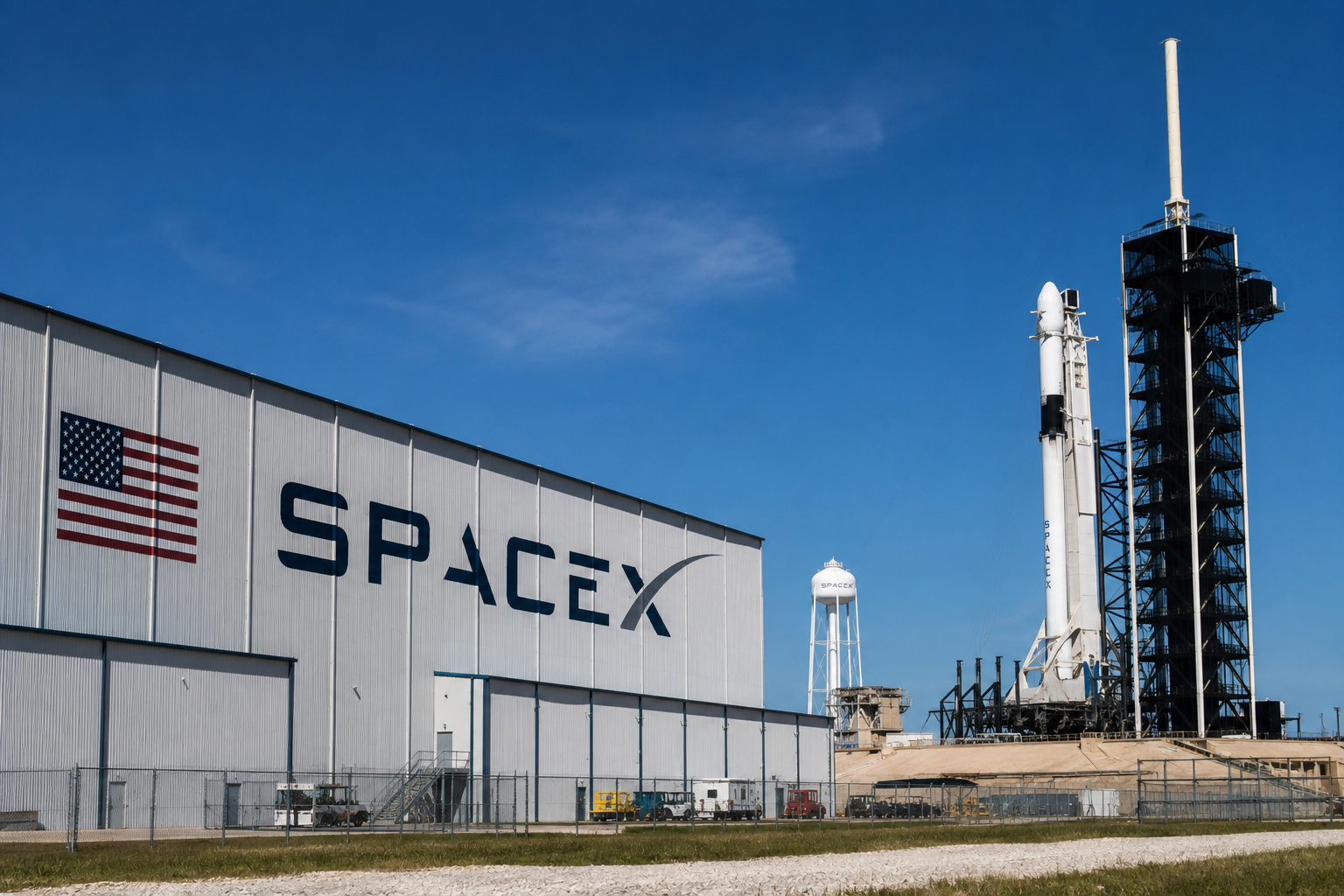
But before we get to that, let's take a quick look at the markets and what matters...
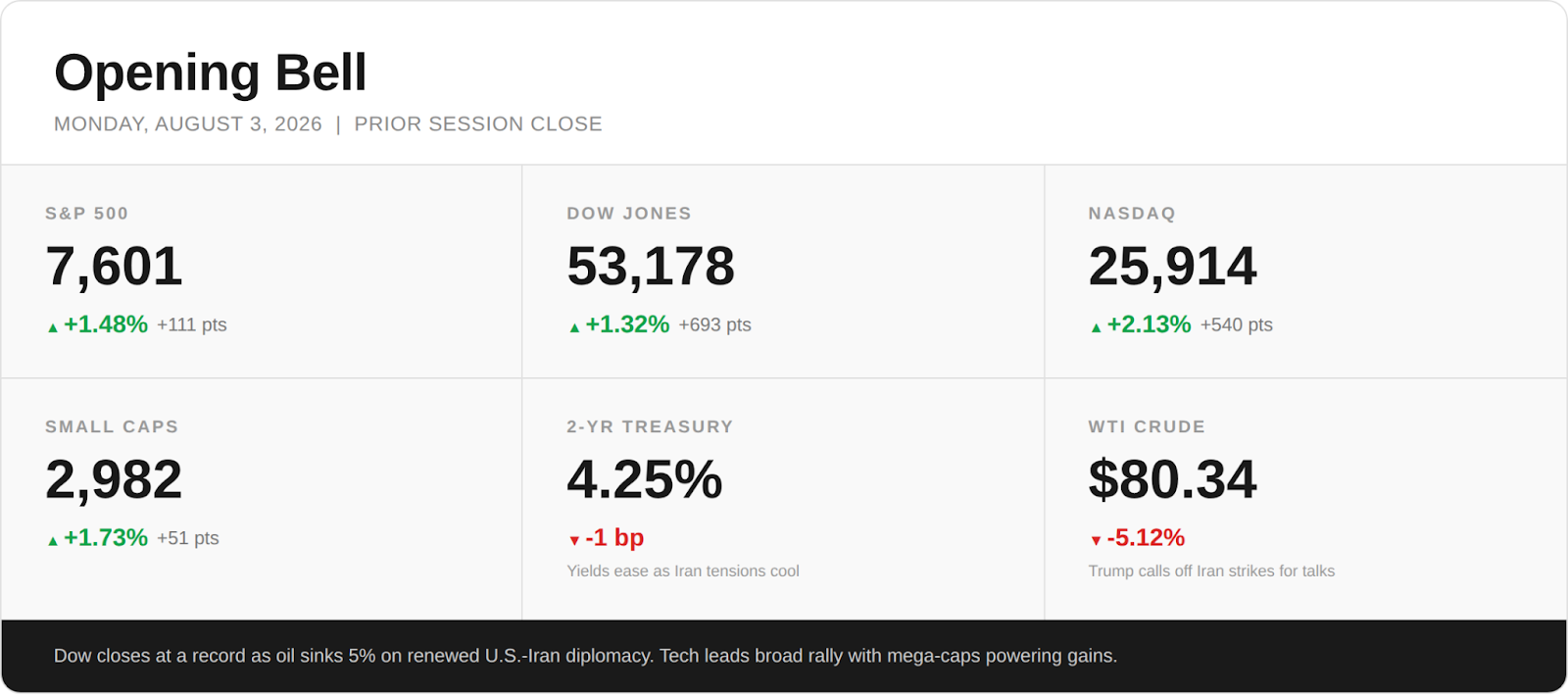
3 Movers in 3 Minutes
1. Amazon crosses $3 trillion. Amazon (AMZN) hit a $3 trillion market capitalization for the first time on Monday, becoming only the fifth company in history to reach that threshold. The push came from a post-earnings surge after Q2 showed AWS revenue of $42.2 billion, beating estimates by nearly $2 billion. CEO Andy Jassy told investors that even with $220 billion in planned capex this year, "we will still not have enough capacity to meet all the demand we have in 2026."
2. Palantir smokes expectations, stock surges 13%. Palantir (PLTR) reported Q2 revenue of $1.94 billion, blowing past the $1.8 billion Wall Street had penciled in. U.S. commercial revenue grew 149% year-over-year. CEO Alex Karp called the quarter "otherworldly." The company raised full-year revenue guidance to $8.15 billion, more than $450 million above prior estimates. Shares jumped roughly 13% after hours.
3. Oil crashes 5% as Trump cancels Iran strikes. WTI crude dropped to around $80.34 a barrel, shedding more than 5% after President Trump called off what he described as a "massive" planned military strike against Iran in favor of restarting negotiations. The drop reversed much of oil's 20%-plus rally through July and immediately eased pressure across the Treasury curve.
3 Signals for Today
- SpaceX (SPCX) reports its first-ever public earnings after the close at 4:30 PM ET, the most anticipated disclosure event of the quarter, with a $116 billion lockup expiration following 48 hours later on August 6.
- June JOLTS job openings data at 10:00 AM ET is the first of two critical labor market reads this week, with Friday's July nonfarm payrolls report carrying even more weight for Fed rate expectations.
New "AI Fuel" discovered near Grand Canyon
A small drilling crew just punched through to a discovery big enough to meet global electricity demand 140 times over, according to the International Energy Agency...
Right near the Grand Canyon.
See why Google, Berkshire Hathaway and the President of the United States are rushing to grab it >>
And with that out of the way, let's get to today's big story: SpaceX opens its books for the first time, and $1.4 trillion meets the quarterly earnings call.
The Sip
The Sandbox Meets the Spreadsheet
For 22 years, SpaceX existed in a world that most public companies can only dream about.
Rockets exploded, and Elon Musk called it progress. Timelines slipped by years, and nobody filed a shareholder lawsuit. Billions were burned on projects with no clear revenue model, and the only people who needed convincing were a handful of private investors who had already bought into the vision.
That world ends tonight.
At 4:30 PM ET, SpaceX (SPCX) will report its first quarterly earnings as a public company. It will be the first time Wall Street gets audited numbers behind what is now a $1.4 trillion enterprise. And the timing could not be more loaded.
The Numbers Behind the Curtain
Here is what the market already knows. SpaceX raised $85.7 billion in its June IPO, the largest initial public offering in American history. Shares priced at $135, opened at $161, and hit $225.64 within a week. As of Monday's close, they traded at $114.53. That is a 50% decline from the peak and roughly 15% below the offering price.
The company lost $4.9 billion in 2025 and another $4.28 billion in the first quarter of 2026 alone on $4.69 billion in revenue. Analysts expect Q2 revenue to come in around $6.88 billion. The stock trades at roughly 49 times expected revenue. No profit is expected.
"SpaceX posted a net loss of $4.9 billion in 2025, and many of its grandest ambitions are still a distant point on the horizon."
But the real pressure point is not the earnings print. It is what happens 48 hours later.
The $116 Billion Overhang
Under the terms of SpaceX's lockup agreement, the first earnings report triggers the release of up to 911.5 million insider shares. At Monday's closing price, that is approximately $104 billion in stock that can suddenly be sold. The lockup opens on August 6, two trading days after the report.
To put the scale in perspective, less than 5% of SpaceX's total shares were available for public trading at the IPO. The August 6 unlock alone could flood the market with tradeable stock worth more than the entire IPO raise. It is, as one Morgan Stanley analyst described, unprecedented in size.
Musk's own shares remain locked under a full one-year restriction until June 2027. But early employees, venture investors, and pre-IPO holders are about to get their first exit window. Whether they use it will depend almost entirely on what management says tonight.
Three Businesses, One Earnings Call
This is the first time investors will see SpaceX broken into its three operating segments.
The Space segment covers rocket launches. SpaceX completed 165 orbital launches in 2025 and 40 more in Q1 2026. But here is the wrinkle: only seven of those first-quarter launches served external customers. The other 33 were internal missions for Starlink deployment and AI infrastructure. SpaceX has effectively become its own largest customer.
The Connectivity segment is Starlink, which had 10.3 million subscribers across 164 countries as of March, up 105% year-over-year. The service generated $11.4 billion in revenue in 2025. This is the business Wall Street cares about most, because it is the only segment generating predictable, recurring cash flow.
Then there is the AI segment, the most controversial addition. In February 2026, SpaceX absorbed xAI, Musk's artificial intelligence venture, along with the social media platform X and a gigawatt-scale data center called Colossus. Investors will want to know how much of the Q2 loss is attributable to AI infrastructure spending versus core operations.
I Became a Millionaire Here While I Was Still in College

This little-known building in Pasadena is where I learned about a kind of investment most people never get access to. Twenty years later, that same opportunity is wide open again. And it's all because of what's about to happen to OpenAI and Anthropic.
This ad is sent on behalf of InvestorPlace Media at 1125 N. Charles Street, Baltimore, Maryland 21201. If you're not interested in this opportunity, please click here.
The Bezos Parallel
There is one company worth thinking about here, and it is the same one that crossed $3 trillion on Monday.
When Amazon (AMZN) went public in 1997, it had $148 million in revenue and was deep in the red. Jeff Bezos famously warned shareholders that "it's all about the long term." He told them to expect aggressive reinvestment, years without profit, and decisions that would not make sense on a quarterly earnings call. Analysts hated it. The stock lost 95% during the dot-com crash.
But Bezos was building infrastructure, specifically warehouses, logistics, and server farms, whose value would not show up on an income statement for years. Amazon did not turn its first full-year profit until 2003. By then, the infrastructure was the moat.
Musk is making a similar bet, but with far more zeros. SpaceX is not just launching satellites. It is building reusable rocket infrastructure, global broadband coverage, AI compute capacity, and the architecture for deep-space transport. None of those assets produce returns that fit neatly into a quarterly earnings model.
What Tonight Really Tests
Morgan Stanley maintains a $300 price target and an overweight rating, betting on long-term enterprise AI and broadband revenue. The average analyst target of $229.66 implies the stock would need to more than double from here.
The question that tonight's call will begin to answer is not whether SpaceX beats or misses the Q2 consensus. It is whether Musk can do something he has always been deeply uncomfortable with: translate a long-term engineering vision into quarterly language that satisfies investors who think in 90-day increments.
Bezos figured it out. The market gave him a decade of patience, and he used it to build one of the most valuable companies in history.
SpaceX is asking for the same faith. But at $1.4 trillion, the stakes have never been higher, and the patience has never been thinner.
Buffett, Gates and Bezos Quietly Dumping Stocks—Here's Why

The world's wealthiest individuals are making huge moves with their money.
Warren Buffett just liquidated billions of shares. Bill Gates sold 500,000 shares of Microsoft. Jeff Bezos filed to sell Amazon shares worth $4.8 billion.
What is going on? One multi-millionaire believes they are preparing for a catastrophic event. But not a crash, bank run, or recession. It’s something we haven’t seen in America for more than a century.
The MarketSips Takeaway
SpaceX's first earnings report is not just about one company. It is a test of whether public markets have learned to price infrastructure-phase businesses, or whether the same short-termism that nearly killed Amazon in 2000 and Tesla in 2018 will take hold again.
The answer will not come tonight. It will come over the next four quarters, as insiders decide whether to sell and analysts decide whether to stay patient.
Watch the lockup window on August 6 more closely than the earnings print itself. The stock's trajectory will be decided by how many early believers choose to walk away now that they finally can.
Until then, sip slowly!
The Market Sip Desk
📊The Market Sips Poll
What do you think will happen to SpaceX stock after tonight's earnings and the lockup?
- A) The earnings will surprise to the upside, and the stock rallies past $135 before the lockup opens.
- B) The report will be decent but the lockup flood will crush the stock below $100.
- C) Musk will say something on the call that changes the narrative entirely.
- D) This is Amazon in 1999. The real returns are five years away, and nothing about tonight matters.


