


A single company listed in Shanghai on Monday. By Tuesday morning, South Korea's stock market had lost over 10% of its value and triggered an emergency circuit breaker. This is not a story about semiconductors. It is a story about what happens when an entire country's equity market becomes a leveraged bet on a single industry, and someone else shows up with the same hand.
But before we get to that, let's take a quick look at the markets and what matters today…
3 Movers in 3 Minutes
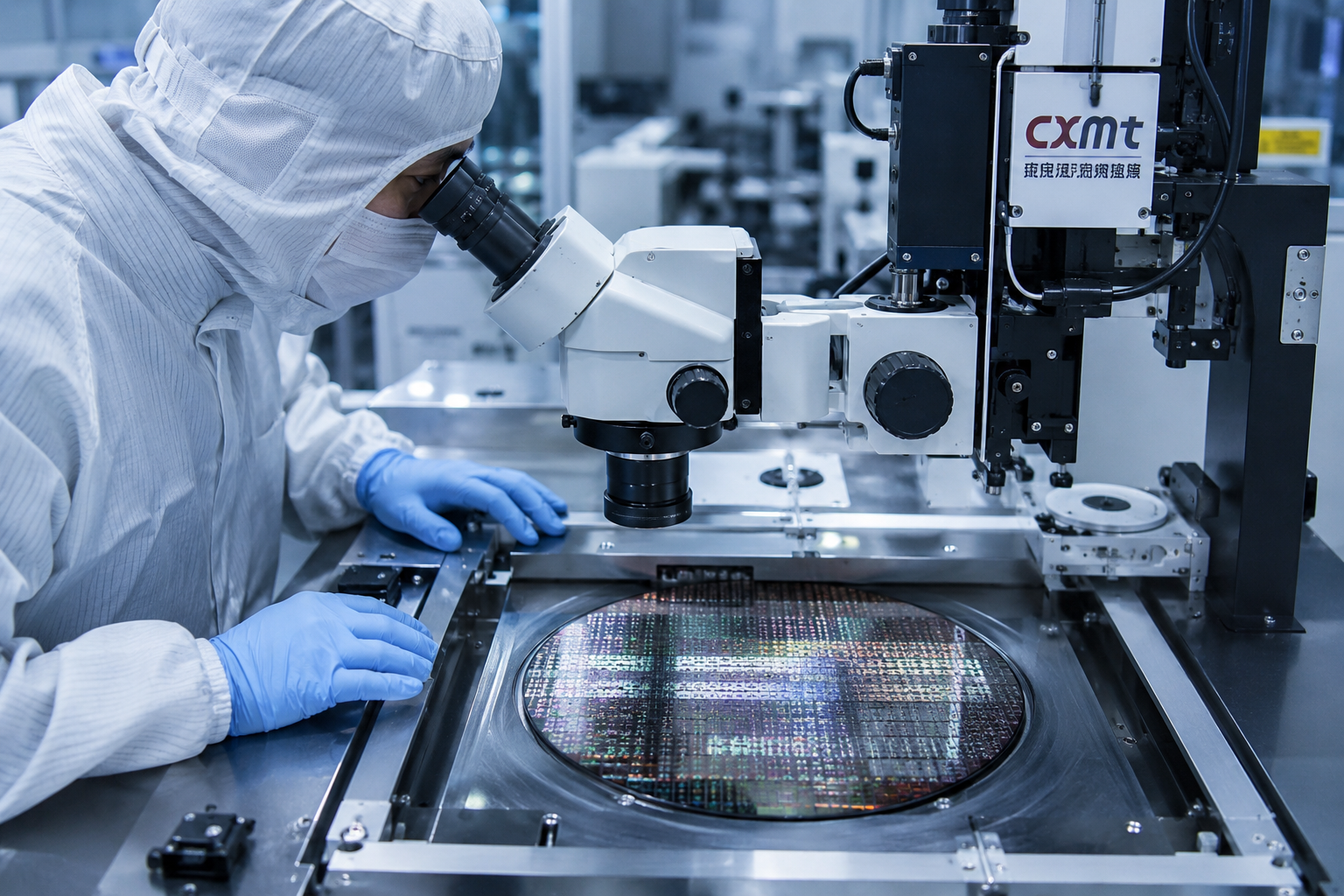
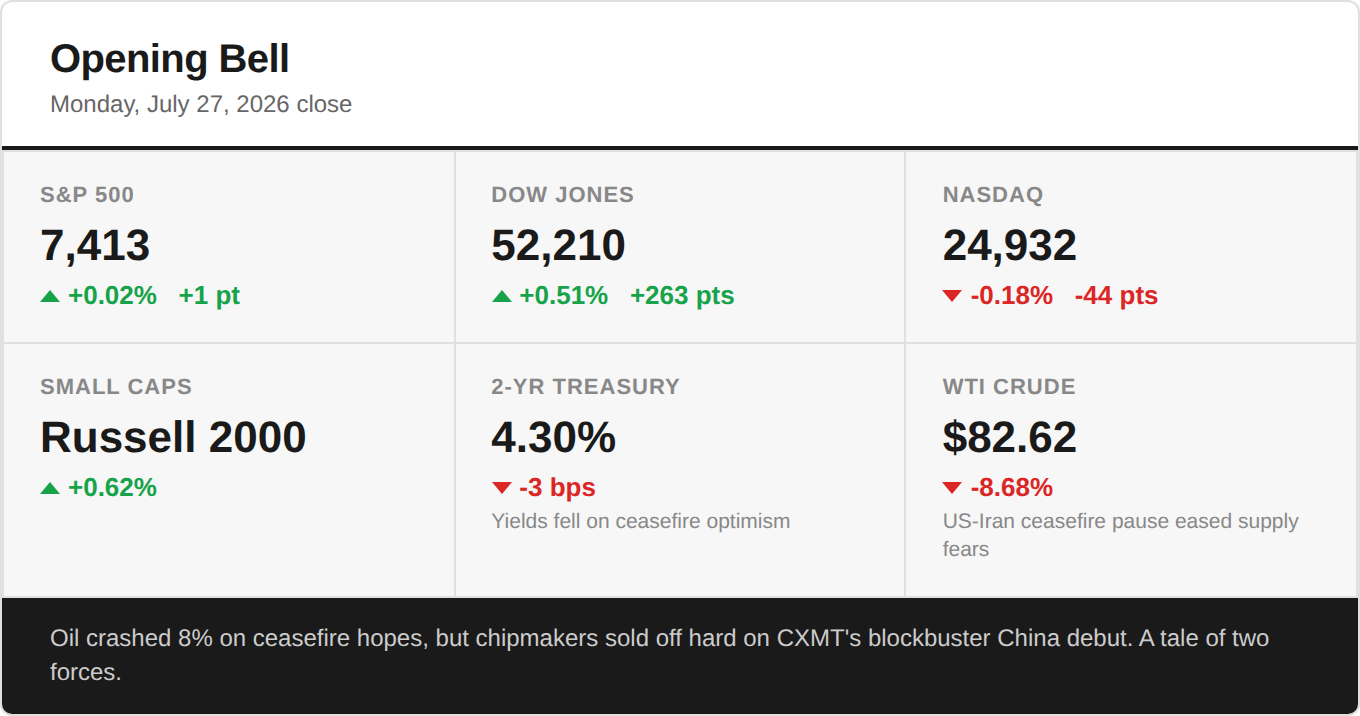
- CXMT's $488 billion debut. Chinese memory chipmaker ChangXin Memory Technologies surged 466% on its first day of trading in Shanghai, closing at 49 yuan against an IPO price of 8.66 yuan. The debut made CXMT China's most valuable listed company, surpassing ICBC at a valuation of roughly 3.3 trillion yuan. The company raised $8.6 billion in Asia's largest IPO of 2026, with institutional demand exceeding 500 times the shares offered.
- Memory massacre. Sandisk (SNDK) plunged 11% and Micron (MU) dropped nearly 5% as CXMT's debut signaled a structural shift in global DRAM pricing power. Nvidia (NVDA) also dropped 5% after reports that a Chinese company could mass-manufacture key chipmaking equipment, threatening the export-control moat that has protected Western chip incumbents.
- Oil's 8% plunge. WTI crude crashed over 8% to roughly $82 a barrel after the US and Iran paused military strikes over the weekend and both sides signaled openness to renewed diplomacy. Brent fell 6.3% to settle at $85.87. The drop boosted blue chips but did not offset the semiconductor selloff in the broader market.
3 Signals for Today
- Kospi contagion watch. South Korea's benchmark index crashed over 10% overnight, triggering a 20-minute circuit breaker halt, its eighth this year. Samsung fell 12%, SK Hynix 12.7%. US semiconductor futures are lower. Watch for spillover at the open.
- Consumer confidence drops today. The Conference Board releases its July consumer confidence index this morning. With oil prices up roughly 20% this month and grocery inflation still elevated, any sharp deterioration could set the tone ahead of the Fed decision tomorrow.
- A packed 72 hours. The FOMC two-day meeting begins today, with the rate decision due Wednesday at 2pm ET. MSFT and META report after close Wednesday. The PCE inflation print, the Fed's preferred gauge, lands Thursday morning. AAPL and AMZN report Thursday evening. This is the most consequential 72-hour stretch of the quarter.
AI's "All In" Moment
In the dot-com days, former Wall Street money manager Alexander Green bought Apple under $1. Netflix at $1.62. Amazon under $2. (Split adjusted.)
Now he's doing the same with AI.
And he says it's the biggest opportunity he's seen in 40 years.
Every few decades, a window opens that can change your financial life forever.
And with that out of the way, let's get to today's big story: how one IPO in China sent shockwaves through an entire country's stock market 6,000 miles away.
The Sip
The Hottest Market on Earth
In early 2025, South Korea's stock market was the trade that nobody was talking about.
The Kospi had spent years in the shadow of Wall Street's AI rally. Korean equities were cheap, under-owned by global funds, and dismissed as a geopolitical risk play sandwiched between China and Japan. The so-called "Korea discount" was a staple of every emerging-market roundtable.
Then the AI boom arrived, and it changed everything.
You see, South Korea is home to two of the three companies that manufacture the memory chips powering every AI data centre on the planet: Samsung Electronics and SK Hynix. As demand for high-bandwidth memory surged, so did their revenue, their margins, and their stock prices. The Kospi rose roughly 75% in 2025 and climbed another 50% into early 2026, making it one of the best-performing major markets in the world.
Retail investors poured in. Margin debt is at 33 trillion won, roughly $22.6 billion. Seoul's stock market had gone from being the one that global investors ignored to the one they couldn't get enough of.
Except here was the problem. The Kospi wasn't really a diversified stock market anymore. It was, in effect, a leveraged single-sector bet dressed up as a national index.
The Day It All Broke
On Monday, July 27, a company called ChangXin Memory Technologies, or CXMT, debuted on Shanghai's STAR Market. It had raised $8.6 billion in Asia's largest IPO of 2026. The stock surged 466% on its first day of trading, closing at a valuation of roughly $488 billion and making it China's most valuable listed company, surpassing even the Industrial and Commercial Bank of China.
The Verdict Is In for AI Stocks in the second half of 2026

The AI trade that made the Mag 7 soar is starting to crack.
Overpriced giants like Nvidia, Tesla, and Amazon are facing slowing returns — just as smaller, lesser-known names are positioning to take market share.
Waiting could be costly.
Three under-the-radar AI stocks are already showing the potential to outperform the Mag 7 in the second half of 2026.
Make sure these alternatives are on your radar before markets open tomorrow.
That's a staggering number. But what made CXMT's debut seismic was not the pop. It was the signal.
CXMT is China's largest domestic DRAM manufacturer, the fourth-largest in the world by shipments, with roughly 9% of the global market. Its first-quarter revenue had surged more than 700% year-over-year to $7.5 billion. And all of this was built in under a decade, in Hefei, a city most global investors could not find on a map, under US export controls specifically designed to prevent this exact outcome.
Here is the part that matters for investors. CXMT is still two to three generations behind Samsung and SK Hynix in high-bandwidth memory, the premium chips that power Nvidia's AI accelerators. But standard DRAM, the commodity memory that goes into servers, smartphones, and PCs, is a different story. CXMT's volume in that segment is growing fast enough to reshape global pricing. And pricing is the only thing that matters in a commodity business.
The market read it instantly: China's memory chip industry is no longer a punchline. It is a pricing threat.
And the first casualty was not an American company. It was South Korea.
Circuit Breaker No. 8
By Tuesday morning, the Kospi had plunged over 10%, falling to its lowest level since April. The decline was driven by major memory-chip producers Samsung Electronics and SK Hynix, which together represent roughly half of the Kospi's total market capitalization.
A Level 1 circuit breaker was triggered, the eighth such halt this year, suspending all trading for 20 minutes. Samsung fell 12%. SK Hynix dropped 12.7%.
The selling was not irrational but mechanical.
When an index is this concentrated in a single sector, and when retail investors have funded their positions with borrowed money, any shock to the thesis triggers a chain reaction. Prices fall. Margin calls go out. Forced selling pushes prices lower. More margin calls follow. The index doesn't just decline but collapses under its own weight.
"The Kospi's decline reflected market concerns over intensifying competition from China and a potential shift in the global memory chip supply chain," analysts at Mirae Asset Securities wrote Tuesday.
And this is the part that most coverage misses. The Kospi's problem is not that CXMT went public. The Kospi's problem is that it became a single-sector ETF without the risk controls of one.
Hidden in Tesla's Filing: A $12 Billion "Super Startup"
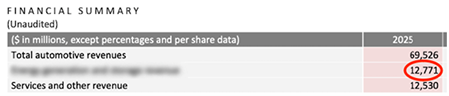
Pull up Tesla's most recent SEC filing. Page 5.
And you'll see a single line showing $12 billion in revenue from a brand-new "super startup" Elon Musk has been quietly incubating inside Tesla.
This new "super startup" has nothing to do with cars or robots or space or AI…
But it sits at the center of what Blackstone calls "a $23 trillion investment opportunity."
And on Oct 21st, Elon is expected to pull back the curtain and reveal exactly what he's building.
But Adam O'Dell already knows… and he reveals it all in this urgent video.
The Real Lesson
What happened in Seoul this week is not unique to South Korea. It is the logical endpoint of what happens when a stock market becomes too dependent on a single narrative.
The US market is further from this kind of fragility, but the direction is the same.
The Magnificent 7 now account for an outsized share of the S&P 500's capitalization.
AI capex is the thesis driving earnings expectations for the largest companies on earth.
And if a credible competitor were to emerge from an unexpected direction, the same reflexive dynamics, concentration, leverage, forced selling, would apply.
Consider the irony. US export controls were designed to keep China from catching up in advanced chips. They may have succeeded in that narrow goal. But they also forced Beijing to pour resources into the segments it could compete in.
CXMT's Hefei campus was built with government backing and domestic supply chains. It did not need ASML's most advanced lithography machines to make commodity DRAM at scale. It just needed time and capital. It got both.
So yeah, South Korea is not a cautionary tale about memory chips. It is a cautionary tale about what happens when a national stock market's fortunes depend on one answer to one question: will AI demand for our products keep growing forever?
The moment that question gets complicated, so does everything else.
The MarketSips Takeaway
A stock market can become too successful for its own good. South Korea's Kospi turned the AI memory boom into a national bull run, but the concentration that powered the rally is the same concentration that makes it fragile.
CXMT's debut did not break the Kospi. It revealed what was already broken: a market where one sector's stumble becomes the entire country's crisis.
The US market should take notes. When the Magnificent 7 report earnings this week, the question is the same one Seoul just answered the hard way: what happens when the trade gets crowded?
What's your read? Is this a buying opportunity in Korean chips, or a warning about concentration risk everywhere? Hit reply and let us know.
Until then, sip slowly!
The Market Sip Desk


