


Moderna went into Wednesday priced like a company that had run out of ideas. It came out priced like a company that had just invented a new category of medicine. The strange part is that both descriptions can be true at the same time, and that is exactly the tension worth reading about today.
But before we get to that, a quick look at the tape and what matters today…
3 Movers in 3 Minutes
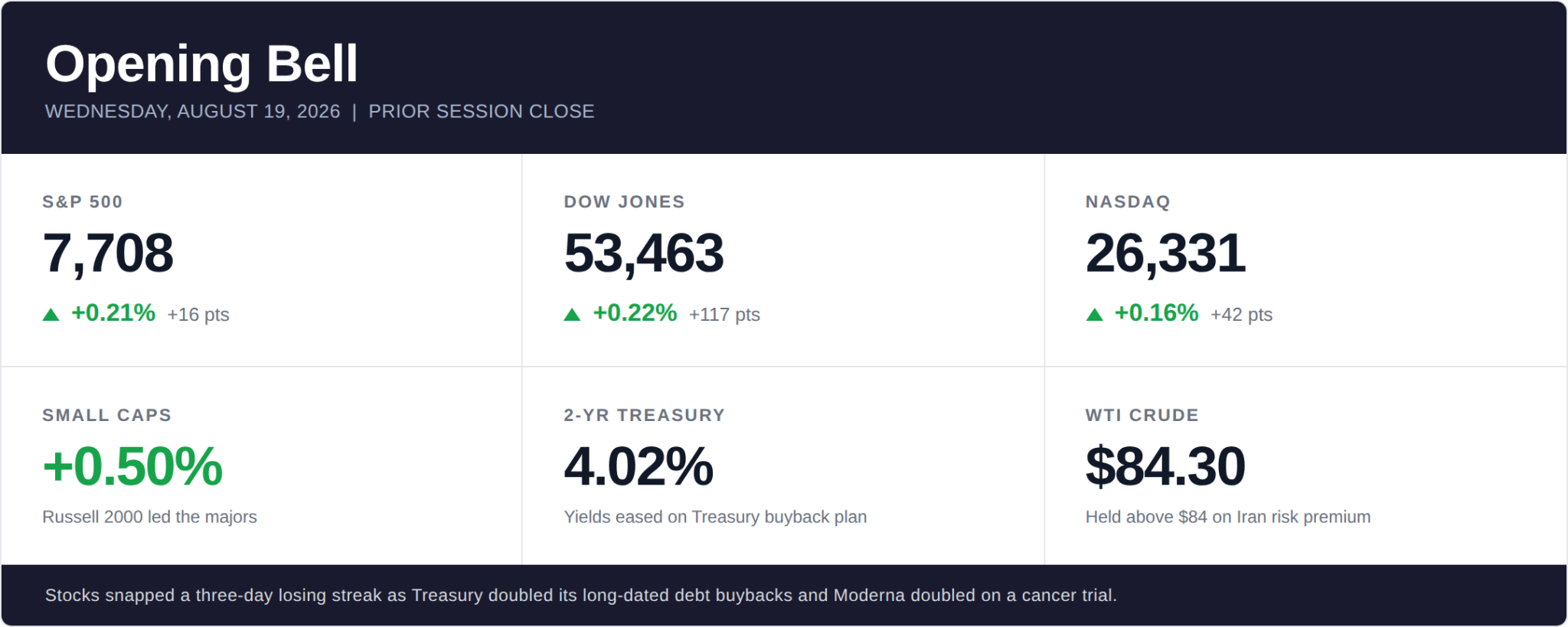
- Treasury blinks first. The Treasury Department said it would more than double buybacks in the 10-to-30-year part of the curve, sending long yields sharply lower. The 30-year yield fell 10 basis points to 5.18% and the 10-year dropped 5 bps to 4.65%. Read it as an admission that the auction market for duration has been on strike since June, and that someone finally had to step in as buyer of last resort.
- Target beats, then does the math on the beat. Target Corporation (TGT) posted Q2 EPS of $4.11 on revenue of $26.54 billion, roughly double consensus, and lifted full-year sales growth guidance to 5%. Comp sales rose 3.8%. Then came the footnote: $994 million of the quarter's earnings came from tariff refunds, not sold merchandise. Shares climbed anyway, but you can see the argument on both sides in one line.
- Unitree makes an entrance. Chinese humanoid robotics maker Unitree debuted on the Shanghai Stock Exchange up 629% intraday, a first-day move that priced the company well ahead of every listed robotics peer in the West. Whether it justifies that is a different question. The signal is that Chinese public markets are now willing to fund physical-AI capex at valuations US venture would balk at.
3 Signals for Today
Walmart Q2 earnings and the 8 AM call. Walmart Inc. (WMT) reports today with the conference call at 8 AM ET. After Target's tariff-refund tell, the read on grocery inflation and low-end consumer traffic is the number that moves the tape.
Jobless claims and Philly Fed at 8:30 AM ET. Two data points, both released together, both sensitive after last month's soft payrolls. Claims prints above 245,000 or a second consecutive negative Philadelphia Fed reading would revive the July dissent debate ahead of Jackson Hole.
Jackson Hole opens next week. The Kansas City Fed's economic symposium kicks off in Wyoming, with Fed Chair keynote. Every year the market says it doesn't expect much and every year it moves anyway. This year the setup is unusually loaded because the July FOMC saw three dissents in favor of a hike.
For 15 Consecutive Months, Physical Silver Has Been Leaving COMEX Warehouses at Volumes the Exchange Has Never Processed.
December alone: 65 million ounces. A single-month record.
All of 2025: 474 million ounces delivered — against 203 million the year before.
Silver has traded in backwardation. Buyers paying MORE for metal today than for a promise of metal next month.
Backwardation is the fire alarm of commodity markets. It only rings when people stop trusting the promise.
Silver's supply has run a deficit five years straight. The government stockpile that used to backstop it is gone.
The gold story gets the headlines. The silver story might be more violent — because the market is a fraction of the size and the exit door is smaller.
One junior miner is sitting on one of the highest-grade silver veins discovered in the last decade.
And with that out of the way, let's get to today's big story: how a company written off for dead just rewrote what "mRNA business" actually means.
The Sip
A stock priced like a mistake
Moderna Inc. (MRNA) went into Wednesday trading with a market capitalisation of about $10 billion, a fraction of the $200 billion peak it hit during the pandemic. The company had cut its workforce, slashed its research budget, and spent most of 2025 explaining to investors why a business built on one product needed a second act. Bears had a simple thesis. COVID demand had collapsed. The RSV vaccine was underperforming. The flu-COVID combo was stuck in front of a hostile regulator. Every credible pipeline candidate was years away.
Then the tape opened and the stock rose over 150% intraday. Merck & Co. (MRK) climbed too, though far more modestly. The move added more equity value to Moderna in eight hours than the company had accumulated in the previous eighteen months.
The trigger was a single press release about a single trial in a single cancer. Read at face value that sounds like the sort of biotech move that fades by Friday. Look closer and it is something structurally different.
What the trial actually did
The Phase 3 INTerpath-001 study enrolled 1,137 patients whose melanoma had been surgically removed. Half received Merck's blockbuster Keytruda, the standard of care after surgery. The other half received Keytruda plus a Moderna-made drug called intismeran autogene. That second drug is where the story lives.
Intismeran is not a vaccine in the way anyone thinks of vaccines. It is not a flu shot with a fresh strain, and it is not a booster off a shared template. Every single dose is manufactured for one specific patient. The company sequences that patient's tumor, identifies up to 34 mutations unique to that tumor, and then prints an mRNA strand that trains the immune system to hunt those specific mutations and nothing else. Two people with the same diagnosis on the same day at the same hospital get two entirely different drugs.
The trial met its primary endpoint. Patients on the combination stayed cancer-free longer, and the cancer spread to distant organs less often. Merck said the improvement was statistically significant and clinically meaningful. For melanoma patients after surgery, this is the first therapy in modern oncology to beat Keytruda monotherapy in the adjuvant setting.
That alone is news. But it also happens to be the first positive Phase 3 readout in history for an individualised neoantigen therapy, and the first ever for an mRNA-based cancer treatment. The William Blair note on Wednesday called it a validation of the mRNA cancer approach across oncology. RBC used the same word. Analysts do not use "validation" casually.
The reframe hiding underneath the price move
Here is where most of the coverage stops and where the real story begins. Moderna's mistake, in the eyes of the market for the last three years, was thinking of itself as a vaccine company. Vaccines are a scale business. You need billions of doses of the same product at a low unit price to make the economics work, and outside of a pandemic you cannot get billions of doses of anything.
FREE Gold Ticker to Buy ASAP: (NYSE:___)
Jim Rickards – the world’s #1 gold expert – has just revealed one of his favorite gold plays… 100% FREE

As Jim sees it, we’re witnessing the biggest gold boom of the last 100 years – and those who keep their money on the sidelines are missing their chance at a fortune thanks to gold’s epic run.
But smart investors who get in now, could make 10X their money in the coming months.
The mRNA business the market kept trying to model was the wrong business.
Intismeran flips that model. There is exactly one patient per dose, one dose per manufacturing run, and one price per patient. Analysts modelling peak sales use figures in the range of $200,000 to $400,000 per course, which is unremarkable by modern oncology standards. Vertex charges $2.2 million for its sickle-cell gene therapy. CAR-T cell therapies are priced in the same zone. Personalised medicine is not a discount business. It never has been.
What Moderna proved on Wednesday is not that mRNA works. It proved that the manufacturing platform for individualised, made-to-order medicine can survive a Phase 3 trial without collapsing. That is the harder problem. Genentech in the 1980s solved the manufacturing question for biologics and unlocked forty years of margin. This is a version of the same moment, one layer more customised.
Why this matters beyond one stock
The immediate second-order effect sits inside Moderna's own pipeline. The INTerpath programme has nine Phase 2 and 3 trials running across melanoma, non-small-cell lung cancer, bladder cancer, and renal cell carcinoma. A Phase 2 readout in kidney cancer is expected by year-end and could be registrational. If one of those hits, the story is no longer about melanoma. It is about a platform.
The third-order effect sits in every biotech that has been sitting on personalised medicine research and getting told by investors that it wasn't a real business. That call just got harder to make. Somewhere on Wednesday afternoon, a mid-cap oncology CEO looked at the Moderna tape and started rewriting a board deck.
The risk, and it is real, is that we still do not have the detailed efficacy numbers. The companies withheld the specific hazard ratios and will present them at a medical conference. Pricing has not been announced. Payors have not weighed in. And Keytruda alone remains a very good drug, which means the combination has to be meaningfully better, not just directionally better, to justify the added cost.
None of that undoes what Wednesday changed. The market has spent three years pricing Moderna as a failed vaccine story. It woke up Thursday morning holding a personalised oncology platform, and it will spend the next several quarters figuring out what that is actually worth.
On September 8th, a powerful new law signed by President Trump
will trigger a radical shift in America’s money system...
When a small group of private companies — not the Fed — will perform a major mint of a new kind of money.
And those who act before this new system fully kicks in could see gains as high as 40X by 2032.
But those who fail to prepare will be blindsided by this sea change to the U.S. dollar.
Go here now for the details — before the September 8th mint hits the market.
The MarketSips Takeaway
The biggest mistake in reading Wednesday's tape is to treat it as a biotech gap-up that will mean-revert. It might. Single-day moves this large usually give some back. But the underlying idea has changed, and the idea is what pays for years.
Watch the RCC readout at year-end, watch Keytruda pricing dynamics, and watch which mid-cap biotechs quietly get re-rated over the next six weeks. The Moderna story is now the tell for a whole subsector.
Today's reply prompt: What's the biggest question you have about the Moderna trial that today's headlines aren't answering?
Until then, sip slowly!
The Market Sip Desk


