


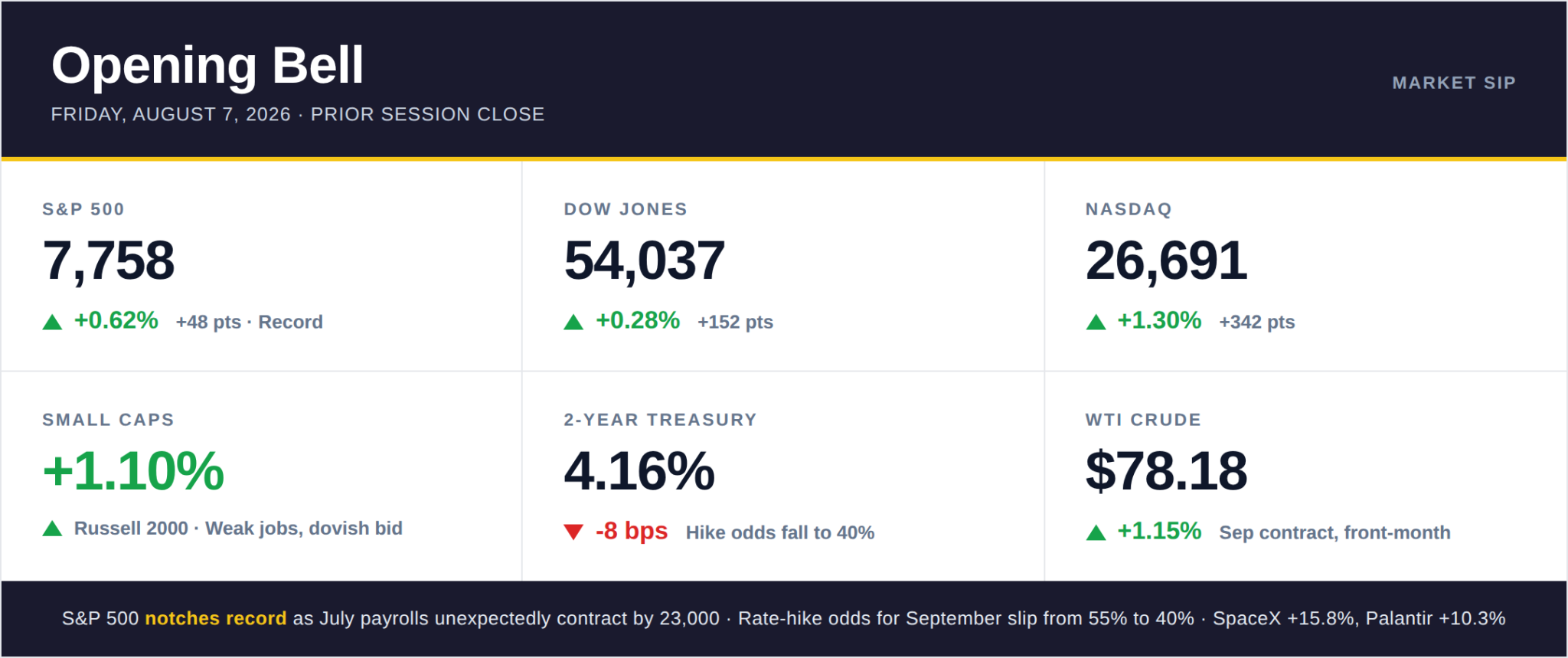
The S&P 500 closed at a record on Friday because 23,000 jobs vanished. That should tell you something is off about the story markets bought at 4pm. Sometimes the number that moves the market isn't the number that matters.
But before we get to that, let's take a quick look at the markets and what matters…
3 Movers in 3 Minutes
- Palantir surges again. Palantir Technologies (PLTR) jumped 10.3% on Friday, extending a week-long rally that began with a Q2 revenue beat and a raised 2026 outlook. The company is now one of the ten most valuable names in the S&P 500 and the loudest evidence that "AI plus government contracts" is a category the market is willing to pay any multiple for.
- Ad-tech breaks. The Trade Desk (TTD) plunged roughly 29% after issuing its first-ever forecast of a revenue decline and drawing a wave of analyst downgrades. Pair that with AppLovin (APP) down double digits after guiding Q3 adjusted EBITDA below consensus, and the message is clear: the "AI ad platform" trade is being priced very differently for the incumbents than for the challengers.
- Fintech gets a haircut. Fiserv (FISV) is nursing a 12% two-day loss after slashing 2026 adjusted EPS guidance to $7.20-7.40 from $8.00-8.30 and CEO Takis Georgakopoulos calling this "a transition year with noise." Argentina's macro drag, slower client onboarding, and a weaker hardware environment did the damage. Adjusted operating margin narrowed from 39.6% a year earlier to 31.8%.
3 Signals for This Week
CPI, Wednesday. July inflation prints at 8:30 am ET on August 12, and it lands into a market that just repriced the Fed hike odds from 55% to 40% on the back of Friday's jobs miss. A hot number reopens the September hike debate. A cool one confirms the "soft landing" trade the S&P closed at. There is no boring outcome.
Cisco, Applied Materials, Deere earnings. Cisco Systems (CSCO) reports Wednesday. Applied Materials (AMAT) and Deere & Co. (DE) report Thursday. Between them: a read on enterprise AI capex conversion, semiconductor equipment demand out of Taiwan and Korea, and how much pain the ag economy is really absorbing.
Retail sales and Michigan sentiment, Friday. July retail sales at 8:30 am and preliminary Michigan consumer sentiment at 10 am. The July jobs report suggested the consumer is losing income. These two prints tell you whether they've noticed yet.
The Market Is Already Looking Beyond the Mag 7
The Magnificent Seven reshaped the market, but leadership rarely stays concentrated forever.
As these giants mature, history shows leadership rotates toward companies with growing cash flows and scalable business models.
Our analysts believe that shift is already underway.
That’s why they created These 7 Stocks Will Be Magnificent in the second half of 2026, a FREE report highlighting the next group positioned to step into market leadership.
And with that out of the way, let's get to today's big story: why Friday's record close may have been priced on a number that no longer means what markets think it means.
The Sip
The number that moved the market
On Friday morning at 8:30 am, the Bureau of Labor Statistics reported that the American economy lost 23,000 jobs in July. It also revised May and June down by a combined 103,000. The unemployment rate ticked down to 4.1%.
Markets celebrated. The S&P 500 closed at a record. The 2-year Treasury yield fell eight basis points. Fed hike odds for September dropped from 55% to 40%.
The trade was clean: weak jobs equals a patient Fed equals higher stocks. A familiar rhythm.
Except this rhythm depends on a very old assumption. And that assumption may no longer be true.
Landmark Executive Order 14241 Unleashes
TRUMP’S NEW DOLLAR
Republican or Democrat – whether you support or oppose Trump’s New Dollar – every American could soon be forced to use it

Discover three critical moves to help you prepare, before it’s too late
The number nobody mentioned
Here is the second number in Friday's report, the one that did not lead any headline. The unemployment rate did not fall because more Americans got jobs. It fell because more Americans stopped looking.
In June alone, 720,000 people left the labor force entirely. The steepest drop came from prime-age workers between 25 and 54, the group that forms the backbone of American output and almost never sits idle by choice. Their participation rate is now at its lowest since December 2023.
Zoom out and the picture gets darker. There are now 105.8 million Americans "not in the labor force", a record. That figure is higher than at the peak of the Great Recession. Higher than at the depths of COVID. Higher than at any point since the BLS began tracking it. The pool of Americans able but not employed has swelled to the size of the working population of Germany and France combined.
Labor economist Nicholas Eberstadt calls it "the flight from work." The Indeed Hiring Lab, in a paper that framed this year's data, calls it "the Great Mismatch" and now projects the US labor force will decline by roughly 5.9 million workers between 2025 and 2032 before partially recovering. That is not a business-cycle number. That is a demographic and behavioral break.
The Fed's dual mandate assumes labor market softness comes from weak demand, the classic cyclical enemy. Rates cut, hiring resumes, the cycle turns. But this softness has a different source. Retirees are exiting faster than the pipeline can replace. Immigration flows have narrowed sharply. Prime-age workers are giving up because, in the words of one CNBC interview subject, the market "wore them down." And a generation of entry-level workers is watching their first-rung jobs get reshaped or erased by AI, with employment for software developers aged 22 to 25 down nearly 20% since late 2022 even as older developers in the same firms grew 6 to 12%.
Rate cuts do not fix any of that. Rate cuts fix demand. This is a supply problem.
The market cheered a data point that means one thing under old assumptions and something very different under new ones.
The Fed's silent tool failure
Japan learned this lesson slowly, then all at once. Its working-age population peaked in 1995. The Bank of Japan spent the next 30 years trying every trick in the monetary playbook: zero rates, quantitative easing, negative rates, yield curve control. None of it produced sustained wage growth or reflation. Because when the arithmetic of the workforce is shrinking, cheaper money does not create workers. It just inflates the assets held by the people who already had them.
This is the trap the American labor market might be edging toward. And it is why Friday's celebration might be premature.
If workforce softening is supply-driven, the inflation story does not get easier. It gets harder. Fewer workers meeting the same consumer demand is a wage-pressure setup, not a wage-cooling one. And if the Fed reads the July print as a cyclical signal and starts cutting, it risks pouring monetary stimulus onto a structural problem that stimulus was never built to solve.
The Fed's nine-to-three hold vote last week, with three members dissenting toward hiking, starts to look less like caution and more like a group of policymakers trying to hedge against an outcome they cannot yet name.
What Wednesday's CPI actually tests
This is why the July inflation print at 8:30am on Wednesday is not just another data release. It is a real-time test of which story Friday's rally bought.
If CPI comes in cool, the cyclical read wins. Rate cuts get pulled forward. Stocks extend. The soft-landing narrative gets another lease.
If CPI comes in hot, the market has to reconcile a shrinking workforce with sticky prices, and the September hike debate roars back to the front of the curve. The rally that just priced away a rate hike would have to price one back in.
Either way, the market's reaction on Friday assumed a version of the world that may not exist anymore. The unemployment rate is broken as a solo signal. Watch prime-age participation instead. It tells the truer story.
Could the AI Boom End Like the Dot-Com Bubble?
But one market statistic — praised by Warren Buffett as the best measure of valuations — is now flashing a historic warning.
It’s currently higher than it was at the peak of the Dot-Com Bubble.
If the signal proves accurate, the coming AI unwind could shake the entire market.
See the alarming stat — and what investors should do before the next crash unfolds.
The MarketSips Takeaway
Friday's rally rested on a comfortable read: weak jobs, patient Fed, buy stocks. But the Bureau of Labor Statistics did not publish a report about slowing demand. It published a report about a shrinking labor force. Those are different economic problems with different policy tools, and only one of them is fixable at 3.50-3.75% Fed funds.
The tell for the next twelve months is not the headline unemployment rate. It is what happens to labor force participation among 25-54 year olds. If it keeps drifting lower, the Fed does not have the tools for what comes next. And every rate move will make less sense than the last one.
Wednesday's CPI is the first checkpoint. Watch it closely.
Until then, sip slowly!
The Market Sip Desk


