


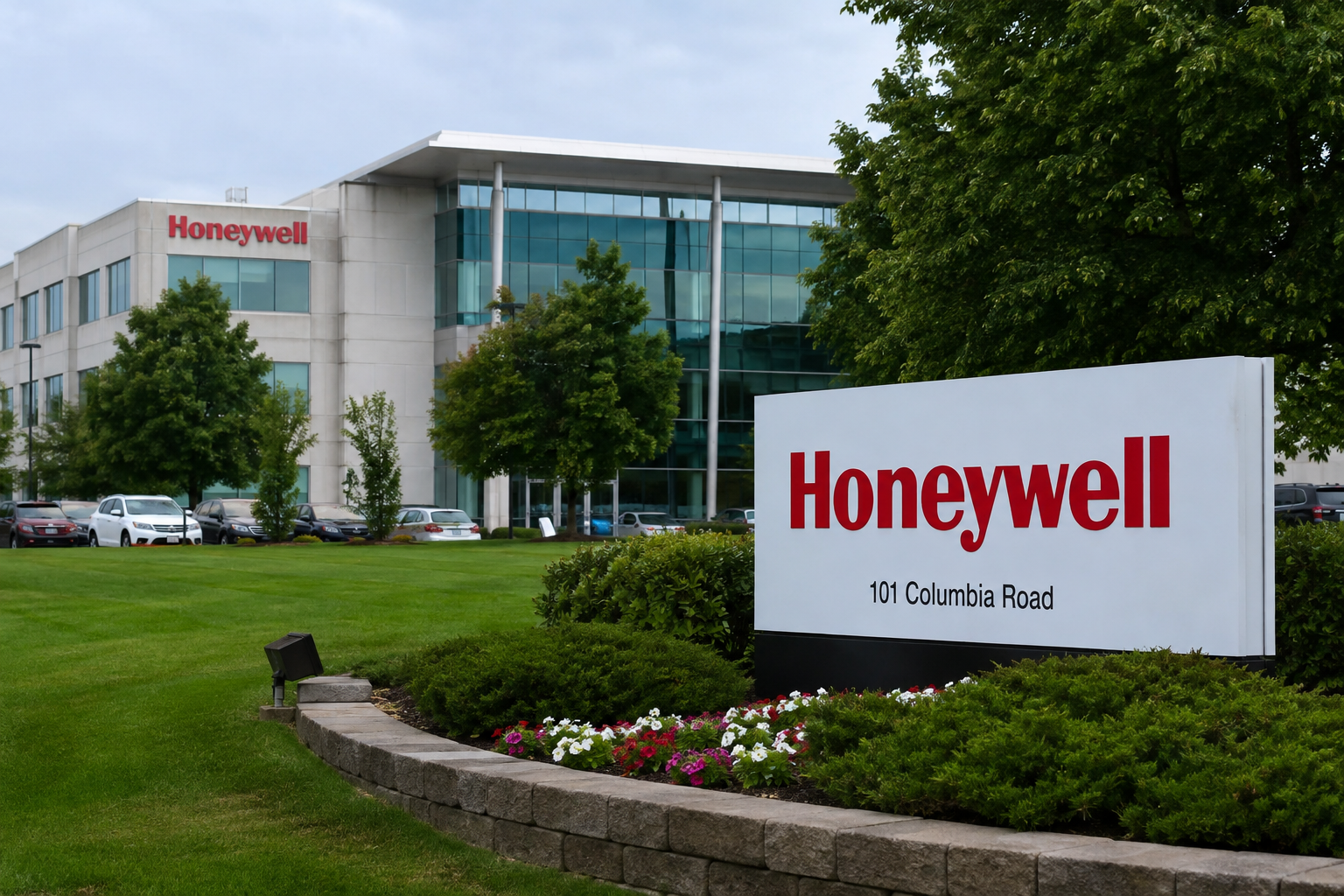
When General Electric split itself into three, shareholders made 220% and Wall Street declared the conglomerate dead. Every activist in America got the same idea. Elliott Management took a $5 billion stake in Honeywell and demanded the same surgery. Eighteen months later, the crown jewel reported its first earnings as a free company. It lost a fifth of its value before lunch. Turns out, some gems look brilliant because of the setting, not despite it.
But before we get to that, let's take a look at the markets and what matters today...
3 Movers in 3 Minutes
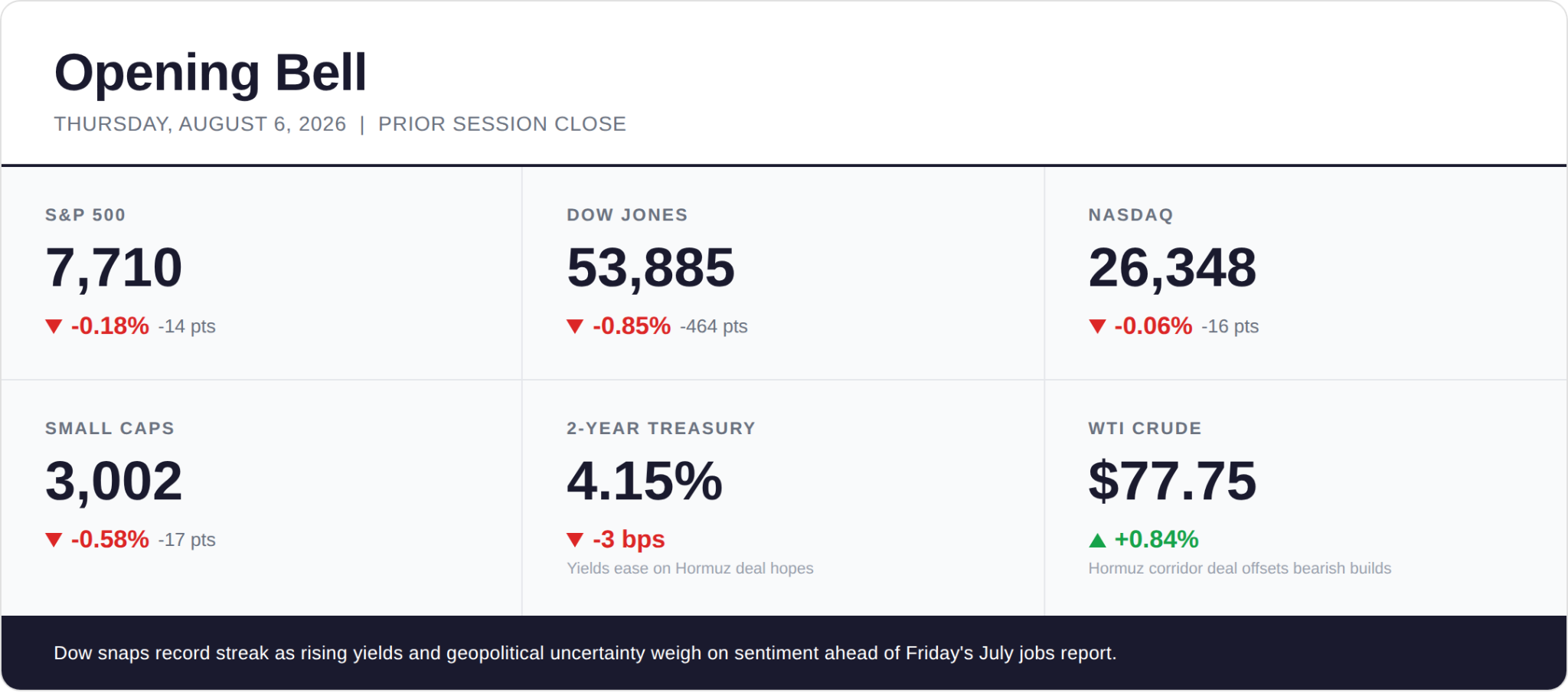
- Fiserv slashes outlook, stock drops 12%. Fiserv (FISV) cut its full-year adjusted EPS guidance to $7.20 to $7.40, down from $8.00 to $8.30, after second-quarter earnings missed estimates with adjusted EPS of $1.84 versus the $1.92 Wall Street expected. The payments giant's organic revenue contracted 5% in the quarter, and the stock has now lost roughly 60% over the trailing twelve months.
- SpaceX lockup expires, 900 million shares hit the market. The first post-IPO lockup on SpaceX (SPCX) expired Thursday, freeing more than 900 million insider shares for sale. The stock popped early but gave back most of its gains by the close as the overhang weighed on sentiment. SPCX has traded more than 17% below its opening-day price since its June 12 debut, even as retail investors have been net buyers every single day since listing.
- Energy leads the S&P 500 as oil jumps on the Hormuz corridor. Oil climbed after Iran and Oman reached a framework agreement for a shipping route through the Strait of Hormuz, boosting expectations of increased energy flows from the Middle East. ExxonMobil (XOM) gained nearly 2% and Chevron (CVX) added more than 1%, making energy one of only two S&P 500 sectors to finish in the green.
3 Signals for Today
- July Nonfarm Payrolls. Consensus expects 80,000 jobs added (prior: 57,000), but Wednesday's ADP print of just 44,000 has markets bracing for a miss. Unemployment is forecast to hold at 4.2%.
- Airbnb (ABNB) after-hours. The travel platform reported what it called its "strongest results in years" after Thursday's close. Markets will digest whether the beat signals broader consumer resilience or masks a Middle East travel headwind.
- S&P 500 Q2 earnings growth on pace for 47.5%. FactSet data shows that if the current rate holds, it will mark the second consecutive quarter above 20% growth and the seventh straight quarter of double-digit expansion. Forward P/E has actually fallen to 19.6, below the five-year average of 19.9, despite the index sitting near all-time highs.
The 7 Stocks Built to Outlast the Market
Some stocks are built for a quarter… others for a lifetime.
Our 7 Stocks to Buy and Hold Forever report reveals companies with the strength to deliver year after year - through recessions, rate hikes, and even the next crash.
One is a tech leader with a 15% payout ratio - leaving decades of room for dividend growth.
Another is a utility that’s paid every quarter for 96 years straight.
And that’s not all - we’ve included 5 more companies that treat payouts as high priority.
These are the stocks that anchor portfolios and keep paying.
This is your chance to see all 7 names and tickers - from a consumer staples powerhouse with 20 years of outperformance to a healthcare leader with 61 years of payout hikes.
The report is free for a limited time - go here to get it now.
And with that out of the way, let's get to today's big story: the aerospace spinoff that stumbled on its very first morning as a solo act.
The Sip
The Playbook That Changed Everything
In November 2021, General Electric announced what would have been unthinkable a decade earlier. The 129-year-old conglomerate, once the most valuable company on Earth, was splitting itself into three.
GE HealthCare spun out in January 2023. GE Vernova followed in April 2024. What remained was GE Aerospace (GE), the crown jewel: a pure-play jet engine and aviation services business that investors had been begging to own for years.
The results were staggering. GE Aerospace's stock rose more than 63% in 2024 alone. Cumulative shareholder return from announcement through year-end 2024 hit roughly 220%. CEO Larry Culp raised earnings guidance in every single quarter. Free cash flow gushed. The conglomerate discount didn't just disappear. It reversed into a premium.
Wall Street had its template. And every activist investor in America took notes.
The Diagnosis
Elliott Management was among them. In November 2024, the hedge fund disclosed a $5 billion stake in Honeywell International (HON) and published a letter with a simple thesis: do what GE did. Honeywell's aerospace division was the engine of the company, generating roughly 40% of its revenue and carrying the highest margins. But it was trapped inside a 119-year-old conglomerate alongside slower-growing automation and materials businesses. Separate it, Elliott argued, and each piece becomes worth more than the whole.
Honeywell's board agreed. In February 2025, the company announced it would split into three: aerospace, automation, and advanced materials. By May 2025, Elliott had a seat on the board. By June 29, 2026, Honeywell Aerospace (HONA) was trading on Nasdaq as a standalone company.
Analysts projected its value between $90 billion and $120 billion. The logic was clean. The precedent was proven. The GE playbook had worked once. Why not again?
Nvidia poured over $7B into this
Take a look at this…
|

It's a radical "light-speed" device that's turning AI as we know it into "Accelerated AI", making it 100 times faster and 100 times more energy efficient.
In fact, Jensen Huang, Nvidia's founder and CEO, says this device is shattering the limitations of AI and without it, AI can't scale.
If you want to discover what this technology is, why Nvidia is betting billions on it…
And the one stock we believe could be the biggest winner when "Accelerated AI" goes mainstream…
The Morning After
On Wednesday evening, August 5, Honeywell Aerospace published its first-ever earnings report as an independent company. And the numbers told a story nobody expected.
Revenue came in at $4.52 billion, up 5% year over year. Backlog climbed to $18.15 billion, up 9%. Orders rose 8%. By every demand metric, the business was healthy.
But adjusted earnings per share came in at $1.87, well below the $2.13 Wall Street expected. GAAP profits collapsed 71% to just $0.78 per share. Adjusted EBIT fell 7%. And then came the guidance cut: organic sales growth was slashed from 7% to 9% down to 4% to 5%. Full-year EBITDA expectations dropped by $300 million at the midpoint.
"For the second half of 2026, we believe it is prudent to align our guidance to our supply chain's demonstrated capabilities at the end of the second quarter."
That was CEO Jim Currier's way of saying: the factory floor can't keep up.
By Thursday morning, HONA had cratered as much as 24% intraday, hitting a 52-week low of $150.03 before stabilizing near $161. Roughly $13.5 billion in equity value evaporated in a single session. The EBIT midpoint fell by $300 million. The market punished the company by 45 times that amount.
What the Conglomerate Was Hiding
Here's the part that should trouble every investor watching the next corporate breakup. Honeywell Aerospace's problem wasn't demand. The backlog was growing. Orders were climbing. Airlines needed parts, militaries needed systems, and the aftermarket was humming.
The problem was supply. Specifically, the supply chain dependencies that were invisible inside the conglomerate.
When Honeywell was one company, its aerospace division could lean on shared supplier relationships, centralized procurement, and the balance sheet cushion of a $130 billion parent. If a tier-two supplier stumbled, Honeywell's scale gave it leverage to find alternatives, absorb delays, or cross-subsidize from healthier divisions.
Alone, HONA lost that buffer. The company disclosed it is now qualifying more than 50 new suppliers and plans to double spending on supplier tooling between 2025 and 2027. It is increasing the number of multi-sourced parts by more than 15% this year. These are the kinds of investments a standalone company must make from scratch, expenses that were previously shared.
The parallel with GE Aerospace is instructive but not in the direction activists hoped. GE Aerospace reported its own Q2 2026 results just weeks earlier: EPS of $2.02 beat estimates by 9%, revenue topped forecasts by nearly 7%, and management raised full-year guidance. CEO Larry Culp cited the same supply chain constraints as HONA but framed them as manageable headwinds, not existential threats.
Same industry. Same headwinds. Wildly different outcomes.
Louis: The "Strawberry Problem" Is Stalling the AI Revolution
Billion-dollar tech investor Louis Navellier calls it "AI's darkest secret." Until AI models solve the "Strawberry Problem," they'll never create new breakthroughs in medicine, energy, or quantum computing. The good news? One company is about to solve the crisis… unleashing a new $100 trillion opportunity.
This ad is sent on behalf of InvestorPlace Media at 1125 N. Charles Street, Baltimore, Maryland 21201. If you're not interested in this opportunity, please click here.
The Long Angle
The activist playbook of the last decade has been remarkably effective. GE's breakup created enormous value. 3M's split is underway. United Technologies unwound into Carrier, Otis, and Raytheon Technologies. According to RBC Capital Markets, a group of 12 industrial splits gained roughly 50% in the year after separation, outperforming the broader market.
But HONA's first earnings report introduces a question the spreadsheets don't capture: what does the crown jewel lose when you pull it from the setting?
The conglomerate discount is real. Investors are right that diversified companies often trade below the sum of their parts. But the conglomerate also provides something harder to price: structural resilience. Shared infrastructure. Negotiating leverage. Balance sheet depth that absorbs shocks the standalone cannot.
Honeywell's aerospace division wasn't being held back by its parent. In some ways, it was being held up by it.
That doesn't mean every breakup is a mistake. It means the thesis needs a harder stress test than "GE did it and the stock went up." The question isn't just what a division is worth alone. It's what it loses when it stands alone.
For the next wave of activist-driven splits, that distinction could be worth $13.5 billion.
The MarketSips Takeaway
The conglomerate discount is one of the most reliable trade setups in activist investing. But Honeywell Aerospace's first earnings remind us of a simple truth: discounts exist for reasons that don't always show up in the sum-of-the-parts model.
Watch the next round of industrial breakups closely. The question to ask isn't whether the division is valuable. It's whether the value survives the separation.
Today's reply prompt: Should companies resist activist pressure to break up, or is the value unlock worth the transition pain? Hit reply and tell us what you think.


