


Eli Lilly just posted $23 billion in quarterly revenue. Nearly two-thirds of it came from two drugs that do the same thing: make people less hungry. That kind of concentration would terrify most CEOs. Instead, Lilly's response has been to spend over $20 billion buying 11 companies in seven months. When a company diversifies at the exact moment it has never been more dominant, it is telling you something about how long it expects the dominance to last.
But before we get to that, let's take a quick look at the markets and what matters today...
3 Movers in 3 Minutes
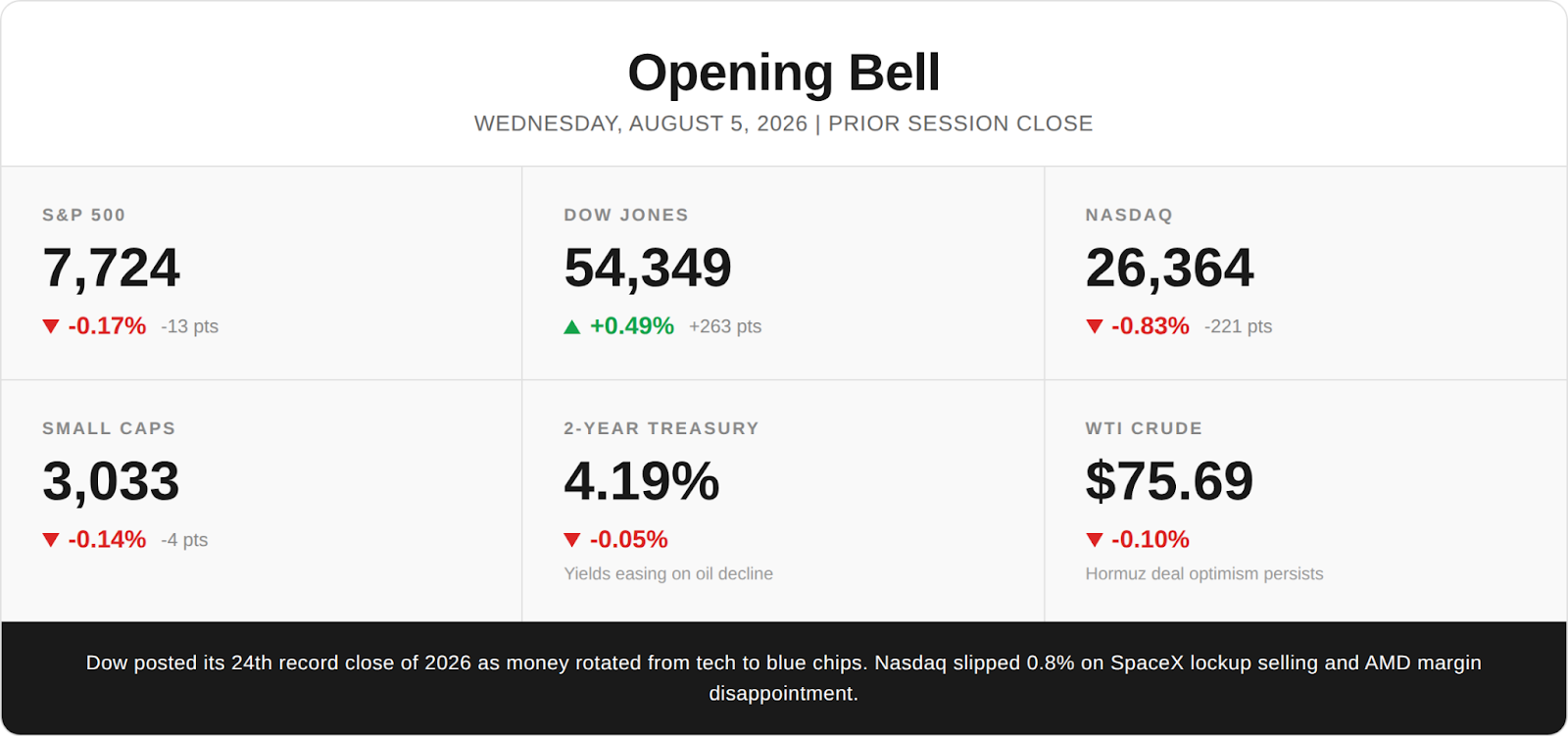
- AMD beats, drops 7%. Advanced Micro Devices (AMD) reported Q2 revenue of $11.54 billion, up 50% year-over-year, with adjusted EPS of $1.66, both above consensus. Data center revenue more than doubled to $6.72 billion. But shares fell 7% after gross margins came in at 54% versus the 56% Wall Street wanted, and investors decided a beat was not enough from a stock up 142% year-to-date. CEO Lisa Su projected data center sales would double by 2027, but the Helios AI chip ramp that underpins that forecast has yet to contribute meaningful revenue.
- Disney parks hit a record. Walt Disney Company (DIS) posted adjusted EPS of $2.06, beating the $1.86 estimate by 11%, while its Experiences segment hit a record $10 billion in quarterly revenue. Streaming operating income more than doubled to $712 million. The company raised its share buyback target to at least $9 billion for fiscal 2026.
- Gold surges 3.5%. Gold jumped to $4,298 per ounce, its highest level in nearly seven weeks, as diplomatic progress toward a 60-day Hormuz interim deal drove investors into safe havens on the view that lower oil prices would give the Fed room to pause. Crude oil, meanwhile, stabilized near $75.69 per barrel after two straight sessions of 5%+ losses.
3 Signals for Today
- Q2 Productivity Data (8:30 AM ET). The preliminary second-quarter productivity and unit labor costs report will be closely watched after the ADP employment number came in at just 44,000 on Wednesday, well below the 75,000 expected, setting a soft tone for labor data this week.
- ConocoPhillips (COP) and Airbnb (ABNB) report after the close. COP will show how America's largest independent E&P navigated the Hormuz-driven oil price whipsaw. ABNB will give a fresh read on consumer travel spending at a moment when savings rates are falling and credit card balances are rising.
- Friday's June payrolls loom. After Wednesday's ADP miss, the market's most important data point this week lands Friday at 8:30 AM ET. A weaker-than-expected nonfarm payrolls number could revive rate-cut speculation and test whether this earnings-driven rally has legs beyond corporate profits alone.
Wall Street just got a warning about the AI trade.
Nvidia's credit default swaps saw their biggest one-day jump on record, with the company losing $250 billion in market value.
Investors are starting to realize that AI needs more than chips.
It needs real human data.
That's where Mode Mobile has quietly built its edge.
Mode's EarnOS rewards users for everyday smartphone activity, creating a vast ecosystem of opted-in, first-party data with applications across advertising, commerce, and AI.
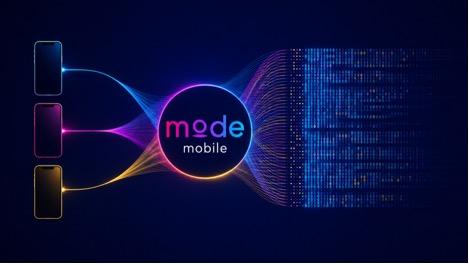
While others build AI infrastructure, Mode is building the data layer that powers it.
Their traction is hard to ignore:
● 490M+ total users
● 100M+ monthly active users
● $115M+ cumulative revenue
● $100M+ invested
Deloitte named Mode the #1 fastest-growing software company in North America after 32,481% 3-year revenue growth in 2023.
And pre-IPO shares are still available at $0.52, but only until August 14th.
Secure your shares at $0.52 before 8/14.
Disclosures *Please read the offering circular and related risks at invest.modemobile.com. *Mode cumulative revenue includes full year revenue of businesses acquired in 2025. Mode Mobile recently received their ticker reservation with Nasdaq ($MODE), indicating an intent to IPO in the next 24 months. An intent to IPO is no guarantee that an actual IPO will occur. The Deloitte rankings are based on submitted applications and public company database research, with winners selected based on their fiscal-year revenue growth percentage over a three-year period.
And with that out of the way, let's get to today's big story: why the most profitable quarter in pharma history is actually a warning sign.
The Sip
When Two Drugs Run the Show
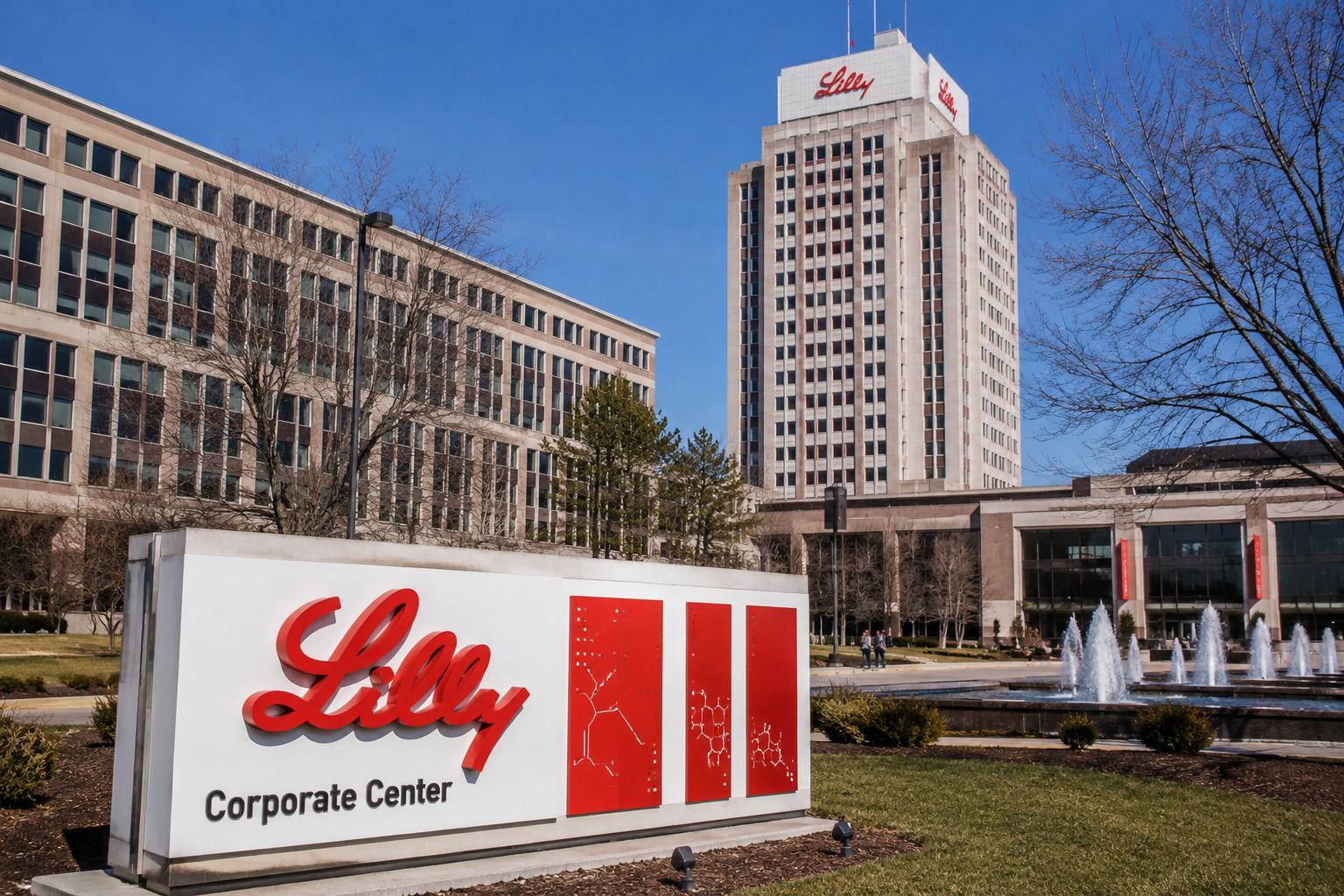
In 1876, a former Union Army colonel named Eli Lilly opened a small pharmaceutical laboratory in Indianapolis. His radical belief, that medicines should be manufactured with consistent quality rather than mixed haphazardly by local pharmacists, was considered borderline eccentric at the time. A century and a half later, the company bearing his name is worth over $1 trillion. It is the most valuable pharmaceutical company on Earth. And almost all of that value sits on top of two drugs.
On Wednesday, Eli Lilly (LLY) reported second-quarter revenue of $23 billion, up 48% from a year ago and roughly $2.4 billion more than Wall Street expected. Adjusted EPS came in at $8.38, beating consensus by 27%. The company raised its full-year revenue guidance to between $85 billion and $87 billion.
The engine behind all of it? Mounjaro and Zepbound, Lilly's diabetes and weight-loss injections, which together generated $14.9 billion in a single quarter.
That is more quarterly revenue than Netflix, Starbucks, or Goldman Sachs generated in their most recent periods. Two drugs. One biological mechanism. Ninety days. And that kind of concentration, in any industry, is either a triumph or a ticking clock.
The Prozac Playbook
Lilly has been here before.
In the late 1980s, the company launched Prozac, a drug that did not merely treat depression but effectively destigmatized it. Prozac became a cultural phenomenon, the subject of bestselling books and magazine covers, and it turned Lilly into one of the most profitable pharmaceutical companies in the world.
Then, in 2001, the patent expired. Generic fluoxetine flooded the market. Within three years, Lilly's revenue from the drug collapsed, and the company spent the better part of a decade searching for its next act.
"If we see great ideas that we think we can use to help people that need them, of course we'll do deals."
That quote comes from Lilly's chief scientific officer, Daniel Skovronsky, speaking about the company's current acquisition strategy. But the subtext is unmistakable. Lilly knows exactly what happens when your golden franchise runs out.
Forget SpaceX, Elon Is Now Powering the Next Hot IPO

While everyone was distracted by the SpaceX IPO, Elon Musk quietly started backing a NEW AI startup…
That has been called "the fastest-growing business in the history of capitalism."
Even though this has nothing to do with robots, self-driving cars, and rockets…
It's growing faster than Tesla… faster than SpaceX… and even 23 times faster than Nvidia.
The Shopping Spree
Which is why the most telling detail from Wednesday's earnings was not the revenue beat. It was the acquisitions.
Since January 2026, Lilly has completed or announced 11 deals totaling more than $20 billion. They acquired Orna Therapeutics (RNA medicines), Ajax Therapeutics (oncology), Centessa Pharmaceuticals (neuroscience), and Kelonia Therapeutics (gene therapy). They built an entirely new infectious disease portfolio from scratch through three additional purchases. They committed another $4.5 billion to expand manufacturing capacity in Indiana.
And then there is AtaiBeckley.
In July, Lilly agreed to acquire the psychedelics startup for $2.8 billion upfront, with up to $1 billion more tied to regulatory milestones. AtaiBeckley develops BPL-003, a psychedelic-based treatment for treatment-resistant depression.
The irony is hard to miss. Lilly invented Prozac and transformed how the world treated depression. Now it is betting billions on a psychedelics company, a class of treatment that would have been unthinkable when Prozac launched 40 years ago. The science evolves, and Lilly is making sure it evolves with it.
The Paradox of Abundance
Here is the tension investors are underwriting.
Lilly's free cash flow is projected to hit roughly $24 billion in 2026 and over $30 billion in 2027, thanks almost entirely to GLP-1 revenue. That gives the company the financial firepower to buy whatever it wants. But the very reason it needs to buy so aggressively is that 65% of its revenue comes from a single drug class that did not exist five years ago. The GLP-1 franchise is so dominant that any disruption, whether from generics, regulatory shifts, side-effect concerns, or a competitor with a superior molecule, would ripple through the entire company.
Lilly is not ignoring this. Retatrutide, its next-generation weight-loss candidate, just completed its Phase 3 clinical data package showing weight loss approaching bariatric surgery levels, and Lilly plans to file with the FDA in the first quarter of 2027. On July 1, the Medicare GLP-1 Bridge program launched, expanding coverage to 20 million eligible Americans and driving a 35% increase in patient access.
But even as Lilly deepens its GLP-1 moat, it is spending the windfall to build something broader. The $20 billion M&A spree is not a sign of confidence in permanent GLP-1 dominance. It is an insurance policy against the alternative.
The Long Angle
For decades, the pharmaceutical industry's business model was diversification through discovery. Companies maintained portfolios of dozens of molecules across multiple therapeutic areas, spreading risk so that no single patent expiry could cripple them.
Lilly has inverted that model entirely. It is generating so much cash from one class of drugs that it can afford to buy its way into oncology, gene therapy, psychedelics, and infectious disease simultaneously. The GLP-1 windfall is not the destination. It is the funding mechanism.
If it works, other pharma companies will follow the template: find one blockbuster franchise, extract maximum revenue during its window, and use the proceeds to acquire everything else before the window closes. If it does not work, we will look back at this quarter, $14.9 billion from two drugs in 90 days, as the high-water mark of the GLP-1 era, and a reminder that in pharmaceuticals, the biggest risk is never the drug that fails. It is the drug that succeeds so spectacularly that everything else becomes an afterthought.
The Verdict Is In for AI Stocks in the second half of 2026

The AI trade that made the Mag 7 soar is starting to crack.
Overpriced giants like Nvidia, Tesla, and Amazon are facing slowing returns — just as smaller, lesser-known names are positioning to take market share.
Waiting could be costly.
Three under-the-radar AI stocks are already showing the potential to outperform the Mag 7 in the second half of 2026.
Make sure these alternatives are on your radar before markets open tomorrow.
The MarketSips Takeaway
Eli Lilly's Q2 was the most profitable quarter in pharmaceutical history. But the company's own behavior, buying 11 companies in seven months for $20 billion, tells you that even Lilly does not believe this pace is permanent. Watch the M&A cadence more closely than the GLP-1 revenue line. When the buying slows down, it will either mean Lilly has built a diversified empire or that the cash engine powering the shopping spree has started to cool. Either way, the next twelve months will determine whether this was the beginning of a new era in pharma or its most expensive final act.
Until then, sip slowly!
The Market Sip Desk
Today’s reply prompt: Is the GLP-1 windfall a once-in-a-generation opportunity or a bubble waiting to pop?
📊The Market Sips Poll
What happens to Eli Lilly's stock price by the end of 2026?
- A) Breaks $1,200. The GLP-1 machine is unstoppable and the M&A pipeline adds optionality.
- B) Holds between $1,000 and $1,200. Great company, but the upside is priced in.
- C) Falls below $1,000. Too much concentration risk and the M&A spree dilutes focus.
- D) Depends entirely on retatrutide FDA filing. That is the only number that matters now.


