


Cisco Systems (CSCO) reported a record quarter last night. Revenue up 18%. AI infrastructure orders up 4.5x. Fiscal 2027 guidance well above the Street. The CEO used the phrase "networking supercycle." And the stock fell almost 5% after hours. Why? Because Wall Street has done this movie before, and it did not end well the first time.
But before we get to that, a quick look at the markets and what matters…
3 Movers in 3 Minutes
1. CoreWeave's inflection point. CoreWeave (CRWV) closed Wednesday up 19% at around $108 after reporting Q2 revenue of $2.58 billion, up 112% year on year, and a revenue backlog of $104.2 billion, up 246%. The number that actually moved the stock was not the revenue beat, which was less than 1%. It was the first real evidence that scale is finally producing operating leverage. Contracted power now sits at 4.2 gigawatts. The debt is still enormous, but the flywheel is spinning.
2. Super Micro's math problem. Super Micro Computer (SMCI) surged 19% to $37.6 after guiding fiscal 2027 revenue to $65 billion to $72 billion, roughly 30% above the Street's $52.5 billion consensus. Nine customers now contribute more than $1 billion each in annual revenue, up from four a year ago. The catch: gross margin hit 17.5%, a record, and the company now has to prove it can hold that margin while ramping shipments 35% quarter over quarter. Growth is the headline. Operating leverage is the actual test.
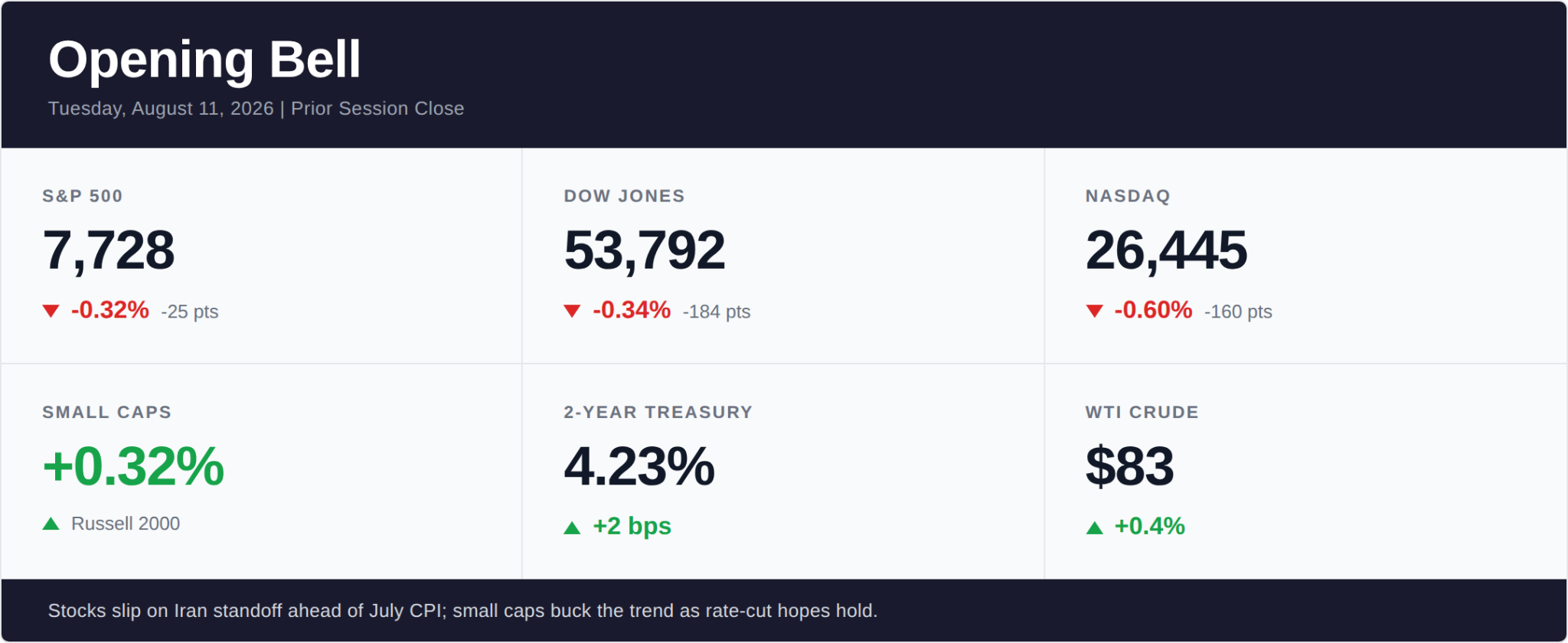
3. Inflation that did not bite. The July Consumer Price Index came in at 3.4% year on year, matching expectations and easing from June's 3.5%. Monthly inflation rose just 0.1%. Traders shifted bets toward a Fed hold at the September meeting from roughly 50-50 the day before. The 2-year Treasury eased three basis points to 4.20%. Boring number, meaningful market signal.
3 Signals for Today
July Producer Price Index this morning. Wholesale prices are the second half of yesterday's inflation story. A soft print all but locks in the September pause.
Applied Materials (AMAT) reports Q3 fiscal 2026 after the close. Consensus expects roughly $9 billion in revenue and $3.36 in EPS. What matters is the outlook on HBM memory equipment and advanced packaging tools. It's the earliest tell on how much hyperscaler capex is being converted into actual factory orders.
Weekly initial jobless claims today. After the July jobs report showed a 23,000 payroll drop against a forecast +83,000 gain, the weekly claims number is doing more work than usual. If claims start drifting higher, the Fed's dissent camp loses ground fast.
90% of AI Runs Through This Company
The biggest AI wins often come from companies you don’t hear about every day.
Case in point:
The database provider now embedded into the big three cloud platforms - with access to 90% of the market.
You’ll find the name and ticker of this newly-minted giant in our 7 AI Stocks to Invest in Today report, along with:
• The chip giant holding 80% of the AI data center market.
• A plucky challenger with 28% revenue growth forecasts.
• A multi-cloud operator with high-end analyst targets near $440.
Plus 3 other AI stocks set to take off.
And with that, on to today's story: the company that broke Wall Street's heart in 2000 is quietly rebuilding it.
The Sip
The number nobody expected
Fiscal 2025, Cisco booked about $2 billion in AI infrastructure orders from hyperscalers. Management thought fiscal 2026 might get to $5 billion. By the third quarter, they raised the goal to $9 billion. The actual final tally, reported Tuesday night, was $9.3 billion. About 4.5 times the prior year.
That is not a beat. That is a company that misjudged its own demand curve by half.
Revenue for the quarter hit $17.3 billion, up 18%. Networking product orders grew 40%, marking eight straight quarters of double-digit growth. Full-year revenue of $63.3 billion, up 12%. Management guided fiscal 2027 to $72.2 to $73.4 billion, implying 15% growth at the midpoint, with $7.5 billion of AI infrastructure revenue baked in.
CEO Chuck Robbins put a name on it on the call. "We believe the accelerating adoption of agentic AI is fueling a networking super cycle."
Then the stock fell 4.6% in after-hours trading to $118.
Where Wall Street lost its nerve
To understand the reaction, you have to remember what Cisco was in March 2000.
Back then, Cisco was the most valuable company in the world. Market cap north of $500 billion. The stock traded at 150 times earnings. Every mutual fund, every 401(k), every dentist's brokerage account owned Cisco. It was the pipe of the internet, and the internet was the future.
Then the bubble popped. Cisco lost roughly 88% of its value in the next 30 months. The company did not go bankrupt. Revenue kept growing eventually. The technology worked. What broke was the demand curve. Telecoms and startups had overbuilt fiber and switching capacity on the assumption that internet traffic would keep doubling every 100 days. It did not. What followed was a decade of dark fiber, empty racks, and a stock that traded sideways while the rest of tech ran laps around it.
Cisco has never reclaimed its 2000 peak. Not once, in 26 years.
For an entire generation of portfolio managers, Cisco is the shape of what happens when a supplier of picks and shovels gets confused with the gold miner. When Chuck Robbins says the word "supercycle" from a Cisco earnings stage, half of Wall Street reflexively reaches for the exit.
The problem is not that Cisco is wrong. The problem is that Wall Street's memory is longer than Cisco's runway.
Why this cycle is not that cycle
Here is the counterintuitive part. The 2000 crash was not really about the technology being bad. It was about demand being roughly a decade early. The fiber, the routers, the switches - they were all real. They just sat idle waiting for YouTube, cloud, mobile video, and streaming to catch up. When those arrived, they filled every bit of the "dark" capacity built during the bubble, and then demanded more.
Today's AI networking buildout starts from the opposite position.
The customers already exist. Alphabet (GOOGL), Microsoft (MSFT), Amazon (AMZN), Meta (META), and Oracle (ORCL) are collectively spending well over $400 billion in capex this year. They are not speculating on future demand. They are building for GPU clusters that are already sold to enterprise customers under multi-year contracts. Cisco's Q4 hyperscaler orders were $4 billion, and the Silicon One systems and 400G/800G optics inside them are shipping into projects that have known deployment dates.
The book-to-bill in the AI segment is running well above one. Which means Cisco is building backlog faster than it can convert it. That is what a healthy supply-constrained business looks like. In 2000, the opposite was true: Cisco was shipping into a demand vacuum masked by vendor financing.
There is also a structural point people miss. Nvidia (NVDA) owns the GPU. But every GPU cluster needs Ethernet fabric to connect the racks, optics to move photons between them, and switches to route the traffic. That is Cisco's home turf. For the first three years of the AI boom, the assumption was that InfiniBand and Nvidia's own networking would dominate. What changed is that the hyperscalers, faced with the prospect of a single-vendor lock-in on the most expensive infrastructure they have ever built, quietly pushed Ethernet back into the room. Cisco won.
What's Your Freedom Number?
It's the exact amount of monthly income you need to never worry about money again. Thanks to a revolutionary new investment it could help you reach YOUR number faster than you thought possible.
Long Angle
Every technology cycle has an "arms dealer" that eventually reprices. Sometimes it takes years. Sometimes it takes 26.
The Cisco reaction last night is really a story about two things happening at once. The company is having its best year of the century. And the market is still charging it a bubble-scar discount. That gap between operational reality and share-price memory is where the interesting investments usually live. Not because it always closes, but because when it does, the closing tends to be violent.
Whether Cisco is a $150 stock or a $118 stock a year from now is not the point. The point is that Wall Street has finally started to encounter a class of businesses where the AI capex thesis is measurable in shipped units, not slide-deck TAMs. Cisco is one. Applied Materials, reporting tonight, is another. The optical names are a third.
The question, as always, is not whether the supercycle is real. It is whether investors will let themselves believe the second one before it too becomes a warning story.
Iran War TRUTH:
What Was Revealed Behind Closed Doors

There’s a strategy behind the Iran war.
I know because I heard it directly in a closed-door meeting with a source whose connections run deep into global power networks.
He walked me through the real purpose and the massive deal tied to it.
The MarketSips Takeaway
The most dangerous phrase in this market is "we've seen this before." Sometimes you have. Sometimes what you're actually seeing is a different movie shot on the same set.
Cisco's $9.3 billion order book is the same technology story from 2000 with an entirely different customer base underneath. Watch how the AI capex debate reprices names that got left for dead the first time.
Until then, sip slowly!
The Market Sip Desk
Reply prompt: Which "left for dead" stock deserves a second look in the AI capex cycle?


