


Kevin Warsh was supposed to be the Fed chair who scared inflation into submission. He came in hawkish. He talked hawkish. He's on record saying inflation is a five-year failure that ends now. And on Wednesday, after keeping rates unchanged for the seventh straight meeting, he stood at the podium and declared - "There is no soft inflation target. There is no soft implicit target, not on this committee's watch. There's only a target, and it's 2%."
The bond market's response was immediate and merciless. The 30-year yield shot above 5.2%. That’s a level not seen since 2007.
The question the bond market is asking today is not whether Warsh believes it. The question is whether he'll actually do something about it.
But before we get to that, let's take a quick look at the markets and what matters...
3 Movers in 3 Minutes
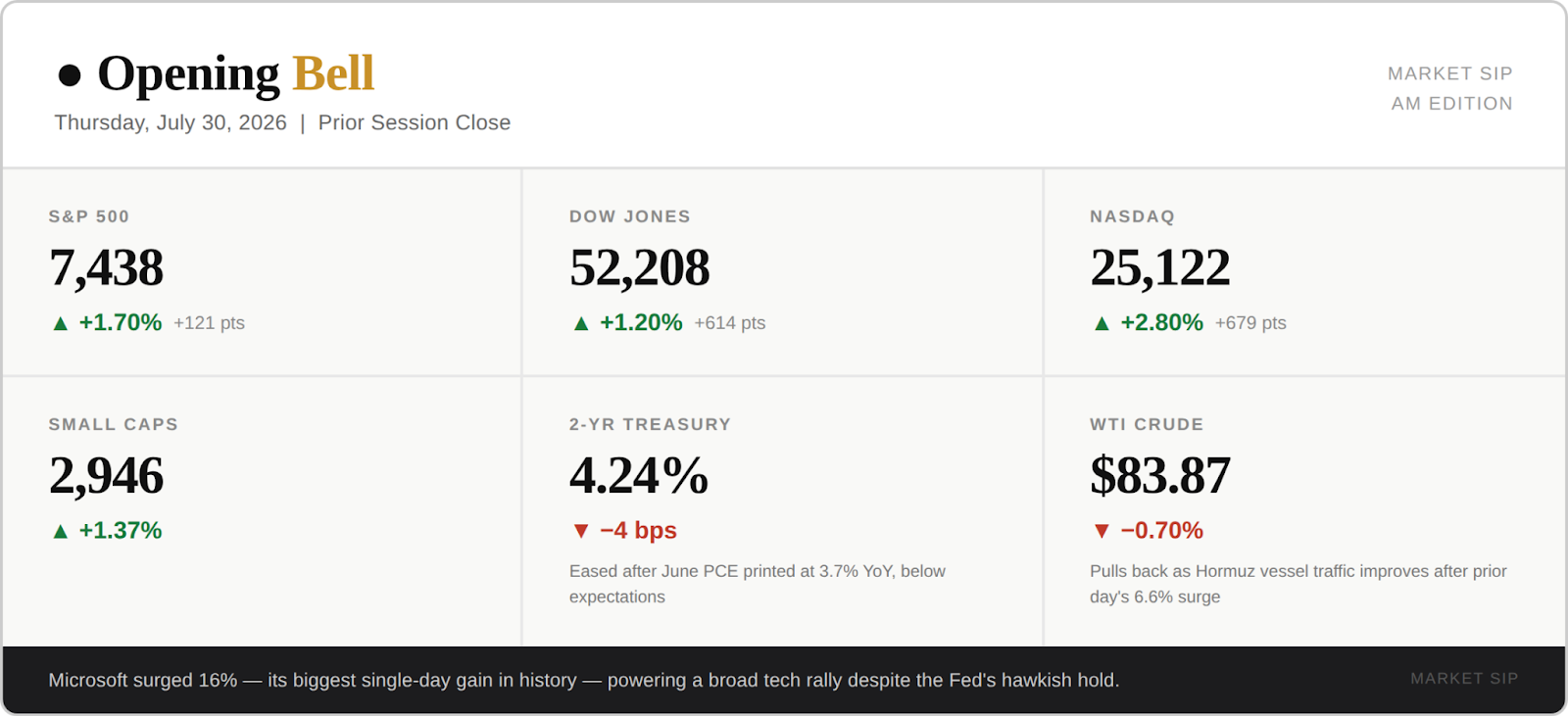
1. Microsoft (MSFT) adds $450 billion in a single day. The software giant jumped 15% Thursday (the largest single-session gain by any stock in history by market cap added) after reporting Azure cloud revenue growth of 43%, the fastest since the AI era began and comfortably above the 40.2% consensus. It was the validation trade: here, at last, was proof that $100 billion in AI infrastructure spend is generating proportional returns. Azure alone has now crossed $100 billion in annual revenue.
2. Amazon (AMZN) crosses $200 billion in quarterly revenue for the first time. AWS grew 37% year over year: its fastest pace in 18 quarters and blowing past the 31% analysts expected. Total revenue hit $200.6 billion, up 20%. CEO Andy Jassy said the company's AI and chips businesses each crossed $25 billion in annualized run rates. The catch: Amazon's capital expenditure on a trailing 12-month basis reached $169 billion, up 64%, while free cash flow swung to a $7.6 billion outflow. The company is spending to build, and the bill is only getting larger, with $220 billion in capex guided for the full year.
3. Apple (AAPL) beats on revenue, misses where it matters, and Tim Cook signs off. Apple posted fiscal Q3 revenue of $109.4 billion, up 16% and its best June quarter on record. EPS came in at $2.02, well ahead of the $1.89 consensus. But Services revenue missed at $30.7 billion against a $31.4 billion estimate, Greater China came in at $18.8 billion versus the $19.6 billion expected, and management flagged memory chip constraints hitting Q4 production. This was Tim Cook's final quarterly earnings call. After 15 years as CEO, he hands the reins to hardware chief John Ternus on September 1.
3 Signals for Today
- Employment Cost Index: The Q2 wage growth print drops this morning and lands directly in the Fed's inflation calculus. Warsh cited labor costs explicitly in his post-meeting remarks. A beat here significantly raises the odds of a September hike, currently priced at 59% by the CME FedWatch tool.
- Final Michigan Consumer Sentiment: The final July read on consumer confidence closes the week. After the Fed's hold triggered a bond sell-off and oil remains elevated near $84, any softness in consumer mood would confirm the inflation-tightening-cycle squeeze that bond vigilantes are pricing in.
- July Jobs Report: The next big macro inflection point is a week away. Initial jobless claims fell to 187,000 last week, the lowest since September 1969. A hot jobs print on August 7 would hand the bond market another argument for why Warsh needs to move, not just talk.
Wall Street Just Got a Warning About AI
Nvidia's credit default swaps saw their biggest one-day jump on record, with the company losing $250 billion in market value.
Investors are starting to realize that AI needs more than chips.
It needs real human data.
That's where Mode Mobile has quietly built its edge.
Mode's EarnOS rewards users for everyday smartphone activity, creating a vast ecosystem of opted-in, first-party data with applications across advertising, commerce, and AI.

While others build AI infrastructure, Mode is building the data layer that powers it.
Their traction is hard to ignore:
● 490M+ total users
● 100M+ monthly active users
● $115M+ cumulative revenue
● $100M+ invested
Deloitte named Mode the #1 fastest-growing software company in North America after 32,481% 3-year revenue growth in 2023.
And pre-IPO shares are still available at $0.52, but only until August 14th.
Secure your shares at $0.52 before 8/14.
Disclosures
*Please read the offering circular and related risks at invest.modemobile.com.
*Mode cumulative revenue includes full year revenue of businesses acquired in 2025.
Mode Mobile recently received their ticker reservation with Nasdaq ($MODE), indicating an intent to IPO in the next 24 months. An intent to IPO is no guarantee that an actual IPO will occur.
The Deloitte rankings are based on submitted applications and public company database research, with winners selected based on their fiscal-year revenue growth percentage over a three-year period.
And with that, let's get to today's story about the most powerful institution in finance that nobody elected.
The Sip
The Man Who Talked Tough
In January 1994, Alan Greenspan raised rates by 25 basis points and it was the first hike in five years. The bond market's response was biblical. 10-year Treasury yields surged from 5.7% to nearly 8% over twelve months, wiping out $1.5 trillion in bond market value globally, capsizing Orange County, and triggering a Mexican peso crisis.
James Carville, Bill Clinton's chief political adviser, watched all of it from the White House. The experience left him shaken in a way no political opponent ever had.
"I used to think that if there was reincarnation," he told, "I wanted to come back as the president or the pope or a .400 baseball hitter. But now I would like to come back as the bond market. You can intimidate everybody."
That quote is thirty-two years old. This week, it is more relevant than it has been at any point since.
The Test Nobody Wanted
Kevin Warsh was meant to be the intimidator.
Trump appointed him to replace Jerome Powell earlier this year with an explicit mandate: fix the inflation problem that has run above 2% for five consecutive years. Warsh arrived with a reputation as an inflation hawk, a deregulation advocate, and a man with no patience for the Fed's recent record. He said, publicly, that the Fed had missed its target for too long and that he intended to fix it.
On Wednesday, at the conclusion of his second FOMC meeting as chair, Warsh held rates steady at 3.5% to 3.75%. It was the seventh consecutive meeting without a move. Three of his own committee members voted to hike. He declined.
He stood at the podium and delivered exactly the kind of language the market wanted to hear. "There is no soft inflation target," he said. The phrasing was crisp and clear. His posture was confident. His conviction, to all appearances, was total.
The bond market was not impressed.
During Warsh's remarks, the 30-year Treasury yield climbed from roughly 5.1% to 5.21%, its highest level since 2007, when George W. Bush was president and the Global Financial Crisis had not yet begun. The Dow fell more than 1,100 points. The 10-year yield crossed 4.67%, near its highest level in over a year.
The bond market was not reacting to what Warsh said. It was reacting to what he didn't do.
World's Largest Investors Are Moving Their Money (Not Into AI)

While the media distracts you with stories about the next big AI IPO... The world's largest investors are moving their money into one asset – at the fastest pace in a generation. This asset has crushed the S&P 500's return over the past 12 months… More than TRIPLED the S&P 500's return in 2025… and has outperformed the S&P 500 over the past 25 years by more than 1,100 percentage points. According to one Wall Street veteran, with over 40 years of professional investing experience… the biggest gains could be still ahead. That's why he's urging you to make one money move now.
This ad is sent on behalf of Stansberry Research, 1125 N Charles St, Baltimore, MD 21201. If you would like to optout from receiving offers from Stansberry Research please click here.
The Institution Nobody Elected
Here is the thing about bond vigilantes that most casual investors miss.
They are not a cartel. They are not an organized group. There is no Slack channel where hedge fund managers coordinate their Treasury sells. Bond vigilantes are simply the aggregate judgment of every pension fund manager, insurance company treasurer, foreign central bank, and sovereign wealth fund on the planet, all making independent decisions about whether a government will deliver on its inflation promises.
When they believe a central bank, they buy bonds. When they don't, they sell and demand higher yields to compensate for the risk that their returns get eaten by inflation. The 30-year yield above 5.2% is not a prediction about where rates are going. It is a verdict about credibility.
And right now, the verdict is that Warsh has not yet earned theirs.
Ed Yardeni, the market veteran who coined the phrase "bond vigilantes" back in 1983, put it directly: "Warsh talked hawkishly. But he did not deliver a rate hike. So bond yields rose."
JPMorgan's chief U.S. economist Michael Feroli revised his rate-hike timeline in response, pulling his expected first Warsh hike from late 2027 all the way to December. The odds of a September hike have moved above 59%. These are not abstract probabilities. They ripple through every mortgage rate, every auto loan, every corporate bond issuance in America.
The 30-year Treasury at 5.2% means the government is paying a 19-year high to borrow for three decades. Every dollar of the national debt that matures and rolls over at these rates costs more. Every leveraged buyout becomes harder. Every homebuyer faces a higher mortgage. The Fed chair controls the overnight lending rate. The bond market controls everything else.
Why This Matters More Now
There is a piece of this story that gets lost in the headline yields.
Core PCE came in at 3.7% year over year for June, still nearly double the 2% target, and above that level for more than sixty consecutive months. Warsh himself has said "we've missed for five years" and that it ends on his watch. But the mechanism for ending it – i.e. actually raising rates – carries real economic risk. GDP grew at just 1.5% in the second quarter. The Iran conflict has pushed oil to $84 a barrel. And there are three FOMC members who wanted to hike on Wednesday and were outvoted.
Warsh is caught in the bind every inflation-era Fed chair eventually faces. If he hikes and the economy slows sharply, he owns the recession. If he continues to hold while inflation runs, he loses the bond market or the entity that can, as Carville once observed, intimidate everybody.
The $450 billion Microsoft day yesterday showed that equity markets can rally on earnings even through this noise. But the 30-year at 5.2% is a different signal. It is the bond market serving formal notice that it is watching, that it remembers every missed target, and that words without action carry a short shelf life.
Kevin Warsh knows this. The question, as always with central banking, is not what you believe. It is what you're willing to do.
He predicted the 2008 financial crisis…
He predicted Trump’s election in 2016….
He even predicted the rise of COVID-19 writing:
“The chance we don’t have something on the scale of a national pandemic in the next few years is near zero”
That was three months before the first reported case.
If he’s right again, God Bless America…
Because this crisis will be tectonic in scale…and it's going to begin with the bubble popping in AI.
The MarketSips Takeaway
The Fed chair is not the most powerful person in finance. The bond market is. And right now, the bond market, running its own 5.2% inflation-credibility test on Kevin Warsh, is pricing in a September hike that Warsh has not yet committed to. Watch two numbers this morning: the Employment Cost Index at 8:30 AM and the 10-year Treasury yield. If ECI comes in hot and yields push higher, the case for a September move becomes very hard to ignore. If both ease, Warsh gets a brief reprieve. Either way, the vigilantes are back. And they are not patient.
Until then, sip slowly!
The Market Sip Desk


