


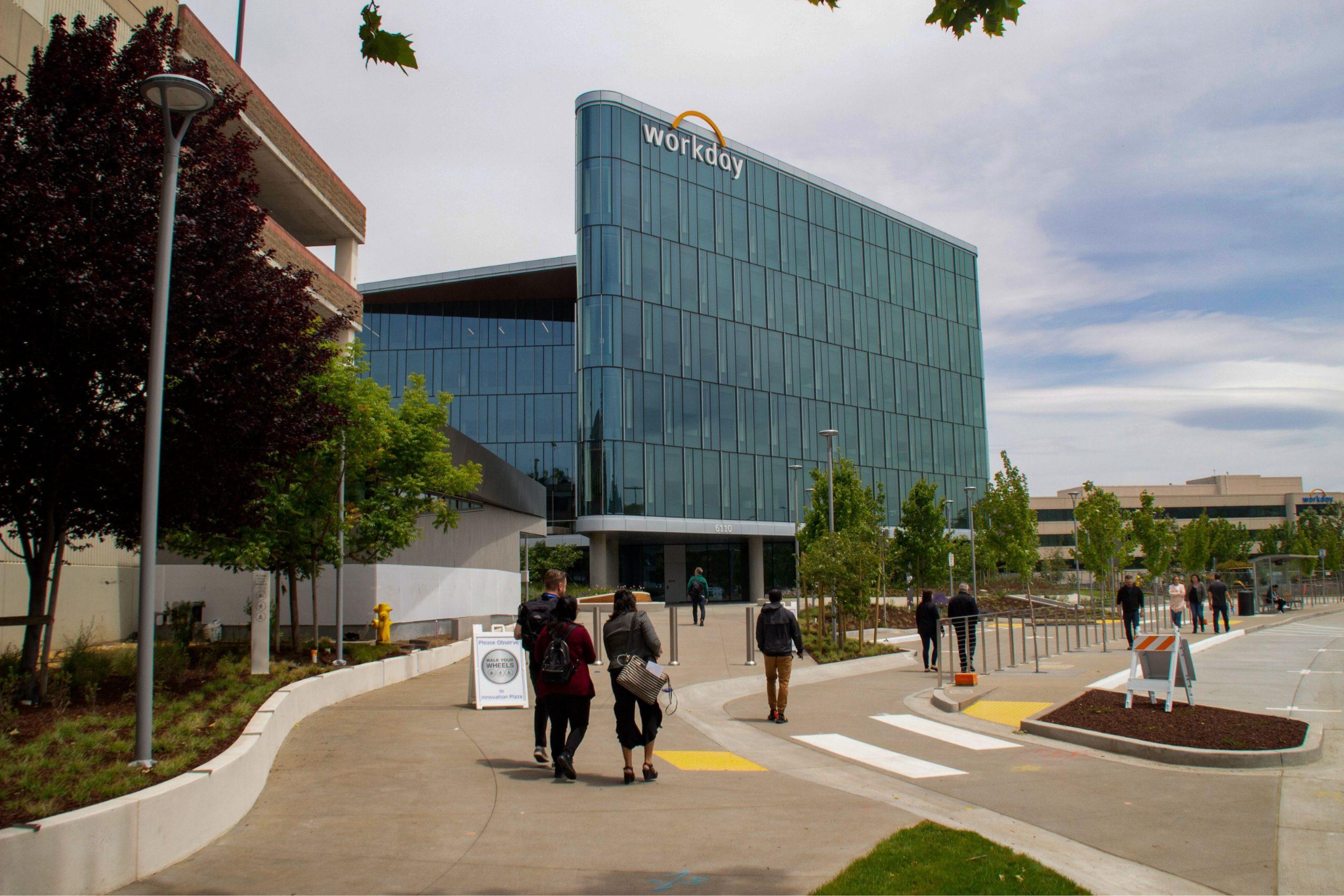
Workday Inc. (WDAY) closed yesterday at $206.45, up nearly 18%, its biggest single-day gain on record. The catalyst wasn't earnings. It wasn't a new AI product. It was a report that a private equity firm might swallow the whole company. Read that sentence again. A $51 billion enterprise software leader's most bullish moment of 2026 is a rumor that it will leave public markets entirely. What exactly does that tell you about the price public markets are willing to pay for enterprise SaaS right now?
But before we get to that, let's take a quick look at the markets and what matters.
3 Movers in 3 Minutes
1. Ackman goes back to Netflix. Netflix (NFLX) jumped roughly 3.7% Thursday after Pershing Square's semiannual filing revealed a new 3.15 million share stake worth 4.9% of the fund. Ackman famously dumped Netflix in 2022 after a $400 million loss. The rejoin note: Netflix has "won the streaming wars." Ackman's second bet is on a stock that has fallen roughly 50% from its June 2025 peak, on the thesis that operating margins near 31% and 90% cash conversion now do the heavy lifting subscriber growth used to.
2. Applied Materials beats and bleeds. Applied Materials (AMAT) reported fiscal Q3 EPS of $3.50 versus $3.45 expected but posted revenue of $9.12 billion, roughly $60 million shy of estimates. The stock fell 3.9% after hours. The signal: even the picks-and-shovels of the AI buildout are being held to a standard where a small revenue miss overwhelms an earnings beat. When option markets prices an 11% earnings move, "good enough" isn't good enough anymore.
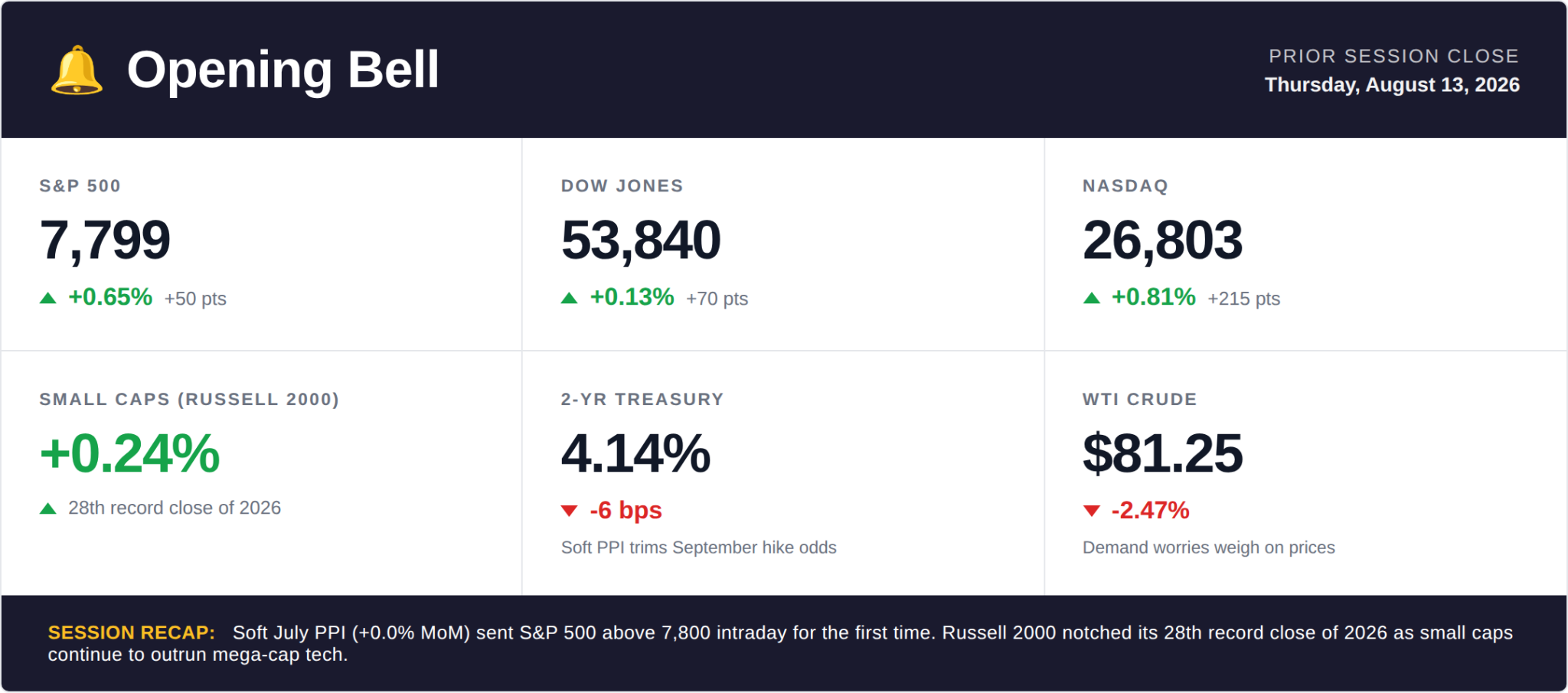
3. Bond buyers demand their pound of flesh. The Treasury's $25 billion 30-year auction Thursday cleared at 5.2%, the highest rate in a quarter century. Stocks celebrated cool PPI. Bond investors quietly reminded everyone that funding a $2 trillion annual deficit still costs something. Two markets, two Fed narratives.
3 Signals for Today
Retail Sales (Jul), morning session. Consensus expects +0.2% MoM headline, +0.2% ex-autos. After a 4.3% July unemployment print signalling structural labor weakness, this is the counter-read: is the consumer still spending, and is that spend broadening or narrowing?
University of Michigan Consumer Sentiment (Aug prelim), 10:00 AM ET. Estimate 68.5 versus 66.4 prior. Watch the 1-year inflation expectation, still parked at 4.2%. A sticky reading complicates the market's soft-PPI story.
Deere & Co. (DE) reports pre-market. The agricultural equipment giant's Q3 print is the cleanest read on U.S. farm belt cash flows, ag commodity exposure and tariff pass-through. Deere has been the quiet macro barometer of the industrial recovery.
I've Read a Lot of Mining Filings. They All Sound the Same.
This one stopped me cold.
Sitting in the filings of one small American gold company is a phrase I have never seen on a gold project: substantial support and partnership from the Department of War.
The Department of War does not partner with gold miners. Except it's partnering with this one.
Here's why. The deposit carries a second metal — one China formally banned from export to the United States. The only domestic reserve of it in the country.
Gold for the dollar war. The banned metal for the shooting war. Both from the same pit.
Washington didn't stop at words. On May 21, 2026, a federal bank voted unanimously to lend nearly $3 billion to build it. Congress got 25 days notice. Nobody objected.
When final papers are signed, funding risk goes to zero — and Wall Street re-rates the stock from speculative developer to federally backed strategic asset.
The company is about one fiftieth the size of Newmont.
And with that out of the way, let's get to today's big story: the moment a $50 billion software titan told public markets, "we'd rather be somewhere else."
The Sip
A private equity firm called. The stock exploded.
On Thursday afternoon, it was reported that Silver Lake had been in months of quiet discussions to acquire Workday. Trading halted three times before the bell. By close, the stock had added roughly $7.5 billion in market value. Workday finished the day worth $51.1 billion, up from $43 billion the morning of.
Silver Lake is the same firm that took Electronic Arts (EA) private last year in a roughly $55 billion deal alongside Saudi Arabia's Public Investment Fund. A Workday buyout, if it closes, would rank among the largest software take-privates ever completed, larger than Hg Capital's $46.4 billion acquisition of OneStream Software earlier this year and dwarfing Thoma Bravo's $12.3 billion take-private of Dayforce (DAY).
The instinct is to file this under "another mega buyout." That misses the deeper thing.
What Workday actually is
Aneel Bhusri and Dave Duffield started Workday in 2005 after Oracle's hostile acquisition of PeopleSoft, where both men had worked. The pitch was simple. Enterprise HR and finance software was stuck in the on-premise era. Cloud was the future. Big companies would replace their SAP and Oracle systems, and Workday would be the modern rail those payrolls and general ledgers ran on. Twenty years later, that pitch worked. Workday runs core HR at more than 60% of the Fortune 500. Its 2012 IPO priced at $28. The stock crossed $300 in 2021.
Then AI happened.
Since its 2024 peak, Workday's stock is down 40%. Coming into Thursday, it was off 15% year to date. Investors have spent 24 months asking the same question about every enterprise SaaS name: what happens when AI agents can rebuild your workflows in weeks, at a fraction of your seat cost, without ever touching your platform? The market's answer for Workday has been a slow, grinding de-rating.
Silver Lake's answer is different. Silver Lake looks at the same 60% of the Fortune 500 penetration and sees something the public market has stopped seeing: an installed base of customers whose finance and HR data has been custom-integrated over a decade, whose switching costs are measured not in dollars but in board-level career risk, and whose recurring revenue converts to cash with rare consistency.
The public market decided Workday was worth less because AI was scary. The private market decided Workday was worth more because AI would take five years to actually matter, and five years of cash flow is exactly what a levered LBO needs.
The gap PE is arbitraging
This is the mechanic worth understanding. Traditional SaaS was priced on revenue multiples that assumed forever growth. When that story cracked, the entire category re-rated. But re-rating on multiples doesn't change the underlying cash generation. Workday still throws off billions in free cash flow. So does Salesforce (CRM). So does ServiceNow (NOW). So does Adobe (ADBE).
Public markets are pricing these companies as if the terminal outcome is disruption. Private buyers are pricing them as if the interim decade is a coupon. Both can be right. But only one of them gets to earn 25% IRRs while everyone else argues about it.
The Dayforce deal was the tell. The OneStream deal confirmed the pattern. Workday, if it happens, makes it a trend. And once a trend is priced in, every other name in the sector gets a new valuation floor: the PE offer they haven't received yet.
Free Stock Pick: The Company First in Line
for America’s New Super Fuel
The U.S. Army and Department of Energy are about to flip the switch on a revolutionary new fuel — and one obscure defense contractor has a five-year head start on every competitor.
This joint, high-priority initiative — ordered by President Trump — is called Project Janus.
And the first powerplant to run this new fuel is expected to go live before December 18, 2026…
When it does, this company’s name will be everywhere.
Full details — including the name and ticker symbol — are being revealed for free.

Click HERE to get the stock name, ticker, and the full Project Janus story for free.
Why the market cheered
There is a subtler read on Thursday's 18% rally. The premium being priced in isn't a Silver Lake bid at $300 per share. It was reported the talks are preliminary and there's no guarantee of a deal. The rally is a reset of Workday's public multiple to reflect the option value of every PE firm in the world now doing the same math. Even if Silver Lake walks, the next call is coming.
This is what a real inflection in the SaaS category looks like. Not a crash. Not a dramatic AI-agent replacement. A quiet, structural handoff, as the public market gives up on holding these companies through the AI transition and the private market takes them off the table.
The Long Angle
For a generation of investors, "software is eating the world" meant SaaS multiples would eat everything else. The unwind of that assumption doesn't require AI to actually kill Salesforce. It just requires public markets to price for that possibility every quarter, while a well-timed PE bid reveals the cash flows underneath are worth more than the tape.
Watch the take-private list. If Workday closes, the next names on the whiteboard aren't hard to guess: mid-cap SaaS companies with 20%+ free cash flow margins, high customer concentration, and stock charts down 30-50% from peak. Snowflake (SNOW). HubSpot (HUBS). Even the giants aren't immune, they're just too big for a single LBO. Yet.
The lesson isn't that SaaS is finished. It's that being public may be finished for the SaaS names caught between AI narrative pressure and cash flow reality. Private equity just found a decade of arbitrage sitting in plain sight, wearing an S&P 500 ticker.
Trump Just Executed a Bloodless Coup.
Nobody Noticed.
For the first time ever, a sitting U.S. President has effectively seized control of the world's most powerful financial institution.
Trump didn't just stack the Fed board.
He's about to weaponize it.
And when it starts on September 16…
A handful of little-known stocks could deliver 1,000%+ gains in 12-24 months.
Discover details on 3 stocks that could explode imminently — and get one FREE ticker symbol today.
The MarketSips Takeaway
When a $50 billion software company's biggest single-day gain in history comes from a rumor it might leave public markets, the market is telling you something important about how it values those markets themselves. Workday isn't a broken business. It's a rerouted one. The signal to watch today isn't retail sales or Michigan sentiment. It's whether any other enterprise SaaS name catches a bid on take-private speculation. If two or three do, the theme is confirmed, and every SaaS multiple has a new floor.
Until then, sip slowly!
The Market Sip Desk
📊The Market Sips Poll
What is really driving the Silver Lake/Workday talks?
- A) AI is genuinely destroying enterprise SaaS moats faster than earnings show
- B) Public markets are systematically underpricing sticky recurring revenue on AI fear
- C) Silver Lake has too much dry powder and Workday was the cleanest target
- D) All three, and the AI narrative just gave PE the cover to strike


