


In 1997, IBM built a supercomputer that defeated the greatest chess player alive. It was the defining moment of artificial intelligence. Nearly thirty years later, the same company just suffered the worst single-day stock crash in its 115-year history. The cause? Artificial intelligence. The irony writes itself, but the lesson underneath it is worth sitting with.
But before we get to the full story, let's take a quick look at the markets and what matters…
3 Movers in 3 Minutes
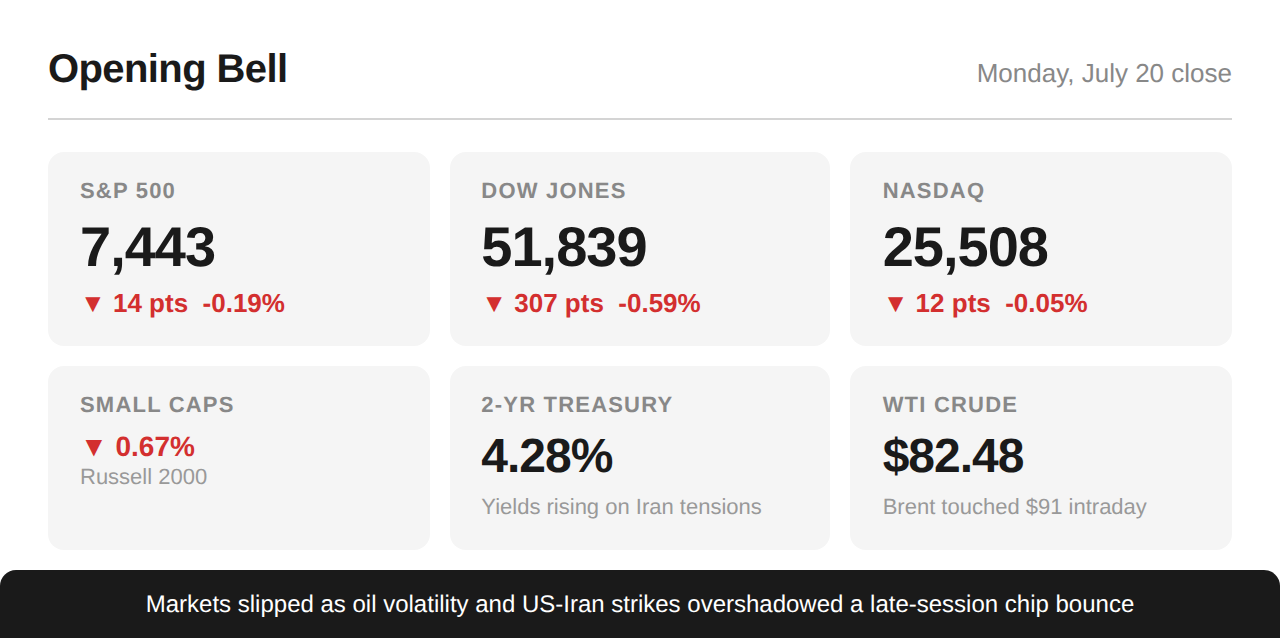
- Intel restructures, market applauds. INTC rose 3.6% on Monday after announcing a new round of layoffs across its data center group, cutting over 5,000 U.S. jobs as part of CEO Lip-Bu Tan's push to become "a more focused and efficient company." The market's read? Discipline ahead of Thursday's Q2 earnings. Intel is up around 150% year to date, but down 30% over the last one month alone.
- Oil touched $90, then pulled back. Brent crude briefly breached $91 intraday as the U.S. completed its 10th consecutive night of strikes on Iran. It settled lower after Iran's Foreign Ministry signalled willingness to pursue negotiations through intermediaries. U.S. gasoline prices are back at $4 a gallon nationally.
- Teradyne (TER) led the S&P 500. The chip testing equipment maker surged 8.4% on Monday, extending its year-to-date gain to around 60%. Even as software stocks crumble under AI budget shifts, the companies that physically test and measure semiconductors keep winning. It is a telling divergence.
3 Signals for Today
- Pre-market earnings gauntlet. GM, SCHW, DHI, MMM, and HAL all report before the bell, giving one of the broadest single-morning reads this quarter on auto demand, brokerage activity, housing, industrial health, and oilfield services.
- Asian chip bounce. Samsung and TSMC helped the MSCI Asia Pacific Index climb 1.7% overnight, breaking a four-session losing streak. Whether U.S. semiconductor stocks confirm or fade this rally will set the tone for Wednesday's mega-cap earnings.
- ASEAN ministers in Manila. Southeast Asian foreign ministers are meeting to call for the reopening of the Strait of Hormuz, a diplomatic effort that could cool oil's risk premium if it gains traction.
The 7 Stocks Built to Outlast the Market
Some stocks are built for a quarter… others for a lifetime.
Our 7 Stocks to Buy and Hold Forever report reveals companies with the strength to deliver year after year - through recessions, rate hikes, and even the next crash.
One is a tech leader with a 15% payout ratio - leaving decades of room for dividend growth.
Another is a utility that’s paid every quarter for 96 years straight.
And that’s not all - we’ve included 5 more companies that treat payouts as high priority.
These are the stocks that anchor portfolios and keep paying.
This is your chance to see all 7 names and tickers - from a consumer staples powerhouse with 20 years of outperformance to a healthcare leader with 61 years of payout hikes.
The report is free for a limited time - go here to get it now.
And with that out of the way, let's get to today's big story: the company that invented AI and is now being devoured by it.
The Sip
The day the machine played like a god
On May 11, 1997, Garry Kasparov leaned over a chessboard in New York and resigned. The game had lasted less than an hour. His opponent was not a grandmaster. It was a 1.4-ton IBM supercomputer called Deep Blue, capable of evaluating 200 million chess positions per second. Newsweek called it "The Brain's Last Stand."
It was the first time a reigning world champion had ever lost a match to a computer under tournament conditions.
IBM had proven something extraordinary. Machines could beat humans at the game long considered the ultimate test of intelligence. The company then followed up with Watson, which defeated Jeopardy champions in 2011 using natural language processing. IBM was not merely participating in the AI race. It was leading it.
Fast forward to 2026. And the company that started it all just got crushed by its own creation.
Two crashes, one cause
On February 23 this year, IBM shares plunged 13% in a single session. The trigger was a blog post. Anthropic, the AI startup behind Claude, had announced a new tool that could modernize COBOL, the decades-old programming language that powers banking systems, airline reservations, and government infrastructure worldwide. COBOL runs on IBM mainframes. IBM charges handsomely to maintain and update those systems. An AI tool that automates the work? That was an existential headline.
Then came July 14.
CEO Arvind Krishna issued an unscheduled letter to investors. Preliminary Q2 revenue was $17.2 billion, missing the consensus estimate of $17.86 billion by roughly $700 million. Adjusted earnings came in at $2.93 a share versus expectations of $3.01.
The stock dropped 25% in a single day. It was the worst session in IBM's history, surpassing even Black Monday in 1987, when it fell 23.7%.
Here is the part that matters. The miss was not enormous. Revenue fell roughly 3.7% short of consensus. That is not usually a 25% stock crash. But the explanation was devastating.
The REAL Reason Trump Is Invading Iran

For a moment…
Forget about Trump’s ties to Israel.
Forget about reports of Iran’s nuclear program.
Because my research has led me to believe we’re risking World War 3 with Iran for a completely different reason.
Click here to find out what it is.
If you have even a single dollar invested in the U.S. stock market, this is going to directly impact you.
The budget cannibals
Krishna told investors that in the final weeks of the quarter, enterprise clients redirected their capital expenditure away from IBM's software and infrastructure products and toward AI hardware purchases: servers, storage, memory chips.
The AI boom has a budget. And that budget is being taken from IBM.
This was not the February crash, where the threat was hypothetical. This time, clients had already moved. They were not buying less technology. They were buying different technology. Money that used to flow into IBM's software division was flowing into the physical infrastructure of the AI buildout instead.
And the damage spread across the sector. Three in five software stocks fell on the same day. Atlassian (TEAM), ServiceNow (NOW), and Adobe (ADBE) all dropped. Meanwhile, cybersecurity stocks rallied. The pattern was clear: clients who deferred software projects still spent on security, because security is harder to postpone.
The correlation between software and semiconductor stocks is now just 0.17. They are decoupling. The AI era is not lifting all tech boats equally. It is lifting the ones that make the inputs to AI and sinking the ones that sell to the same clients footing the bill.
What tomorrow must answer
IBM's full Q2 earnings call lands Wednesday at 5 PM ET. The preliminary numbers are already known. What investors need is context.
How many of the delayed deals have since closed? Is the full-year guidance being revised or reaffirmed? What do Red Hat and watsonx revenue look like underneath the headline miss? Can IBM confirm a free cash flow trajectory that sustains its 3%+ dividend yield?
There is also the matter of a securities fraud investigation that has opened in the wake of the crash, probing whether IBM's pipeline disclosures were misleading.
The stock sits at roughly $212, down 28% for the year. One quarter ago, IBM had beaten estimates, grown software revenue 11%, and looked like a company successfully pivoting toward AI and hybrid cloud. That narrative evaporated in a single afternoon.
The Verdict Is In for AI Stocks in the second half of 2026

The AI trade that made the Mag 7 soar is starting to crack.
Overpriced giants like Nvidia, Tesla, and Amazon are facing slowing returns — just as smaller, lesser-known names are positioning to take market share.
Waiting could be costly.
Three under-the-radar AI stocks are already showing the potential to outperform the Mag 7 in the second half of 2026.
Make sure these alternatives are on your radar before markets open tomorrow.
The Long Angle
IBM's story is not really about IBM. It is about what happens when the technology you helped pioneer grows large enough to rearrange the economy around you.
Deep Blue proved machines could rival human intelligence. Watson proved they could understand language. But neither prepared IBM for a world in which the commercial explosion of AI would redirect enterprise budgets away from its own products.
There is a pattern here. The company that builds the early version of a transformational technology is rarely the company that profits most from its maturity. Xerox invented the graphical user interface. Nokia made smartphones mainstream. Yahoo built the first great internet portal. And IBM? IBM showed the world what artificial intelligence could do.
The companies capturing the value of AI today are not the ones who won the chess match. They are the ones building the hardware, the models, and the infrastructure that make the next move possible. IBM is learning what every pioneer eventually learns: the revolution does not owe royalties to the company that started it.
The MarketSips Takeaway
Watch Wednesday's IBM earnings call not for the numbers, which are already priced in, but for whether management can articulate a path that makes IBM relevant in the AI economy it helped invent.
The broader lesson is structural: the AI buildout is cannibalizing enterprise software budgets in real time, and any company selling to the same CIOs who are writing checks for GPU clusters should be thinking hard about where it sits in the new pecking order.
Alphabet, Tesla, and Intel also report this week. Together, they will tell us whether the AI spending cycle is accelerating, rotating, or beginning to crack.
What is the biggest lesson you take from IBM's story? Hit reply and tell us.
Until then, sip slowly!
The Market Sip Desk


