


On February 20, the Supreme Court struck down the most sweeping tariff regime in modern American history. Five months later, American importers are paying nearly the same rate they were before the ruling. The legal authority has changed three times. The tariff hasn't. That's not a glitch. It's the story.
But before we get to that, here's how the markets moved last week and what to watch this Monday…
3 Movers in 3 Minutes
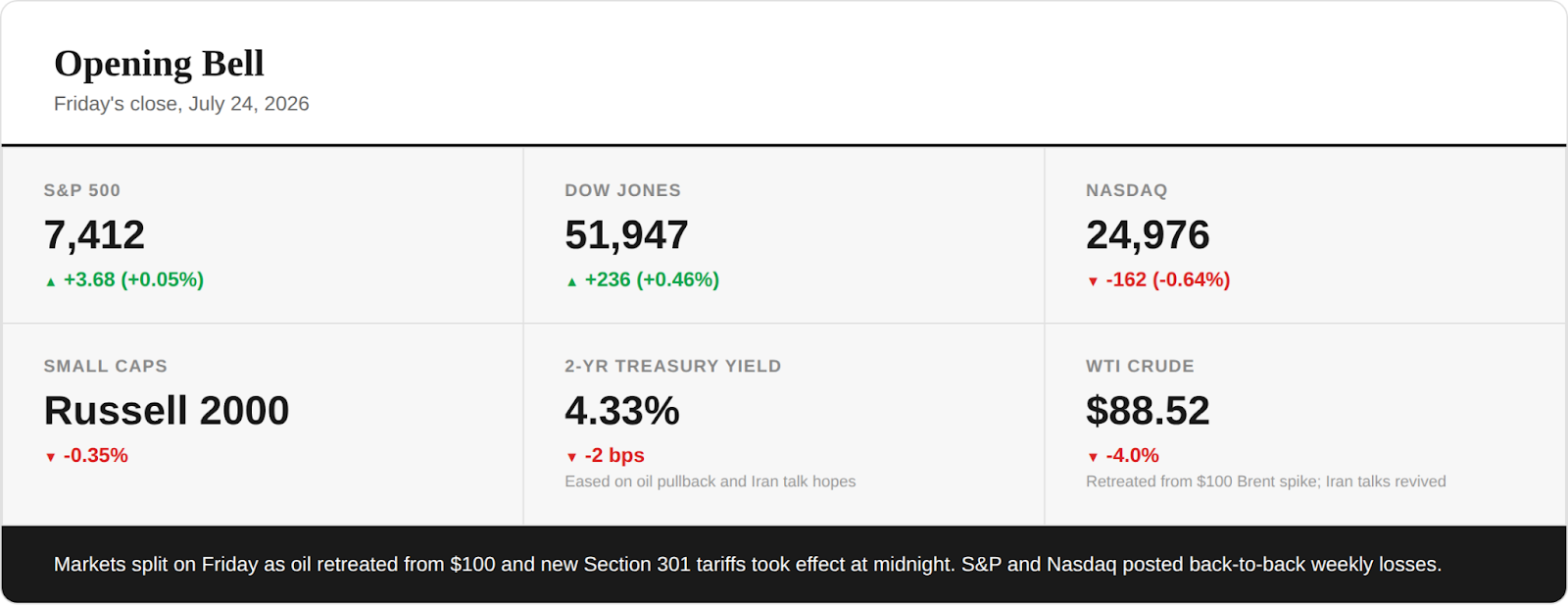
- Intel doubled estimates, then cratered. INTC fell nearly 8% on Friday despite posting its fastest revenue growth in 15 years: $16.1 billion in Q2 sales, double the expected EPS at $0.42 versus $0.21 consensus. The stock initially surged 13% after hours. Then investors read the capex line: $20 billion in 2026, up from $18 billion, with 2027 "significantly higher." The same pattern that sank Alphabet and Tesla this week played out again. AI spending is now a sell signal.
- Oil pulled back from $100, but the damage is done. Brent crude briefly touched $100 last week after Houthi militants struck two Saudi oil tankers in the Red Sea, opening a second chokepoint alongside the Strait of Hormuz. Prices fell Friday on reports that Pakistan and China were exploring a path to restart US-Iran talks. Goldman Sachs sees $120 by Q4 if disruptions persist.
- New tariffs replaced old tariffs at midnight. At 12:01 AM Friday, the White House imposed Section 301 tariffs on 60 economies covering 99.4% of US imports, seamlessly replacing the Section 122 global tariff that expired at the same moment. Rates range from 10% to 12.5%.
3 Signals for Today
- June Durable Goods Orders (8:30 AM ET) will provide the freshest read on capital spending, a critical datapoint with AI capex fears dominating this earnings season.
- FOMC rate decision Wednesday. The Fed meets with oil above $88 and the 10-year yield at 4.69%, the highest since January 2025. Markets are now pricing odds of a rate hike, not a cut.
Why Nvidia is Investing in the "Energy Cube"

As AI's demand for electricity explodes, Nvidia is making moves in a surprising new area.
The company recently partnered with Los Alamos National Laboratory and backed a project tied to the technology known as the "Energy Cube."
One tiny stock sits at the center and a major government catalyst arriving in August could bring it into the spotlight.
And with that out of the way, let's get to today's big story: the tariff that refuses to die.
The Sip
A Toy Company vs. The President
On February 20, 2026, the Supreme Court of the United States handed down one of its most consequential trade rulings in decades.
The case was called Learning Resources, Inc. v. Trump. Learning Resources is not a bank. It is not a defence contractor or a multinational commodity trader. It is a company that makes educational toys for children.
And it had just won a 6-3 ruling that IEEPA, the International Emergency Economic Powers Act, does not authorise the President to impose tariffs. Chief Justice Roberts wrote the majority opinion. The ruling was sweeping. It invalidated the most aggressive tariff regime since Smoot-Hawley, covering virtually every US trading partner at rates ranging from 10% to 145% on Chinese goods.
The victory was supposed to be total. The tariffs in question had been imposed under IEEPA starting in April 2025, covering virtually every trading partner. By the time they were struck down, they had reshaped supply chains, inflated consumer prices, and generated billions in revenue that the administration was counting on.
Importers were owed an estimated $166 billion in refunds. Constitutional scholars called it a reassertion of Congressional authority over the "power of the purse." The separation of powers had worked.
Except… the tariffs never stopped.
Satellite Confirms: Elon Musk Activating Strange 'Dark Energy' Across U.S. South
Confirmed by satellites 300 miles above the Earth's surface... Elon Musk is rolling out a breakthrough technology that could replace our need for foreign oil and ignite a $10 trillion boom a small group of stocks. Click here to learn how you can invest in this before it becomes mainstream.
The Midnight Swap
Here is what happened on the same day the Supreme Court ruled.
Within hours of the decision, President Trump issued an executive order terminating all IEEPA tariffs as required. But he simultaneously imposed a new 10% global tariff under Section 122 of the Trade Act of 1974, a statute designed for temporary balance-of-payments emergencies.
The rate barely changed. The legal authority changed completely. And the clock started ticking, because Section 122 has a hard limit: 150 days, with a 15% rate cap. No extensions without Congressional action.
So the administration began building a replacement before the stopgap even settled. In March 2026, the Office of the US Trade Representative launched two parallel Section 301 investigations: one covering "forced labor" enforcement failures across 60 economies, another covering excess manufacturing capacity in 16 nations.
Both were explicitly designed to produce replacement tariffs before Section 122 expired.
And on July 24 at 12:01 AM, they did exactly that.
The legal authority changed. The tariff rate didn't.
Three Statutes, Zero Gaps
The Court of International Trade had already found that the US did not actually have a balance-of-payments problem as required by Section 122. But it didn't matter. The 150 days ran out before the challenge could wind through the courts. And the new Section 301 tariffs were already in place.
Here is what makes this iteration different.
Section 301 has no rate cap and no time limit. Unlike IEEPA, which was a presidential proclamation, Section 301 is an agency action reviewed under the Administrative Procedure Act. It is procedurally harder to strike down. The administration also separately invoked Section 338 of the Tariff Act of 1930 to impose 50% tariffs on certain Canadian goods.
That is three different statutes in five months. And each one is more durable than the last.
The Peterson Institute for International Economics has already argued that the Section 301 forced-labor rationale is "unlikely to survive a court challenge." But legal challenges take months. The tariffs are collecting revenue today.
The Fiscal Hole Nobody Mentions
There is a quieter consequence buried in the math.
The Congressional Budget Office had projected that the IEEPA tariff regime would generate a specific amount of revenue, revenue the administration's tax cut plans partly depended on. The Section 301 replacement generates roughly 60% less, translating to an $825 billion shortfall through 2036 compared to the February baseline.
So the Supreme Court's ruling didn't just change trade law. It blew a hole in the fiscal math that was supposed to pay for the tax cuts. The tariffs survived. The revenue didn't.
On September 8th, a powerful new law signed by President Trump
will trigger a radical shift in America’s money system...
When a small group of private companies — not the Fed — will perform a major mint of a new kind of money.
And those who act before this new system fully kicks in could see gains as high as 40X by 2032.
But those who fail to prepare will be blindsided by this sea change to the U.S. dollar.
Go here now for the details — before the September 8th mint hits the market.
The Long Angle
There is a pattern in American tariff history that rarely gets discussed.
In 1964, President Lyndon Johnson imposed a 25% tariff on light trucks in retaliation for European tariffs on American chicken. It was supposed to be temporary. Sixty-two years later, it is still in effect. Automakers still design vehicles specifically to navigate around it.
Tariffs, once they exist, tend to find ways to survive. The legal authority changes. The justification shifts. The rate adjusts. But the tariff itself persists, because someone is always collecting the revenue and someone is always benefiting from the protection.
So what happened on July 24 was not an anomaly. A toy company brought the case that was supposed to end it all. The Supreme Court ruled 6-3 in their favour. And five months later, American importers are paying nearly the same rate they were before the decision was issued.
The court won the argument. The tariff won the war.
And if the Section 301 regime is struck down too? The excess capacity investigation covering 16 economies is still ongoing. Section 232 national security tariffs remain untouched. The next statute is always waiting.
The MarketSips Takeaway
The real story of the 2026 tariff saga is not constitutional law. It is the discovery that executive trade authority is distributed across at least half a dozen Cold War-era statutes, each with different triggers, timelines, and judicial review standards. Strike one down, and the next is already loaded. For investors, the implication is simple: do not price in tariff removal. Price in tariff mutation. The rate may change. The tariff will not.
What do you think: should a single Supreme Court ruling be enough to end a tariff regime, or is the legal architecture simply too fragmented to contain executive trade power? Hit reply and tell us!
Until then, sip slowly!
The Market Sip Desk


