


Tesla delivered 480,000 vehicles last quarter, its most ever. Revenue crossed $28 billion, beating every estimate on the street. And then the stock fell 13% in a single session. The reason isn't complicated, but it isn't what most headlines are telling you either. It has nothing to do with cars, and everything to do with what Tesla is quietly becoming.
But before we get to that, let's take a quick look at the markets and what matters…
3 Movers in 3 Minutes
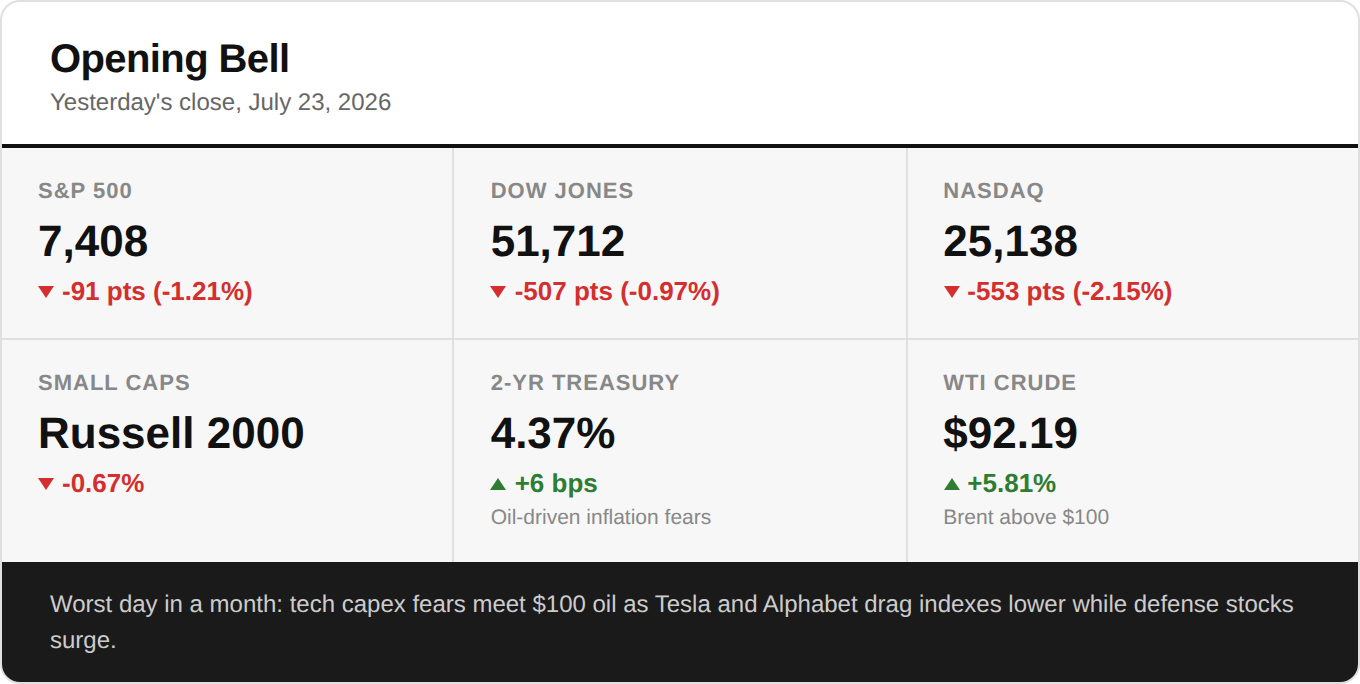
- Lockheed Martin surges 10.8% on a war-fuelled earnings beat. LMT posted Q2 revenue of $20.1 billion (up 10.5% year over year) and earnings of $7.94 per share, blowing past the $7.23 consensus. But the real number was the backlog: $230.4 billion in unfilled orders, up 38.4% from a year ago, driven by missile production and global rearmament demand. Management raised full-year guidance. In a session where nearly everything else bled red, the defence trade printed money.
- Brent crude crosses $100 for the first time since May. Brent settled at $100.69 and WTI at $92.19 after Houthi militants attacked two Saudi oil tankers in the Red Sea, the Encelia and the Layla, claiming enforcement of a maritime blockade against Saudi ports. Oil is now up more than 30% this month. Goldman Sachs sees Brent at $120 by Q4 if supply disruptions persist.
- The 10-year Treasury hit a 52-week high. The benchmark yield climbed to 4.67%, its highest level in a year, as surging oil prices rekindled inflation fears. The 30-year yield pushed above 5.15%. With crude back at $100, the bond market is repricing the Fed's timeline. Rate cut expectations for 2026 have been fading all month, and Thursday's move made that retreat harder to ignore.
3 Signals for Today
- INTC market reaction: Intel crushed Q2 estimates after the close, posting $16.1 billion in revenue (vs. $14.4B expected) and $0.42 EPS (double the $0.21 consensus), its fastest revenue growth since 2011. Watch how the stock opens after a 28% decline in July.
- New Home Sales for June at 10:00 AM ET: a key demand signal for housing with the 10-year yield at a 52-week high and mortgage rates under pressure, Wells Fargo expects the data to underscore a sluggish market.
- Fed meeting positioning begins: the July 28-29 FOMC meeting is less than a week away, and the combination of $100 oil and a 10-year at 4.67% is complicating the rate outlook heading into the weekend.
The Seven Hottest IPOs On Wall Street’s 2026 Watchlist — FREE
The 2026 pipeline looks very different from years past.
Here’s what’s attached to some of the companies expected to headline the calendar:
• $24 billion in annualized revenue.
• 55% year-over-year revenue growth.
• $1.4+ billion in pre-tax profit.
• 200+ million monthly active users.
• Eight consecutive years of profitability.
Unlike many IPOs, those aren’t projections ten years out - they’re current figures tied to a select set of private companies preparing for public markets.
And with that out of the way, let's get to today's big story: the most expensive identity crisis on Wall Street.
The Sip
The Factory Floor Tells the Story
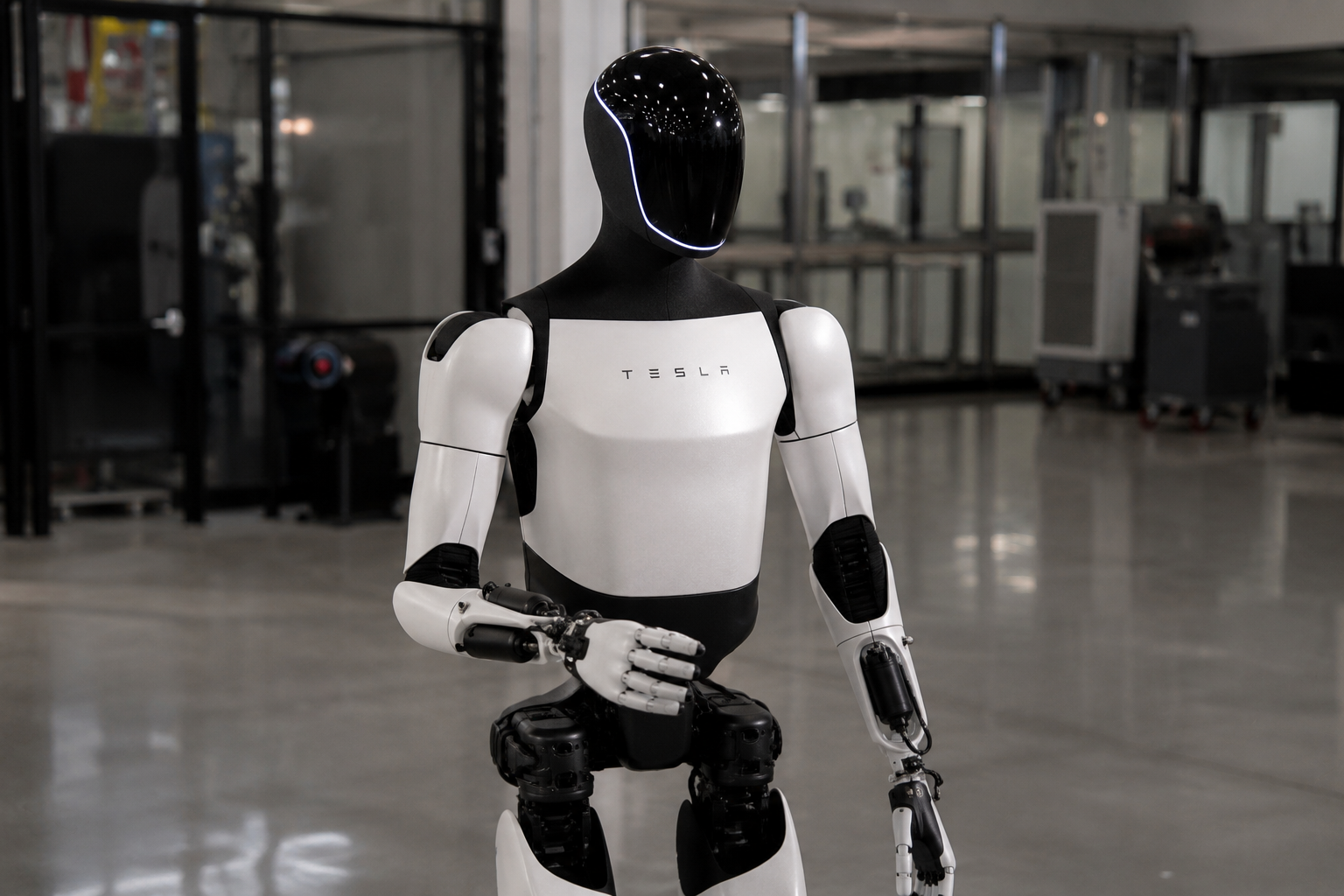
Somewhere inside Tesla's Fremont factory, workers recently started an unusual task. They began dismantling the production lines that used to build the Model S and Model X, Tesla's original luxury vehicles. But not because those cars stopped selling but because Elon Musk needs the floor space for something else entirely: Optimus, a humanoid robot that Tesla plans to start manufacturing in late summer 2026.
A car company ripping out car production lines to build robots. That image alone tells you more about Tesla's current predicament than any earnings call ever could.
Best Quarter. Worst Reaction.
On Wednesday evening, TSLA reported what should have been a triumph. Revenue hit $28.24 billion, up 26% year over year. Deliveries reached a record 480,126 vehicles, comfortably beating estimates. For the first time in its history, Tesla crossed $100 billion in trailing twelve-month revenue.
And then the stock dropped roughly 13% in a single session.
The reason sits in three lines buried below the revenue headline. Non-GAAP earnings came in at $0.33 per share, missing the $0.51-$0.53 consensus by nearly 40%. GAAP operating income collapsed 57% to just $398 million. And free cash flow swung to negative $1.09 billion, the first negative quarter in over two years.
Best revenue quarter in history. Cash burned.
Two Companies, One Balance Sheet
Here is the number that explains everything: capital expenditure surged 142% year over year to $5.79 billion. In Q2 2025, Tesla spent $2.39 billion on capex. One year later, it spent more than double that in a single quarter.
Operating cash flow was actually strong at $4.7 billion, up 85%. The car business is generating real cash. But the capex consumed all of it and then some. That is the gap that turned free cash flow negative. And it is not a one-off. Tesla has guided to more than $25 billion in total capital spending for 2026, nearly triple the $8.5 billion it spent in all of 2025.
Where is the money going, you ask?
He predicted the 2008 financial crisis…
He predicted Trump’s election in 2016….
He even predicted the rise of COVID-19 writing:
“The chance we don’t have something on the scale of a national pandemic in the next few years is near zero”
That was three months before the first reported case.
If he’s right again, God Bless America…
Because this crisis will be tectonic in scale…and it's going to begin with the bubble popping in AI.
Not into selling more Model Ys. It is going into AI training infrastructure, semiconductor fabrication, Optimus robot manufacturing, and Cybercab development, Tesla's purpose-built autonomous vehicle for robotaxi fleets. Meanwhile, operating expenses climbed 47% to $4.35 billion, driven almost entirely by research and development spend on artificial intelligence.
The operating margin tells the story in a single number: 1.4%. A year ago, it was 4.1%. The car business did not suddenly become unprofitable. It is subsidizing an entirely different business that does not yet generate revenue.
Tesla is not one company anymore. It is two companies sharing a single balance sheet, and the market just decided it does not know how to price that.
The Bezos Parallel, and Why It Breaks
Wall Street has seen this movie before. In the summer of 2014, Amazon reported a net loss of $126 million on nearly $20 billion in revenue. The stock dropped about 10%. Jeff Bezos was pouring billions into AWS data centres, Prime Video licensing, and a doomed experiment called the Fire Phone. Analysts were furious. The retail business was growing, but every dollar of profit was being swallowed by ventures that had not yet proved themselves.
Three years later, AWS alone was generating over $17 billion in annual revenue and had become the most profitable division in Amazon's history. Bezos was vindicated. The reinvestment was genius, because AWS served the same customer base. Developers built apps for Amazon's marketplace. Prime Video drove Prime subscriptions, which drove more retail purchases. Every dollar spent reinforced the core business.
Musk's bet is structurally different. Building a humanoid robot does not sell a single additional Model Y. Training an autonomous driving model does not improve the gross margin on a Cybertruck. The $5.79 billion in quarterly capex is not flowing back into the business that generated the $4.7 billion in operating cash flow. It is flowing into a parallel universe that has zero commercial revenue today.
That distinction matters. Amazon was investing in a flywheel. Tesla is investing in a second company.
LEAKED:
July 24th: The Trump Finale No One Saw Coming
Trump has signed 220 Executive Orders in one year…more than almost every U.S. president in history.
Now, on July 24th… He’s preparing to sign what sources say will be his final one.
A White House leak suggests this won’t just erase Biden’s legacy…
It will trigger a $2 trillion initiative to radically reshape America forever.
While making fortunes for those who are prepared for what’s coming.
The details are shocking. But you can’t miss this.
The Long Angle
On the earnings call, Tesla's CFO confirmed the company exited Q2 with its largest order backlog since 2023. The car business is not dying. In fact, production constraints are currently limiting deliveries, not demand. Tesla is also generating $791 million in annual recurring revenue from its self-driving subscription, a number that barely existed two years ago.
But the market is no longer pricing the car company. It is pricing the gap between what Tesla earns and what Tesla spends. And right now, that gap is widening every quarter.
Musk has said that Optimus manufacturing will be the hardest scaling challenge Tesla has ever faced, with no existing supply chain for its components. He compared it, perhaps unintentionally, to the Model 3 production hell of 2018, when the company nearly went bankrupt trying to automate its way to mass production.
Here is the question investors are really asking: can a company that builds the world's most popular electric vehicles also build the world's first commercially viable humanoid robot, and fund both ambitions from the same cash register?
History says companies that try to be two things at once usually end up being forced to choose. The market has a way of demanding that clarity. The question is whether Musk, who has built his career on ignoring exactly that kind of pressure, will listen this time. Or whether, like Bezos a decade earlier, the refusal to listen is precisely the point.
The MarketSips Takeaway
Tesla's Q2 is not an earnings miss. It is an identity declaration. The company is telling you, in plain numbers, that it is willing to sacrifice current profitability to build businesses that do not exist yet. Whether that is visionary or reckless depends entirely on whether Optimus and Cybercab become real commercial products before the car business runs out of patience, and capital, to subsidize them. Watch the capex line every quarter. It is now the single most important number in Tesla's entire financial statement.
What do you think: is Musk's AI bet the next AWS, or the next Fire Phone? Hit reply.
Until then, sip slowly!
The Market Sip Desk


