


There is a reliable tell in corporate life. When a company stops publishing a number on the old schedule, the number has usually stopped being flattering. Netflix retired its subscriber count in 2025. On Thursday it announced its viewing report is going from twice a year to once. Both times, the explanation was that investors should focus on what really matters. Both times, the metric being retired had just gone quiet.
But before we get to the full story, a quick look at the tape and what actually matters today.
3 Movers in 3 Minutes
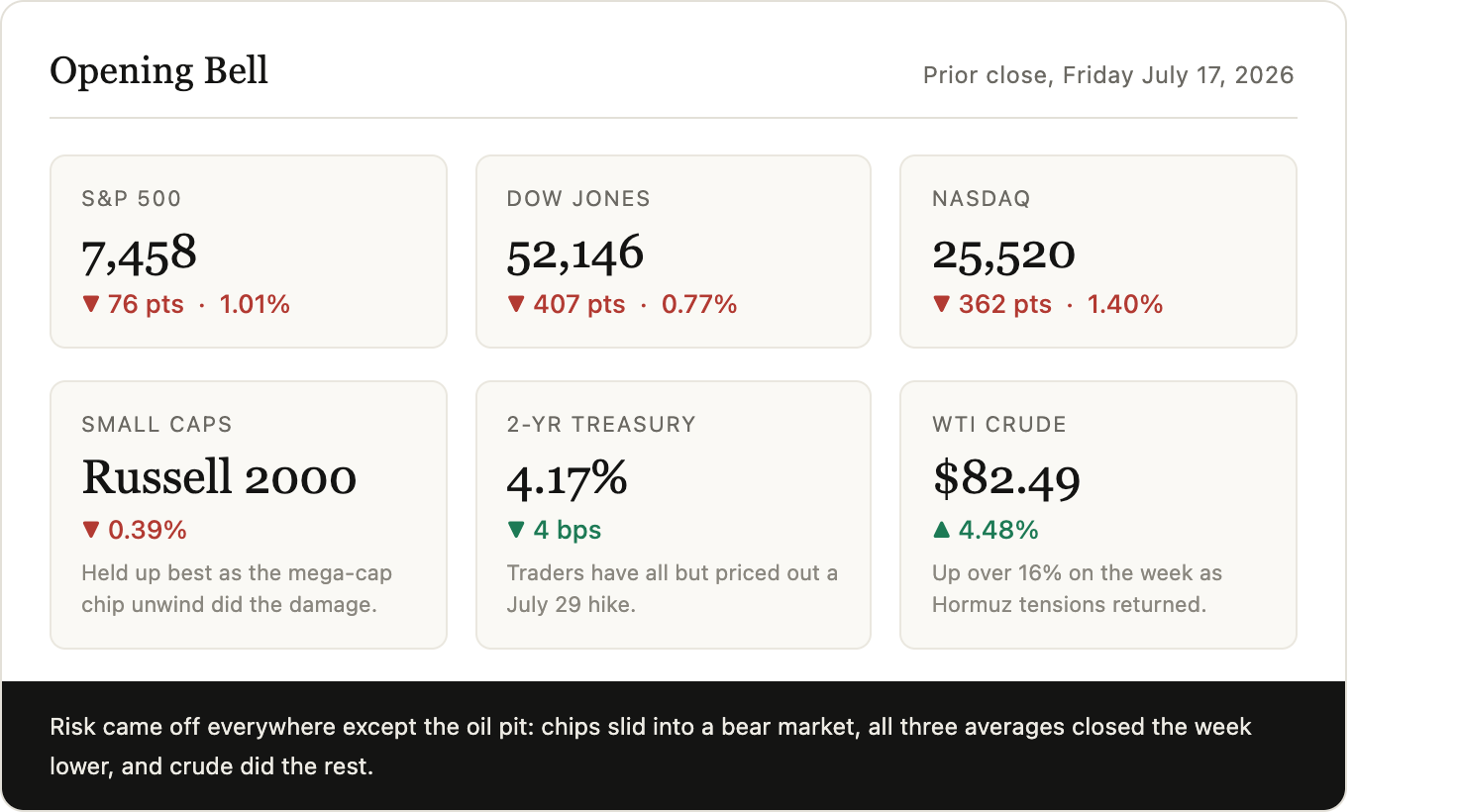
- Chips crossed the line. The semiconductor complex fell 20% from its record, its worst week since April 2025, after Chinese startup Moonshot's model release reopened the question of whether frontier AI needs quite so much silicon. Note who did the selling: this was a positioning unwind in mega-cap tech, not a demand signal. The Russell 2000 barely moved.
- Beating estimates stopped being enough. Intuitive Surgical (ISRG) grew revenue 18.5% and EPS 26.5%, comfortably ahead of forecasts, then fell roughly 13% because it guided da Vinci procedure growth to a 13.5% to 15.5% band, down from 18% last year. The market is no longer paying for the beat. It is paying for the second derivative.
- Oil went vertical. WTI settled at $82, up 4.48% on the day and more than 16% on the week, as renewed Strait of Hormuz disruption pushed crude to its highest since mid-June. Energy was the only green sector on the board, and the one input that lifts every inflation print from here.
3 Signals for Today
- US Leading Index, 9:00 AM ET. The Conference Board's composite follows a 0.1% prior reading on an otherwise thin calendar, which gives it more weight than usual in a week hunting for direction.
- The industrial and consumer read, on the calls not the prints. General Motors, 3M, Danaher, D.R. Horton and Charles Schwab all report before the open, and after Friday the guidance commentary will matter far more than the quarters themselves.
- The first hyperscaler verdict is loaded. Alphabet (GOOGL) reports later this week, the first of the big chip buyers to speak since the selloff, and its capex line is the number that either validates or breaks the bear-market call in semis.
Your Last TV Cost $300... While an ER Visit Costs $3,000... AI Is About to FLIP That
For 50 years, technology got cheaper while everything that actually matters - your doctor, your house, your kid's tuition - went up 4,000%. Nobody could fix it. Until NOW.
A 41-year stock market legend says AI is about to do to healthcare, housing, and education what it already did to your TV.
"Prices won't just drop. They will COLLAPSE. And investors who understand why could make a fortune." For the full story, click here.
And with that, today's story: what happens when the most-watched company on earth quietly runs out of new hours to sell.
The Sip
A number that stopped being useful
For most of television's history, the audience was measured by a company that nobody watched. Nielsen put meters in a few thousand American homes and extrapolated, and for sixty years advertisers spent tens of billions of dollars on the strength of that extrapolation. It was a strange arrangement. An entire industry priced itself off a sample.
Streaming was supposed to end all that. Netflix (NFLX) knows exactly who watched what, for how long, and where they stopped.
Which makes what happened on Thursday quite interesting.
Netflix reported a fine quarter. Revenue of $12.56 billion, up 13.4%, earnings of 80 cents against a 79-cent consensus. Alongside it came the semi-annual "What We Watched" report, and the headline was a record: more than 97 billion hours viewed in the first six months of 2026.
Buried in that record is the whole story. Those 97.7 billion hours were up 2% from 95.2 billion a year earlier, and up a rounding error from the 97.1 billion of the previous half.
Revenue grew thirteen percent. The audience grew two.
And in the same shareholder letter, Netflix announced that from Q1 2027 the viewing report moves from twice a year to once, so that attention stays on revenue and operating profit.
The gap has two names
For a subscription business, an eleven-point gap between revenue growth and audience growth is a trophy. It means you raised prices and almost nobody left. Netflix has the lowest churn in streaming, and it has spent three years proving it can charge more for the same library.
For an advertising business, that same gap is a wall.
Advertising has a chain of custody that cannot be negotiated. Revenue needs impressions. Impressions need somebody sitting there. And Netflix is now betting its next chapter on advertising, with ad revenue on track to roughly double to $3 billion this year and over 60% of new sign-ups choosing the cheaper ad tier.
You cannot price your way out of an inventory shortage. A subscriber who pays twice as much still generates one set of eyeballs.
WARNING: A Major Market Shift Could Hit Stocks in 2026
If you have any money in the stock market, you may want to pay attention.
New research points to a massive market-moving event that could send hundreds of popular stocks into a sudden free fall.
Holding the wrong stocks when this hits could erase years of gains.
That’s why analysts have now identified a list of stocks investors may want to avoid as this event unfolds.
If you want to see what’s coming — and which stocks could be most at risk —
Co-CEO Greg Peters put the defence plainly on the call, saying there is no linear relationship between viewing hours and revenue because all hours are not created equal. He is right. He is also describing a company that would very much prefer you look at a different number.
Netflix spent a decade teaching investors that engagement was the moat. Now that engagement is flat, engagement is a distraction.
What it costs to stand still
Here is the part that got almost no coverage.
Free cash flow in the quarter fell to $1.5 billion from $2.3 billion a year earlier. Content spend is heading toward $20 billion this year, with amortisation growing around 10%.
Netflix is spending materially more to hold attention essentially flat. That is not a growth business. That is a treadmill with a rising incline.
And the hours it does have are dangerously concentrated. Netflix's own report shows the top 200 series, barely 2% of its roughly 8,200 titles, drew about 36% of all views.
A catalogue of that size is supposed to spread risk. Instead the whole thing leans on a few dozen shows, which is why the reporting on second-season falloff has stung so much. Ted Sarandos told analysts there was no material change in returning-season viewership and that dropoff had slightly improved this year. Perhaps. But the company that keeps the best audience data in the world chose that week to publish it half as often.
Then look at what it is buying instead.
Live programming took just over 5% of content spend and delivered about 1% of view hours. Terrible value, if hours are the point. Except live events accounted for six of the ten biggest sign-up days in five years.
Netflix has quietly discovered that live sport and spectacle do not buy watching. They buy arriving. Which is precisely what you buy when your problem has shifted from keeping people to getting them through the door.
"A Dangerous Financial Plan Unfolding in D.C. Could Cost You 40% of Your Wealth"

Former Goldman Sachs executive who traded through Black Monday warns this plan is all written down in black and white, spearheaded by a financial insider who infiltrated the Federal Reserve... It's gone "viral" in the hedge fund circles… and yet practically nobody on Main Street understands this financial shock playing out across America. He lays out all the evidence... plus a detailed roadmap for exactly what to do. (And it doesn't require shorting... options... or perfectly "timing the market.")
You must see this critical market briefing today.
This ad is sent on behalf of Stansberry Research, 1125 N Charles St, Baltimore, MD 21201. If you would like to optout from receiving offers from Stansberry Research please click here.
The Long Angle
There are twenty-four hours in a day and roughly five of them go to video. That ceiling has never moved. Netflix, YouTube and TikTok are not growing a market; they are trading share of a fixed one, and eMarketer sees Netflix adding one minute of daily viewing in 2027 against three for YouTube.
Every attention business eventually meets this wall. When volume stops growing, the only lever left is yield per hour: raise the price, add the ads, or both. Yield extraction works beautifully, right up until it doesn't, because a customer will tolerate a price increase far longer than they will tolerate a worse product.
Netflix won the streaming wars. Nobody told it that the prize was a mature business.
The MarketSips Takeaway
The thing to watch is not Netflix's subscriber price or its next hit. It is the spread between revenue growth and viewing hours. That spread is the purest measure of whether an attention business is still growing or merely charging more, and it applies to Spotify, YouTube, Disney and every platform selling your time. ‘
When a company narrows what it discloses, start tracking the metric it narrowed. Companies rarely reduce transparency about numbers that are about to improve.
Today's reply prompt: Netflix says all hours are not created equal. Do you buy it, or is that a company changing the subject?
Until then, sip slowly!
The Market Sip Desk


