DraftKings did something companies rarely do. In its own earnings deck, it modeled the day its fastest-growing product could lose its best feature: sports contracts ending on July 31, 2028. Then it told investors it will spend $650 million to $700 million on that product this year, more than twice what its August outlook implied. The stock is down about 20% before the open. The obvious read is that DraftKings is overspending to chase Kalshi. The more interesting question is whether it is buying a bet on the courts, or insurance against them. 
But before we get to that, let's take a quick look at the markets and what matters today… 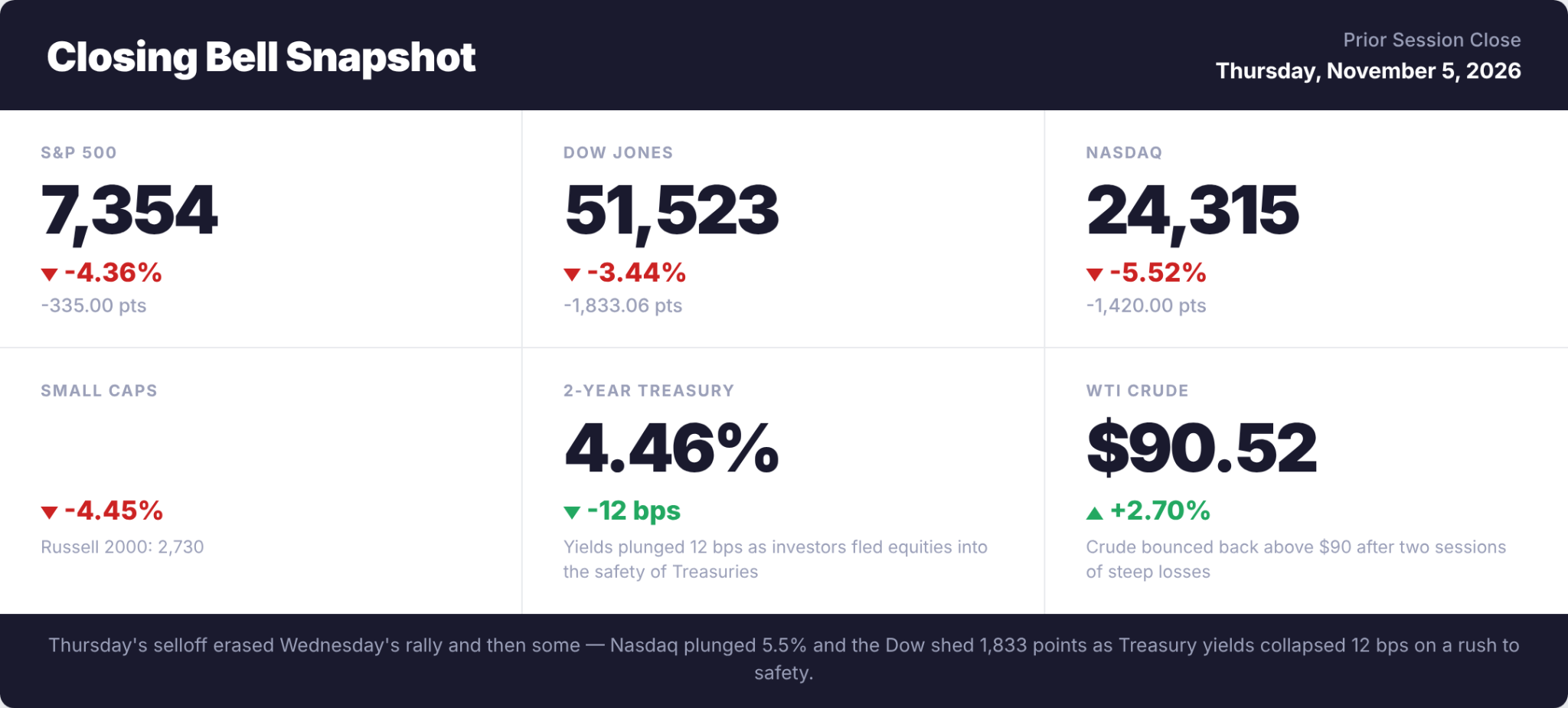
PREMIER FEATURE The Magnificent Seven reshaped the market, but leadership rarely stays concentrated forever. As these giants mature, history shows leadership rotates toward companies with growing cash flows and scalable business models. Our analysts believe that shift is already underway. That’s why they created These 7 Stocks Will Be Magnificent in the second half of 2026, a FREE report highlighting the next group positioned to step into market leadership. Download your free report today. 3 Movers in 3 Minutes1. Seoul's foreign investors ran. Its locals caught them. Asia took Thursday's chip rout and extended it. South Korea's Kospi fell more than 8% early, tripping a 20-minute circuit breaker, and closed down 6%. Foreigners sold a net 2.77 trillion won of Korean stocks. Local institutions and retail investors bought about 2.3 trillion won. Japan's Nikkei fell about 6%, into bear-market territory, and Taiwan lost about 4.5%. The exit started before the election. Foreign investors pulled $31.8 billion from Taiwanese stocks in October, the most in data going back to 2000, according to the Institute of International Finance. In New York, Nasdaq futures were up more than 1% before dawn, and AMD (AMD) and Micron (MU) rose about 7% to 8% in premarket trading. Whatever set off Thursday, foreign money was already heading for the door. 2. Unity's best quarter shrank the gap to a reported $25 billion. Unity Software (U) has held talks to be taken private by Silver Lake, which owns about 8% of it, and Saudi Arabia's Public Investment Fund. Reuters reported the talks, citing people familiar with the matter. The group discussed a valuation of about $25 billion. That was before Thursday's results: revenue up 32% to $622.1 million and Unity's first GAAP profit since its 2020 IPO. The stock jumped 15% while the S&P 500 fell 4.4%, and it is up about 5% more before the open. By our math, $25 billion was about 34% above Unity's market value before earnings. It is now about 11% above. No deal is certain, and terms may change. The better Unity performs on its own, the smaller the gap to $25 billion. 3. Bitcoin's miners are quitting bitcoin. IREN (IREN) said bitcoin mining revenue fell to $28 million last quarter from $67 million the quarter before. It is pulling out miners to make room for AI chips and aims to mostly finish by year-end. AI cloud revenue nearly tripled from the prior quarter, to $200 million. Keel Infrastructure (KEEL), formerly Bitfarms, sold its entire bitcoin treasury and now sells what it mines daily. Core Scientific (CORZ) is converting its remaining mining sites to data-center hosting. The stock market already treats them as AI stocks, not bitcoin proxies: IREN fell 17% on Thursday while bitcoin fell about 5.5%. IREN is up about 15% before the open on a revenue beat, even after pushing its $4 billion-plus revenue run-rate target to January. Every miner that stops holding what it digs is one less patient owner of new bitcoin supply. 3 Signals for Today Payrolls, and a hike bet that already blinked. Economists expect October payrolls to show roughly 65,000 new jobs, with some surveys nearer 59,000, after 29,000 in September. Unemployment is expected at 4.2%. Kalshi's December Fed hike contract sits near 68 cents. It slid from 80 cents to as low as 62 during Thursday's selloff, on a day jobless claims matched their lowest level since 1969. A firm number tests whether that slide was about the economy or about stocks. A soft one would give the retreat from a hike the reason it lacked on Thursday.
The open shows whether investors are sorting again. Cloudflare (NET) fell 8% with the market on Thursday. Then it reported revenue up 39% and lifted its full-year forecast to about $2.96 billion, above the $2.87 billion analysts expected. It is up about 16% before the open, even though its adjusted gross margin slipped to 72.4% from 75.3%. Airbnb (ABNB) is up about 12% on a beat and a new $12 billion buyback. Atlassian (TEAM) also beat, but is down about 14% on a slower subscription outlook. If beats get paid and cuts get punished by the close, Thursday's broad selling is giving way to stock-picking.
The CFTC answers Wall Street on stock perps. The derivatives regulator's response is due today in a suit by a group backed by Cboe (CBOE) and Citadel Securities to stop perpetual futures on single U.S. stocks. A federal judge let the contracts keep trading this week while finding the challengers likely to win their argument that the CFTC lacked the power to approve them. Kalshi started with Qualcomm (QCOM), McDonald's (MCD), Amgen (AMGN) and Costco (COST), and says it now offers contracts on more than 50 companies. Kalshi raised $1 billion last week partly to build products like these. An injunction after the group's reply on Tuesday could halt them within weeks of launch.
And with that out of the way, let's get to today's big story: the sportsbook that modeled its own worst case, then raised its bet. The SipDraftKings priced its own worst case. Then it spent more.DraftKings (DKNG) now expects $175 million to $275 million of adjusted EBITDA this year. In August, the range was $700 million to $900 million. The stock is down about 20% before the open, near $18.75, just above its 52-week low of $18.35. The reason is Predictions, its prediction-market product. DraftKings will spend $650 million to $700 million building it this year. It says Predictions revenue will be immaterial in 2026, because new-customer promotions will offset "the lion's share" of what it brings in. Sales and marketing jumped to $605.7 million last quarter from $360.4 million a year earlier. The core forecast came down too. In August, DraftKings said its core business was on track for about $1 billion of adjusted EBITDA. Now it expects $875 million to $925 million. The engine funding the bet is now expected to earn less, in the same quarter the bet got bigger. What $700 million buysDraftKings' case rests on its unit economics. More than 1.6 million customers have used Predictions this year. On its own exchange, trades generated an 11.1% take rate across all participants in September and October, and DraftKings kept 65.6% of it. It expects this year's customers to pay back their acquisition cost in about 20 months. It guides to $650 million to $750 million of Predictions revenue in 2027. The geography matters more than the math. Predictions offers sports contracts in states where DraftKings' sportsbook is not licensed, including California, Texas, Florida and Georgia. For a company whose growth was capped by state-by-state legalization, it is a route into the three most populous states without a state license. The slide most investors skippedDeep in the earnings deck is a downside case. DraftKings modeled sports event contracts ending on July 31, 2028. After that date, it assumes a Predictions customer is worth 20% of what they are worth with sports. Under that scenario, customers signed in 2027 take 41 months to pay back instead of 18. This year's group, it estimates, pays back by May 2028, before the assumed cutoff. That 20% carries a lot of weight. So far, nearly 20% of Predictions customers have traded anything other than sports. The date is an assumption, not a forecast. But few companies ever put a number on how their own product could be shut down. FROM OUR SPONSORS Why Did Trump Just Ban America's Most Powerful AI?It's not Nvidia. It's not OpenAI. It's not Google. It's a San Francisco AI lab whose technology is used by eight of the ten largest companies in America — and which Bloomberg calls the highest-revenue AI company on earth. Trump banned it from every federal agency and the Pentagon blacklisted it. The reason isn't what you think. Full details here. The courts are writing the other halfThe week DraftKings raised its bet, appeals courts went against Kalshi. On Nov. 3, the Second Circuit refused to stop New York and Connecticut from enforcing their gambling laws against Kalshi's sports contracts while it appeals. A day later, the Ninth Circuit, whose rulings cover California, declined to rehear its August decision in Nevada's favor. In that ruling, the panel wrote that the substance of the contracts "is sports gambling, regardless of whether Kalshi calls them swaps." The Third Circuit sided with Kalshi in New Jersey, and New Jersey has asked the Supreme Court to take the case. States do not need a final ruling to shrink the market. After Utah filed criminal charges against Kalshi and its founders, DraftKings and FanDuel pulled sports contracts from their prediction products in the state within two days, and Fanatics said it would stop taking trades there. Washington is on the other side: the U.S. and the CFTC have sued Utah, arguing federal law overrides state gambling statutes. A hedge with a price tagHere is what a 20% drop may be missing. DraftKings, like FanDuel, holds sportsbook licenses in more than two dozen states. Kalshi holds none. If courts decide sports contracts are gambling, Kalshi's biggest product shrinks state by state, and DraftKings' licensed sportsbooks lose an unlicensed competitor. If they do not, DraftKings has a product in states its sportsbook cannot reach. It is paying to stand on both sides of the ruling. The catch is position. Kalshi says it handles more than 75% of prediction-market trading volume, and it raised money last week at a $40 billion valuation. DraftKings and FanDuel's parent, Flutter (FLUT), were worth about $26 billion combined at Thursday's close, before DraftKings' after-hours drop. By Needham's count, DraftKings' exchange took 3% of sports prediction volume in the NFL's opening week, against 76% for Kalshi. What settles itFirst, this morning's call, the first chance to hear whether next year's $250 million to $350 million of Predictions spending is a ceiling. Second, whether 2027 Predictions revenue lands near $700 million once promotions fade. Third, the Supreme Court, which could decide whether the July 2028 slide stays a hypothetical. PARTNER SPOTLIGHT According to Wall Street legend Dr. Martin D. Weiss, there’s a $3 trillion financial crisis happening right now. And almost nobody but him is warning people. In fact, according to WSJ, this $3 trillion market “is under growing strain, despite industry’s upbeat tone.” Weiss says the biggest danger is NOT just another stock market crash. The biggest danger is NOT only a major bank failure. Rather, it’s a chain reaction of crashes and failures across the globe. >Go here now to see his shocking warning. 11780 US Highway 1, Palm Beach Gardens, FL 33408-3080 Would you like to edit your e-mail notification preferences or unsubscribe from our mailing list? Copyright © 2026 Weiss Ratings. All rights reserved. The Market Sips TakeawayDraftKings' most useful disclosure was not the spending. It was the exchange rate between legal risk and customer value: in its own model, a customer with sports contracts is worth five times one without them. That makes the next year easy to score. The bet is working if Predictions revenue shows up near $700 million in 2027 as promotions shrink, and if the share of customers trading beyond sports climbs well past 20%. It breaks if more states copy Utah before the Supreme Court rules, or if Kalshi's lead survives the NFL and NBA seasons intact. The second-order signal is the valuation gap. When a private exchange is worth more than DraftKings and FanDuel's parent combined, the market is telling you who it thinks owns the customer. DraftKings is spending $700 million to prove it wrong. Until then, sip slowly! The Market Sips Desk Reply prompt: If the Supreme Court rules that sports contracts are gambling, who comes out ahead, DraftKings or Kalshi? Hit reply and tell us. AI Moves Into the Biotech LabFor most of the AI boom, the money followed the hardware. Chips. Data centers. Cloud.
Now the algorithms are walking into the lab.
In September, a drug whose target was found by AI, and whose molecule was designed by AI, dosed its first patient in a Phase III trial. A second AI-engineered medicine is in Phase III too.
We profiled the 5 companies leading the shift in a new FREE Special Report: AI Moves Into the Biotech Lab.
We'll text it straight to your phone. Get the Free Report by Text → | 


