


Alphabet beat Wall Street estimates by 216% last night. The stock fell 5%. That is not a typo. The reason involves an obscure 2016 accounting rule, a $965 billion AI startup, and $99 billion in profits that exist only on paper. Warren Buffett warned this exact thing would happen. Nobody listened. Let’s understand what it all means.
But before we get to that, here’s a quick look at the markets and what matters today...
3 Movers in 3 Minutes
- Super Micro surges 21% on record backlog. SMCI rallied to its best session in months after reporting over $60 billion in new orders during its fiscal Q4, pushing its backlog to a record. The real surprise was gross margins: management now expects 15% to 17%, nearly double its prior guidance of 8.2% to 8.4%. Dell (DELL) and HPE (HPE) rose in sympathy.
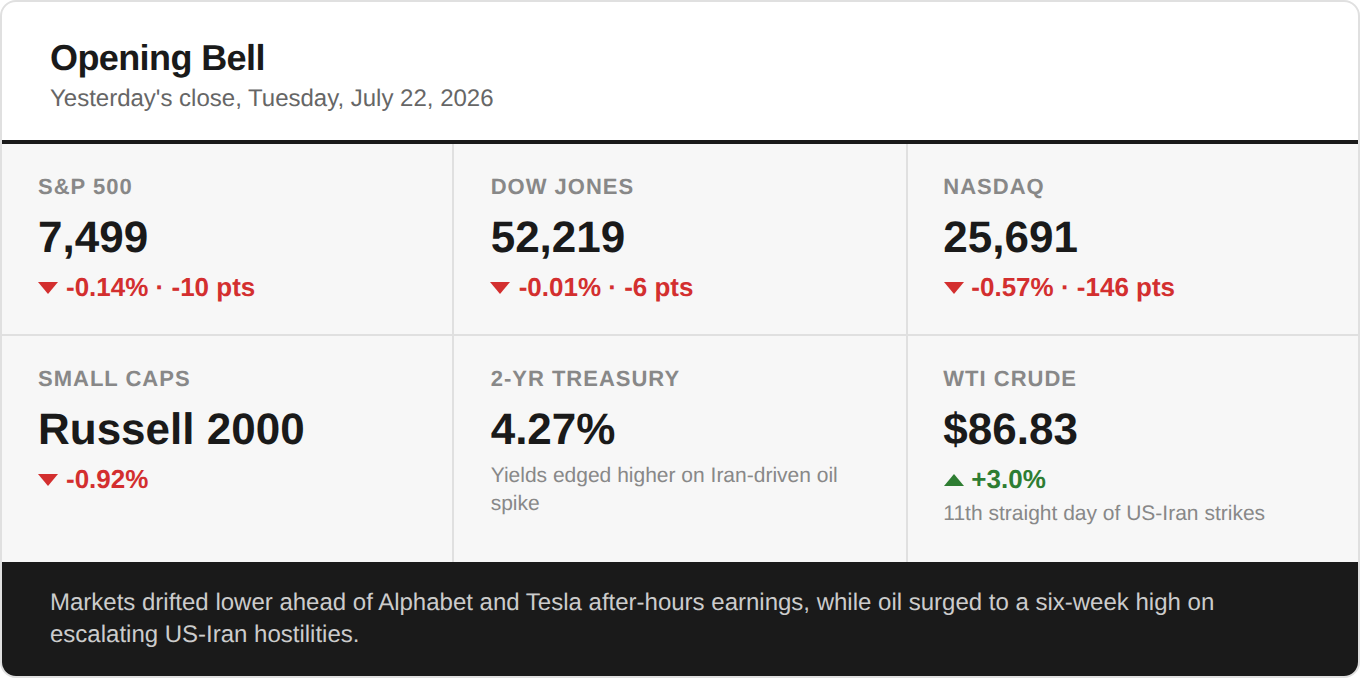
- Oil hits six-week high as US-Iran strikes enter 11th day. WTI crude surged 3% to $86.83, while Brent briefly topped $95, its highest since early June. Secretary of State Rubio accused Iran of failing to honour previous commitments, saying Washington would "do what is necessary" to protect allied interests. Attacks on the Caspian Pipeline Consortium terminal in the Black Sea added further pressure on global supply.
- Reddit drops 9% on Google AI licensing dispute. RDDT fell to $169 after the Wall Street Journal reported that the company is considering cutting off GOOG's access to its content for AI training as its $60 million annual licensing deal nears renewal. Reddit is one of several publishers reassessing AI deals after Google's AI Overviews slashed referral traffic: Semrush data shows Business Insider's Google traffic plunged 85% in the past year alone.
3 Signals for Today
- Alphabet and Tesla after-hours reactions set the tone. GOOGL fell 5% after raising 2026 capex guidance to $205 billion, while TSLA dropped ~3% on a massive profit miss despite record revenue. Watch whether the Nasdaq can absorb the overnight pressure or gaps lower at the open.
- ECB rate decision. The European Central Bank announces its latest monetary policy decision, with President Lagarde's press conference at 8:30 AM ET. Markets are watching for any signal on the trajectory of rate cuts.
- Initial jobless claims. Consensus expects 212,000 new filings versus 208,000 the prior week, which marked the lowest count in over two months. The labour market's resilience remains a key input for Fed rate path expectations.
The Market Is Already Looking Beyond the Mag 7
The Magnificent Seven reshaped the market, but leadership rarely stays concentrated forever.
As these giants mature, history shows leadership rotates toward companies with growing cash flows and scalable business models.
Our analysts believe that shift is already underway.
That’s why they created These 7 Stocks Will Be Magnificent in the second half of 2026, a FREE report highlighting the next group positioned to step into market leadership.
And with that out of the way, let's get to today's big story: how Google's biggest earnings beat in history was mostly an accounting mirage.
The Sip
The Warning Nobody Heeded
In early 2018, Warren Buffett wrote one of the strangest warnings of his career.
It had nothing to do with markets, valuations, or the economy. It was about an accounting rule.
The Financial Accounting Standards Board had just implemented ASU 2016-01, a standard that changed how companies report gains on their stock investments.
Before the rule, if a company held shares in another business, any unrealized gains or losses stayed quietly tucked away on the balance sheet, in a line called "other comprehensive income." Investors who dug into the footnotes could find them. But they never touched the headline earnings number.
The new rule flipped that. Starting in 2018, every quarterly mark-to-market swing on equity investments would flow straight through net income. The same line that tells you how much money a company actually made from selling products and services would now also include paper gains on stocks the company had not sold.
Buffett's assessment was blunt. The change would produce, in his words, "truly wild and capricious swings" in Berkshire's bottom line and render it "useless" for analytical purposes.
Eight years later, Alphabet just proved him spectacularly right.
The $6.26 That Wasn't
Last night, Alphabet reported second-quarter earnings of $9.11 per share. Wall Street had expected roughly $2.88. That is a 216% beat. The largest in the company's history by a staggering margin.
Except $6.26 of that $9.11 came from a single line item: unrealized gains on equity securities.
Alphabet booked $99.03 billion in gains on its investment portfolio during the quarter. Not $99 million. $99 billion. Up from $1.29 billion in the same quarter a year earlier. The gains added $77.1 billion to Alphabet's net income after taxes, according to the company's own filing.
And the primary source? Its roughly 14% stake in Anthropic, the AI company behind Claude.
You see, Anthropic's valuation tripled during the second quarter, surging from $380 billion to $965 billion after a $65 billion fundraising round. Under the FASB rule, Alphabet had to mark its stake to the new valuation, and the roughly $82 billion increase in the stake's value went straight into net income. Not as a footnote. Not as an asterisk. As profit.
Except nobody at Alphabet sold a single share. No cash changed hands. The "profit" exists entirely on paper.
Strip out the investment gains and Alphabet's operating EPS was roughly $2.85. A perfectly solid quarter. Just not a historic one.
The Business Beneath the Illusion
Here is the irony. Alphabet's actual business had a genuinely excellent quarter.
Revenue hit $119.8 billion, up 24% year on year. Google Cloud was the star, with revenue surging 82% to $24.8 billion, the fastest growth the division has ever reported. Its contracted backlog reached $514 billion, up more than $50 billion in a single quarter. Search revenue grew 17% to $63.3 billion. The Gemini App now has 950 million monthly active users.
By any measure, this was a company executing.
And yet the stock fell 5% after hours.
Because investors were not reading the EPS line. They were reading the capex line.
The Spending That Spooked the Market
Alphabet told investors it now expects to spend between $195 billion and $205 billion in capital expenditure this year. That is up from the $180 billion to $190 billion it guided just last quarter. Second-quarter capex alone was $44.9 billion, exactly double what it spent in the same period a year ago.
And CFO Anat Ashkenazi noted, almost casually, that 2027 capex would "significantly increase" from there.
That is a single company's annual infrastructure budget for a technology whose commercial returns are still, in many applications, unproven at scale.
Ashkenazi defended the spending by saying Alphabet remains "supply-constrained" for multiple consecutive quarters. Demand for AI compute is outrunning the company's ability to build capacity. That may well be true. But investors are now facing a company that earned $2.85 in real operating EPS, booked $6.26 in paper gains, and plans to spend $200 billion building AI infrastructure. All in the same quarter.
Landmark Executive Order 14241 Unleashes
TRUMP’S NEW DOLLAR
Republican or Democrat – whether you support or oppose Trump’s New Dollar – every American could soon be forced to use it
Discover three critical moves to help you prepare, before it’s too late
The Long Angle
This is not just an Alphabet story. It is a story about what "earnings" mean in the age of AI.
The same FASB rule that inflated Alphabet's quarter will ripple across every public company with significant private AI holdings. SoftBank holds stakes in dozens of AI startups. Microsoft holds a large position in OpenAI. Nvidia holds minority stakes across the AI supply chain. As these private companies raise at higher valuations, the mark-to-market gains will produce headline EPS figures that have less and less to do with how the business actually performed.
And when those valuations reverse, as SpaceX's has already begun doing (down roughly 33% since Q2 ended), the losses will flow through just as violently. Buffett was not making a prediction. He was issuing a warning.
The market has already decided how to read this quarter. It ignored the $9.11 and fixated on the $205 billion. It looked past the paper profits and saw the real cost of staying competitive in AI. And it concluded that Alphabet's most profitable activity right now, owning a piece of Anthropic, is not a business strategy. It is a fortunate side effect.
The most valuable number in Alphabet's earnings release was not the one that made the headlines. It was the one the headlines obscured.
Could the AI Boom End Like the Dot-Com Bubble?
But one market statistic — praised by Warren Buffett as the best measure of valuations — is now flashing a historic warning.
It’s currently higher than it was at the peak of the Dot-Com Bubble.
If the signal proves accurate, the coming AI unwind could shake the entire market.
See the alarming stat — and what investors should do before the next crash unfolds.
The MarketSips Takeaway
Alphabet's quarter reveals a new era of earnings distortion. When the largest AI investors are also public companies bound by mark-to-market accounting, headline EPS becomes a funhouse mirror. The real story is in operating income, free cash flow, and capex. For investors parsing this earnings season, the lesson is simple: if the beat looks too good to be true, read the footnotes before you read the headline.
What's your read: does $200 billion in annual AI capex from a single company feel like conviction or excess?
Until then, sip slowly!
The Market Sip Desk


