Whirlpool said Monday that it now expects to lose money this year. Twelve minutes later, Celestica, which builds AI data-center hardware, said it expects revenue to nearly double next year to $40 billion, and that its customers expect even more in 2028. This morning Sherwin-Williams, whose sales still rose 7.9% last quarter, said demand would stay muted into 2027. The Federal Reserve starts its two-day meeting today with one interest rate to set for all of them. The question isn't whether rates are too high. It's which economy they actually reach. 
But before we get to that, a quick look at what moved overnight and what matters today… 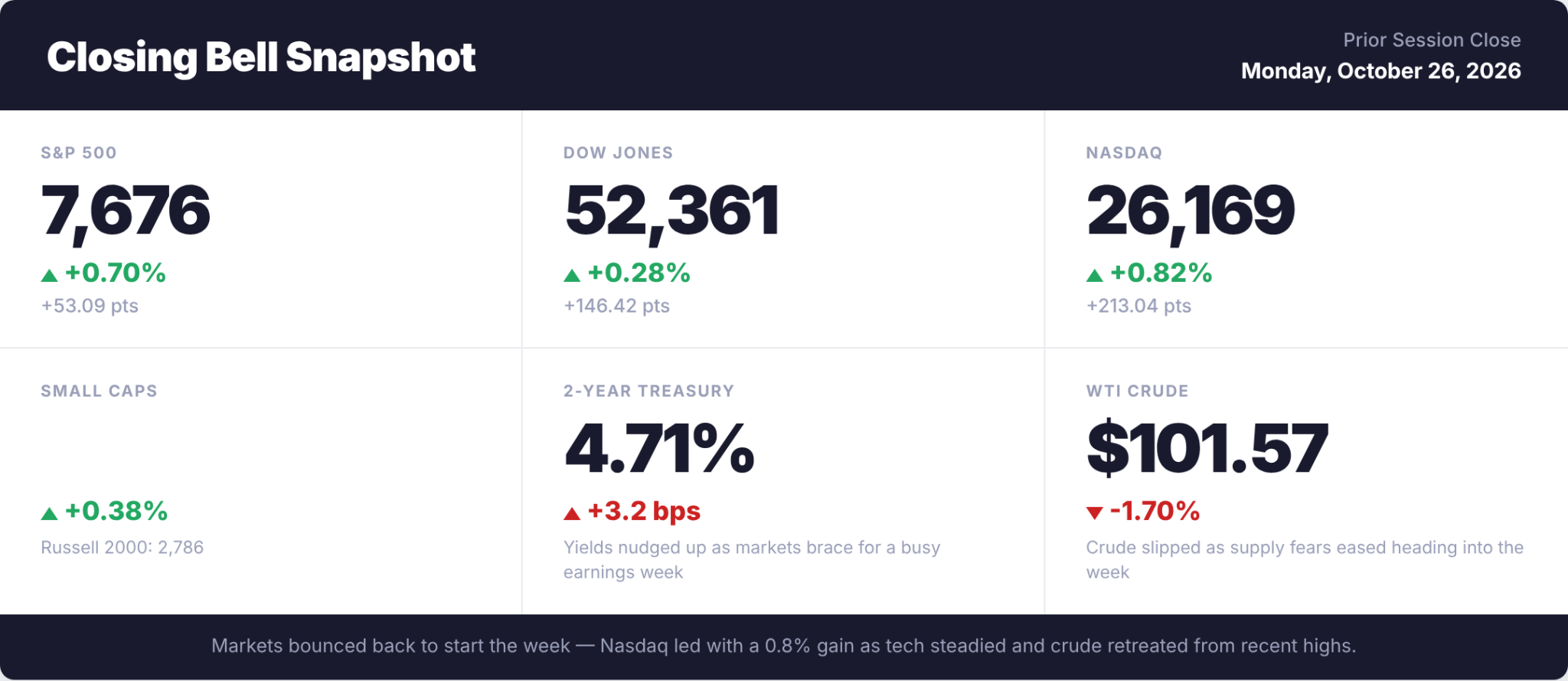
3 Movers in 3 Minutes 1. HSBC's profit jumped 32%. The shares fell 7%. HSBC Holdings (HSBC) said third-quarter pretax profit rose 32% to $9.63 billion, roughly in line with forecasts, and announced another buyback of up to $1 billion. London shares still fell almost 7% early Tuesday. Most of the jump was last year's legal bill going away: excluding notable items, profit grew 10%. Revenue of $18.62 billion missed the $18.93 billion consensus the bank compiled, Wealth fee income was flat, and the core capital ratio slipped to 13.9%, below its 14% to 14.5% target range. HSBC expects new capital rules to lift that ratio by about half a point in January. Investors weren't buying the headline. They were pricing the growth engine, and the engine looked tired. 2. A fire near Saudi Arabia's biggest oil terminal, and oil went down. Saudi Arabia contained a fire near its Ras Tanura export terminal early Tuesday after an attack in the region. Brent briefly rose above $116, then gave it back, trading near $115 at 8 a.m. ET, below Monday's $115.81 settle. Overnight, Polymarket's contract on the U.S.-Iran ceasefire holding through Oct. 31 climbed gradually to about 93 cents from 86.5 cents. Monday's talks in Tehran with Saudi, Pakistani and Turkish officials ended with an agreement to keep talking, and fewer days left for a strike likely to explain part of the move. Read across the expiries, the prices imply about a 7% chance of a U.S. strike by Oct. 31 and about 45% by Nov. 15. The biggest step sits across the Nov. 3 midterms, before which President Trump said on Oct. 8 the U.S. would not attack. Oil traders and bettors appear to agree on the same thing: the risk is on the calendar, not in the terminal. 3. Ripple says it got a federal charter. XRP didn't notice. Ripple said Monday evening that the Office of the Comptroller of the Currency granted final approval for Ripple National Trust Bank, following conditional approval in December. The trust bank will hold and act as trustee for the reserves behind RLUSD, which Ripple puts at about $2.5 billion, and offer custody once it opens. The charter covers the reserves, not the token: RLUSD will still be issued by Ripple's New York-regulated trust company. XRP sat near $1.30, little changed. This is a plumbing upgrade for the stablecoin business, and the competitive read lands on Circle, which reports Nov. 4, more than on XRP holders. 3 Signals for Today Brazil's Treasury is now the bond market's buyer. On Monday it spent about R$14.8 billion buying back bonds it had just stopped selling, and long-term rate futures still closed about 2.6 percentage points higher, with the January 2031 contract at 15.24%. Today's only government bond sale is floating-rate debt tied to the Selic. If long rates climb again after São Paulo opens, the market is saying buybacks can't stand in for a fiscal plan, and the pressure shifts to Lula's choice of finance minister for his new term. If they ease, Monday starts to look like an overshoot.
The capex economy and the housing economy report by 10 a.m. At 8:30 a.m. ET, core capital goods orders, the government's best early read on business equipment investment, are expected to rise 0.7% after 1.6% in August. At 10:00, September new home sales are expected at a 650,000 annual pace, down from 684,000, alongside Conference Board confidence (about 81 expected). Strong orders next to falling home sales would put an official number on today's Sip just as the Fed sits down.
Robinhood reports into a crypto air pocket. Robinhood Markets (HOOD) reports after the close, with analysts expecting 56 cents a share on $1.44 billion of revenue, according to FMP data. On Monday the S&P 500 rose 0.7% while Strategy (MSTR) fell 4.2%, Coinbase (COIN) 2.9% and Robinhood 2.3%, and bitcoin slipped under $80,000 overnight. Robinhood's third-quarter numbers cover July through September, before bitcoin's October slide, so the more current read is whatever management says about activity this month. If October trading held up, Monday's selloff in the bitcoin treasury stocks looks more like a financing worry specific to them. If it didn't, retail is stepping back ahead of Coinbase and Strategy on Thursday.
PREMIER FEATURE The Market Is Already Looking Beyond the Mag 7The Magnificent Seven reshaped the market, but leadership rarely stays concentrated forever. As these giants mature, history shows leadership rotates toward companies with growing cash flows and scalable business models. Our analysts believe that shift is already underway. That’s why they created These 7 Stocks Will Be Magnificent in the second half of 2026, a FREE report highlighting the next group positioned to step into market leadership. 👉 Download your free report today. And with that out of the way, let's get to today's big story: two manufacturers, twelve minutes apart, and the one interest rate that has to cover both. The SipTwelve minutes apartAt 4:05 p.m. on Monday, Whirlpool (WHR) reported third-quarter sales down 8.8% to $3.68 billion and an ongoing loss of 21 cents a share. It cut its full-year forecast to an adjusted loss of about $1.30 a share. In January, it expected to earn about $7. Its message has shifted from earnings to cash. The shares were about 6% lower before the open. At 4:17 p.m., Celestica (CLS), the Toronto-based maker of AI data-center hardware, reported revenue up 83% to $5.83 billion, above the top of its own forecast. Then it gave a 2027 outlook of $40 billion in revenue, nearly double this year, and said its customers' forecasts for 2028 are "meaningfully higher." The shares were about 12% higher before the open. At 7:00 a.m. today, Sherwin-Williams (SHW) said its leading indicators point to "muted demand over the remainder of the year and into 2027," even after a quarter in which sales rose 7.9%. Its shares were down about 4% premarket. Same night. Same stock exchange. Same Federal Reserve. Both of them sold stockHere is the detail that turns two earnings reports into one story. Both companies went to the equity market this year. They went for opposite reasons. In February, Whirlpool sold common stock at $69 a share alongside $575 million of mandatory convertible preferred paying 8.5%, part of a roughly $1.2 billion recapitalization. In the second quarter it suspended its dividend. On Monday the stock closed at $26.45, about 62% below the price it sold at. Whirlpool's entire market value is now about $1.7 billion. In August, Celestica sold $3.45 billion of stock at $310 a share to fund working capital and capital spending. That one offering raised roughly twice what all of Whirlpool is now worth. Overnight, Meta Platforms (META) priced $25 billion of common stock at $625, just 0.9% below Monday's close, plus $12.5 billion of mandatory convertible preferred paying 6.5%. Nvidia (NVDA), the company selling Meta its chips, said it will invest $3 billion in the offering. A $1.6 trillion company and one now worth $1.7 billion used the same instrument this year. Meta will pay 6.5%, after the Fed's September hike. Whirlpool paid 8.5%, before it. One sold to fund growth its suppliers are helping pay for. The other sold to buy time. It isn't all one-way. Celestica closed Monday at $246.40, well below its own August price, and even after last night's jump it is still under $310. The AI economy's equity is generous, not safe. FROM OUR SPONSORS Satellite Confirms: Elon Musk Activating Strange 'Dark Energy' Across U.S. South
Confirmed by satellites 300 miles above the Earth's surface... Elon Musk is rolling out a breakthrough technology that could replace our need for foreign oil and ignite a $10 trillion boom a small group of stocks. Click here to learn how you can invest in this before it becomes mainstream. Where the Fed's lever landsThe Fed raised rates in September. Wednesday's decision is expected to be a hold, with Polymarket pricing it at about 93 cents. As of Monday, CME FedWatch put the odds of a December hike near 80%. Follow a rate hike through each economy. On the Whirlpool side, it travels through the 30-year mortgage, which averaged 7.32% last week against 6.19% a year earlier. Fewer home sales mean fewer new kitchens and fewer appliance orders. Whirlpool is also paying more for raw materials and fuel with Brent above $110, so it takes the squeeze on both sides of the income statement. On the Celestica side, more of the money comes from places a quarter-point barely touches. Meta still pays for most of its buildout from its own cash flow, and its new shares go out through forward contracts it can settle whenever it chooses through November 2027. Its chip supplier has committed $3 billion. Celestica raised equity and cut its 2026 free-cash-flow target to $460 million from $600 million to fund working capital for 2027. The exception is credit: SpaceX's $40 billion chip lease from an Apollo-managed lessor gets its rate only when it prices. That's the asymmetry. The half of the economy that is already contracting feels each hike directly. The half that is booming leans on cash flow, stock and supplier money that doesn't reprice when the Fed moves, at least until it needs to borrow. What the market keeps missingInvestors read last night as two sector stories: AI good, housing bad. The bigger consequence is for the policy path. If the AI build keeps running on cash flow, equity and vendor money, it keeps pulling on power, components and labor, and the Fed's inflation problem doesn't go away. In last week's S&P Global flash survey, companies raised selling prices at the sharpest rate since August 2022. But the tool the Fed has reaches the economy mostly through mortgages, car loans and credit cards. Every hike aimed at an economy that's running hot lands hardest on the part that isn't. That gap doesn't close by itself. Celestica's customers are already forecasting more for 2028. Sherwin-Williams' indicators point to a muted 2027. Two leading indicators, from the same week, pointing in opposite directions. The Fed can only set one price for money. The economy is running on two. PARTNER SPOTLIGHT 
Renowned tech investor James Altucher – the man who called the rise of Nvidia, Apple and SpaceX years in advance – just uncovered Elon Musk’s latest breakthrough idea…And according to James, it’s going to be even bigger than the SpaceX IPO – creating up to 1.8 million new millionaires over the coming years. The pieces behind it are inside this briefcase – which he reveals 100% FREE in this video. Click here now for all the details. The Market Sips TakeawayExpect a hold tomorrow. The real decision is December, and it will be made into a split economy. Three things decide whether the split widens or closes. First, today's new home sales and Thursday's mortgage-rate survey: a turn in housing would ease the pressure on the Whirlpool side. Second, Meta against its $625 offer price after the deal closes Oct. 29: if the AI half's stock window stays open, it stays less exposed to rates. If Meta trades below the offer and Microsoft and Alphabet trim capex on Wednesday, the AI half starts needing debt, and it starts feeling the Fed too. Third, watch the second-order names: homebuilders, appliance makers and paint retailers on one side; contract manufacturers, power suppliers and chipmakers on the other. If the gap between them keeps widening, a December hike lands on customers who are already paying more for fuel and for their mortgage. Until then, sip slowly! The Market Sips Desk Reply prompt: Are you positioned for the server economy, the washing-machine economy, or for the two to converge? Hit reply and tell us why. Rates Just Reset. Who Feels It First?On January 2, the 10-year yielded 4.19%. By September 30, 5.29% — most of it in one quarter. Some companies earn from higher rates. Some pay. Each runs on a different clock. We traced three: IBKR, WRB and FIS. One has already reported. The other two report next, and the report tells you the exact line to check. Free report, texted to your phone. Send the Report to My Phone → (free) |
|


